

9.2 Derivation of the Expression for K P
483
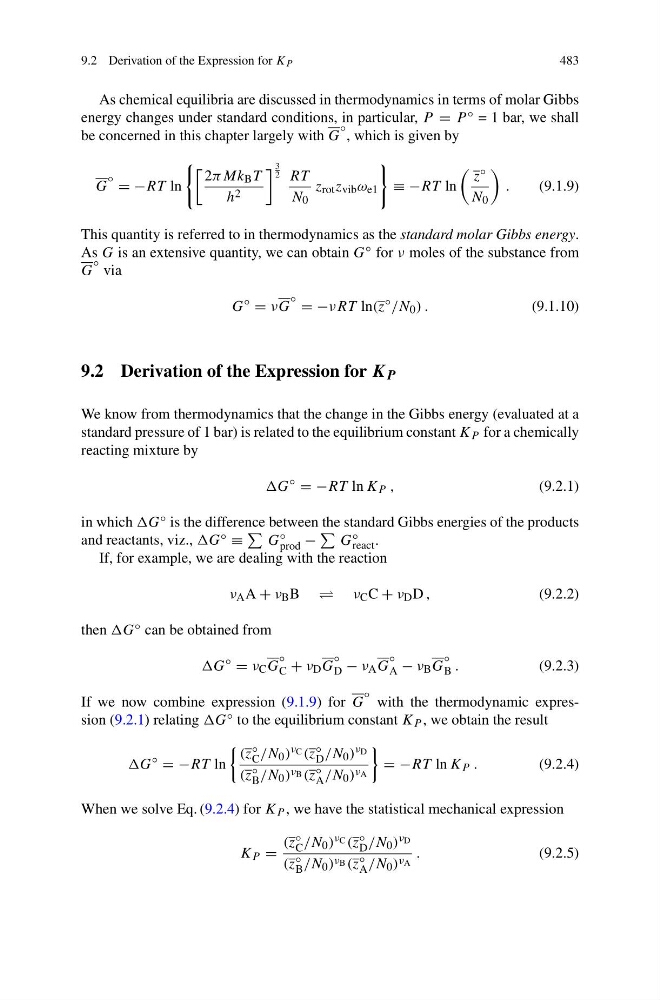
As chemical equilibria are discussed in thermodynamics in terms of molar Gibbs
energy changes under standard conditions, in particular, P = P ◦ = 1 bar, we shall
be concerned in this chapter largely with G
◦ , which is given by
G
◦ = −RT ln
2πMk B T
h 2
3
2 RT
N 0
z rot z vib ω e1
≡ −RT ln
z
◦
N 0
.
(9.1.9)
This quantity is referred to in thermodynamics as the standard molar Gibbs energy.
As G is an extensive quantity, we can obtain G ◦ for ν moles of the substance from
G
◦ via
G
◦
= νG
◦ = −νRT ln(z
◦ /N 0 ) .
(9.1.10)
9.2 Derivation of the Expression for K P
We know from thermodynamics that the change in the Gibbs energy (evaluated at a
standard pressure of 1 bar) is related to the equilibrium constant K P for a chemically
reacting mixture by
G
◦
= −RT ln K P ,
(9.2.1)
in which G ◦ is the difference between the standard Gibbs energies of the products
and reactants, viz., G ◦ ≡
G ◦
prod −
G ◦
react .
If, for example, we are dealing with the reaction
ν A A + ν B B ν C C + ν D D ,
(9.2.2)
then G ◦ can be obtained from
G
◦
= ν C G
◦
C + ν D G
◦
D − ν A G
◦
A − ν B G
◦
B .
(9.2.3)
If we now combine expression (9.1.9) for G
◦ with the thermodynamic expression (9.2.1) relating G ◦ to the equilibrium constant K P , we obtain the result
G
◦
= −RT ln
(z
◦
C /N 0 ) ν C (z
◦
D /N 0 ) ν D
(z
◦
B /N 0 ) ν B (z
◦
A /N 0 ) ν A
= −RT ln K P .
(9.2.4)
When we solve Eq. (9.2.4) for K P , we have the statistical mechanical expression
K P =
(z
◦
C /N 0 ) ν C (z
◦
D /N 0 ) ν D
(z
◦
B /N 0 ) ν B (z
◦
A /N 0 ) ν A
.
(9.2.5)
483
As chemical equilibria are discussed in thermodynamics in terms of molar Gibbs
energy changes under standard conditions, in particular, P = P ◦ = 1 bar, we shall
be concerned in this chapter largely with G
◦ , which is given by
G
◦ = −RT ln
2πMk B T
h 2
3
2 RT
N 0
z rot z vib ω e1
≡ −RT ln
z
◦
N 0
.
(9.1.9)
This quantity is referred to in thermodynamics as the standard molar Gibbs energy.
As G is an extensive quantity, we can obtain G ◦ for ν moles of the substance from
G
◦ via
G
◦
= νG
◦ = −νRT ln(z
◦ /N 0 ) .
(9.1.10)
9.2 Derivation of the Expression for K P
We know from thermodynamics that the change in the Gibbs energy (evaluated at a
standard pressure of 1 bar) is related to the equilibrium constant K P for a chemically
reacting mixture by
G
◦
= −RT ln K P ,
(9.2.1)
in which G ◦ is the difference between the standard Gibbs energies of the products
and reactants, viz., G ◦ ≡
G ◦
prod −
G ◦
react .
If, for example, we are dealing with the reaction
ν A A + ν B B ν C C + ν D D ,
(9.2.2)
then G ◦ can be obtained from
G
◦
= ν C G
◦
C + ν D G
◦
D − ν A G
◦
A − ν B G
◦
B .
(9.2.3)
If we now combine expression (9.1.9) for G
◦ with the thermodynamic expression (9.2.1) relating G ◦ to the equilibrium constant K P , we obtain the result
G
◦
= −RT ln
(z
◦
C /N 0 ) ν C (z
◦
D /N 0 ) ν D
(z
◦
B /N 0 ) ν B (z
◦
A /N 0 ) ν A
= −RT ln K P .
(9.2.4)
When we solve Eq. (9.2.4) for K P , we have the statistical mechanical expression
K P =
(z
◦
C /N 0 ) ν C (z
◦
D /N 0 ) ν D
(z
◦
B /N 0 ) ν B (z
◦
A /N 0 ) ν A
.
(9.2.5)