

482
9 Chemical Equilibrium
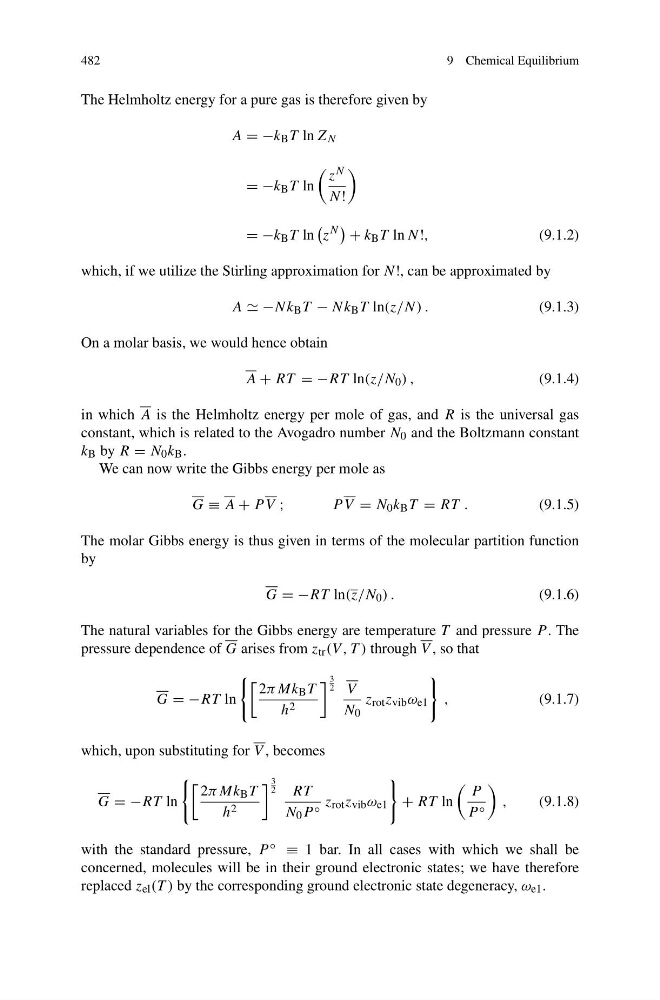
The Helmholtz energy for a pure gas is therefore given by
A = −k B T ln Z N
= −k B T ln
z N
N!
= −k B T ln
z
N
+ k B T ln N !,
(9.1.2)
which, if we utilize the Stirling approximation for N!, can be approximated by
A −Nk B T − Nk B T ln(z/N ) .
(9.1.3)
On a molar basis, we would hence obtain
A + RT = −RT ln(z/N 0 ) ,
(9.1.4)
in which A is the Helmholtz energy per mole of gas, and R is the universal gas
constant, which is related to the Avogadro number N 0 and the Boltzmann constant
k B by R = N 0 k B .
We can now write the Gibbs energy per mole as
G ≡ A + P V ;
P V = N 0 k B T = RT .
(9.1.5)
The molar Gibbs energy is thus given in terms of the molecular partition function
by
G = −RT ln(z/N 0 ) .
(9.1.6)
The natural variables for the Gibbs energy are temperature T and pressure P . The
pressure dependence of G arises from z tr (V , T ) through V , so that
G = −RT ln
2πMk B T
h 2
3
2 V
N 0
z rot z vib ω e1
,
(9.1.7)
which, upon substituting for V , becomes
G = −RT ln
2πMk B T
h 2
3
2
RT
N 0 P ◦ z rot z vib ω e1
+ RT ln
P
P ◦
,
(9.1.8)
with the standard pressure, P ◦ ≡ 1 bar. In all cases with which we shall be
concerned, molecules will be in their ground electronic states; we have therefore
replaced z el (T ) by the corresponding ground electronic state degeneracy, ω e1 .
9 Chemical Equilibrium
The Helmholtz energy for a pure gas is therefore given by
A = −k B T ln Z N
= −k B T ln
z N
N!
= −k B T ln
z
N
+ k B T ln N !,
(9.1.2)
which, if we utilize the Stirling approximation for N!, can be approximated by
A −Nk B T − Nk B T ln(z/N ) .
(9.1.3)
On a molar basis, we would hence obtain
A + RT = −RT ln(z/N 0 ) ,
(9.1.4)
in which A is the Helmholtz energy per mole of gas, and R is the universal gas
constant, which is related to the Avogadro number N 0 and the Boltzmann constant
k B by R = N 0 k B .
We can now write the Gibbs energy per mole as
G ≡ A + P V ;
P V = N 0 k B T = RT .
(9.1.5)
The molar Gibbs energy is thus given in terms of the molecular partition function
by
G = −RT ln(z/N 0 ) .
(9.1.6)
The natural variables for the Gibbs energy are temperature T and pressure P . The
pressure dependence of G arises from z tr (V , T ) through V , so that
G = −RT ln
2πMk B T
h 2
3
2 V
N 0
z rot z vib ω e1
,
(9.1.7)
which, upon substituting for V , becomes
G = −RT ln
2πMk B T
h 2
3
2
RT
N 0 P ◦ z rot z vib ω e1
+ RT ln
P
P ◦
,
(9.1.8)
with the standard pressure, P ◦ ≡ 1 bar. In all cases with which we shall be
concerned, molecules will be in their ground electronic states; we have therefore
replaced z el (T ) by the corresponding ground electronic state degeneracy, ω e1 .