

476
8 Electric and Magnetic Phenomena
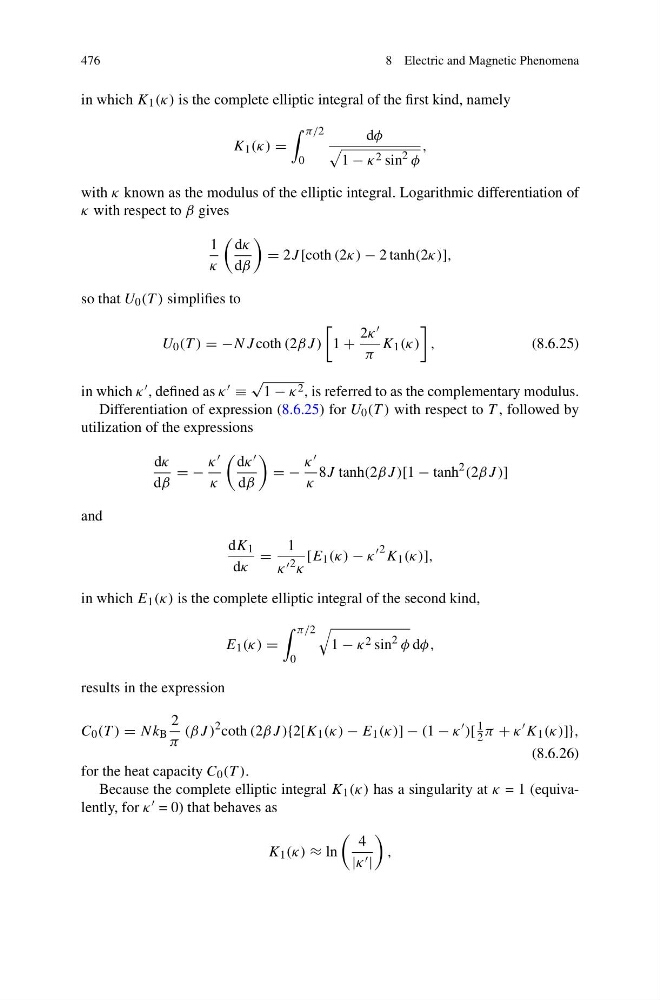
in which K 1 (κ) is the complete elliptic integral of the first kind, namely
K 1 (κ) =
π/2
0
dφ
1 − κ 2 sin
2 φ
,
with κ known as the modulus of the elliptic integral. Logarithmic differentiation of
κ with respect to β gives
1
κ
dκ
dβ
= 2J [coth (2κ) − 2 tanh(2κ)],
so that U 0 (T ) simplifies to
U 0 (T ) = −NJ coth (2βJ )
1 +
2κ
π
K 1 (κ)
,
(8.6.25)
in which κ , defined as κ ≡
√
1 − κ 2 , is referred to as the complementary modulus.
Differentiation of expression (8.6.25) for U 0 (T ) with respect to T , followed by
utilization of the expressions
dκ
dβ
= −
κ
κ
dκ
dβ
= −
κ
κ
8J tanh(2βJ )[1 − tanh
2 (2βJ )]
and
dK 1
dκ
=
1
κ 2 κ
[E 1 (κ) − κ
2 K 1 (κ)],
in which E 1 (κ) is the complete elliptic integral of the second kind,
E 1 (κ) =
π/2
0
1 − κ 2 sin
2 φ dφ,
results in the expression
C 0 (T ) = Nk B
2
π
(βJ )
2 coth (2βJ ){2[K 1 (κ) − E 1 (κ)] − (1 − κ
)[
1
2 π + κ
K 1 (κ)]},
(8.6.26)
for the heat capacity C 0 (T ).
Because the complete elliptic integral K 1 (κ) has a singularity at κ = 1 (equivalently, for κ = 0) that behaves as
K 1 (κ) ≈ ln
4
|κ |
,
8 Electric and Magnetic Phenomena
in which K 1 (κ) is the complete elliptic integral of the first kind, namely
K 1 (κ) =
π/2
0
dφ
1 − κ 2 sin
2 φ
,
with κ known as the modulus of the elliptic integral. Logarithmic differentiation of
κ with respect to β gives
1
κ
dκ
dβ
= 2J [coth (2κ) − 2 tanh(2κ)],
so that U 0 (T ) simplifies to
U 0 (T ) = −NJ coth (2βJ )
1 +
2κ
π
K 1 (κ)
,
(8.6.25)
in which κ , defined as κ ≡
√
1 − κ 2 , is referred to as the complementary modulus.
Differentiation of expression (8.6.25) for U 0 (T ) with respect to T , followed by
utilization of the expressions
dκ
dβ
= −
κ
κ
dκ
dβ
= −
κ
κ
8J tanh(2βJ )[1 − tanh
2 (2βJ )]
and
dK 1
dκ
=
1
κ 2 κ
[E 1 (κ) − κ
2 K 1 (κ)],
in which E 1 (κ) is the complete elliptic integral of the second kind,
E 1 (κ) =
π/2
0
1 − κ 2 sin
2 φ dφ,
results in the expression
C 0 (T ) = Nk B
2
π
(βJ )
2 coth (2βJ ){2[K 1 (κ) − E 1 (κ)] − (1 − κ
)[
1
2 π + κ
K 1 (κ)]},
(8.6.26)
for the heat capacity C 0 (T ).
Because the complete elliptic integral K 1 (κ) has a singularity at κ = 1 (equivalently, for κ = 0) that behaves as
K 1 (κ) ≈ ln
4
|κ |
,