

8.7 Problems for This Chapter
477
while E 1 (κ) is approximately unity, the heat capacity C 0 (T ) has a logarithmic
singularity at a temperature T c determined from κ c = 1 (κ
c = 0). This condition
gives T c ≈ 2.431J /k B for the square lattice, which has a coordination number (i.e.,
number of nearest-neighbours) q of 4. Two-dimensional lattices with different coordination numbers have different critical temperatures, the higher the coordination
number, the higher will T c be: for example, for q = 3, T c ≈ 1.517J /k B , while for
q = 6, T c ≈ 3.640J /k B . In the vicinity of T = T c the heat capacity C 0 (T ) for a
square Ising lattice behaves as
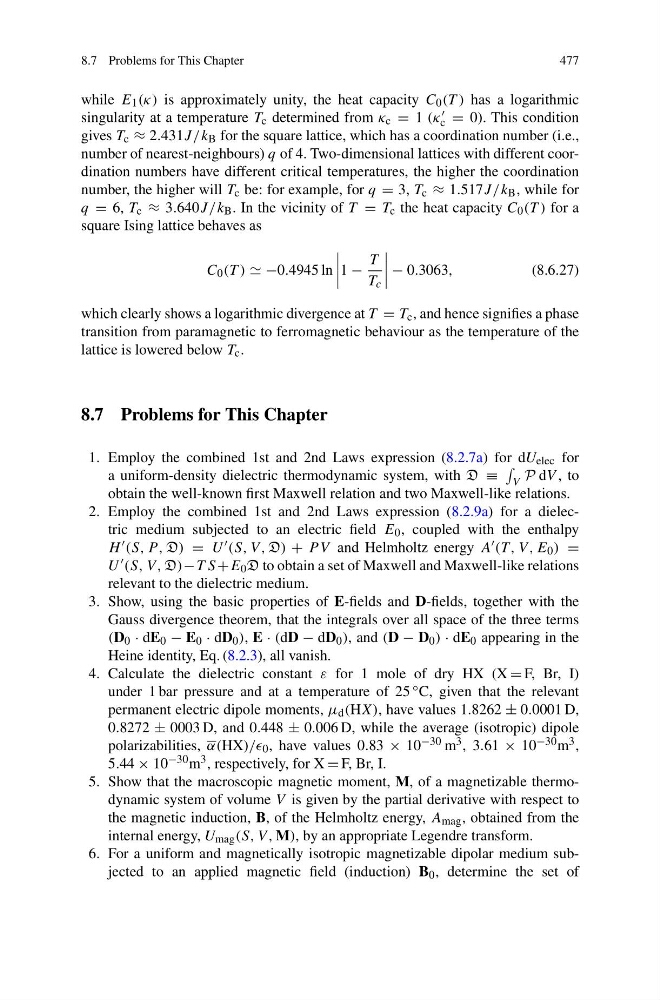
C 0 (T ) −0.4945 ln
1 −
T
T c
− 0.3063,
(8.6.27)
which clearly shows a logarithmic divergence at T = T c , and hence signifies a phase
transition from paramagnetic to ferromagnetic behaviour as the temperature of the
lattice is lowered below T c .
8.7 Problems for This Chapter
1. Employ the combined 1st and 2nd Laws expression (8.2.7a) for dU elec for
a uniform-density dielectric thermodynamic system, with D ≡
V P dV , to
obtain the well-known first Maxwell relation and two Maxwell-like relations.
2. Employ the combined 1st and 2nd Laws expression (8.2.9a) for a dielectric medium subjected to an electric field E 0 , coupled with the enthalpy
H (S, P , D) = U (S, V , D) + P V and Helmholtz energy A (T , V , E 0 ) =
U (S, V , D)−T S +E 0 D to obtain a set of Maxwell and Maxwell-like relations
relevant to the dielectric medium.
3. Show, using the basic properties of E-fields and D-fields, together with the
Gauss divergence theorem, that the integrals over all space of the three terms
(D 0 · dE 0 − E 0 · dD 0 ), E · (dD − dD 0 ), and (D − D 0 ) · dE 0 appearing in the
Heine identity, Eq. (8.2.3), all vanish.
4. Calculate the dielectric constant ε for 1 mole of dry HX (X = F, Br, I)
under 1 bar pressure and at a temperature of 25 ◦ C, given that the relevant
permanent electric dipole moments, μ d (HX), have values 1.8262 ± 0.0001 D,
0.8272 ± 0003 D, and 0.448 ± 0.006 D, while the average (isotropic) dipole
polarizabilities, α(HX)// 0 , have values 0.83 × 10 −30 m 3 , 3.61 × 10 −30 m 3 ,
5.44 × 10 −30 m 3 , respectively, for X = F, Br, I.
5. Show that the macroscopic magnetic moment, M, of a magnetizable thermodynamic system of volume V is given by the partial derivative with respect to
the magnetic induction, B, of the Helmholtz energy, A mag , obtained from the
internal energy, U mag (S, V , M), by an appropriate Legendre transform.
6. For a uniform and magnetically isotropic magnetizable dipolar medium subjected to an applied magnetic field (induction) B 0 , determine the set of
477
while E 1 (κ) is approximately unity, the heat capacity C 0 (T ) has a logarithmic
singularity at a temperature T c determined from κ c = 1 (κ
c = 0). This condition
gives T c ≈ 2.431J /k B for the square lattice, which has a coordination number (i.e.,
number of nearest-neighbours) q of 4. Two-dimensional lattices with different coordination numbers have different critical temperatures, the higher the coordination
number, the higher will T c be: for example, for q = 3, T c ≈ 1.517J /k B , while for
q = 6, T c ≈ 3.640J /k B . In the vicinity of T = T c the heat capacity C 0 (T ) for a
square Ising lattice behaves as
C 0 (T ) −0.4945 ln
1 −
T
T c
− 0.3063,
(8.6.27)
which clearly shows a logarithmic divergence at T = T c , and hence signifies a phase
transition from paramagnetic to ferromagnetic behaviour as the temperature of the
lattice is lowered below T c .
8.7 Problems for This Chapter
1. Employ the combined 1st and 2nd Laws expression (8.2.7a) for dU elec for
a uniform-density dielectric thermodynamic system, with D ≡
V P dV , to
obtain the well-known first Maxwell relation and two Maxwell-like relations.
2. Employ the combined 1st and 2nd Laws expression (8.2.9a) for a dielectric medium subjected to an electric field E 0 , coupled with the enthalpy
H (S, P , D) = U (S, V , D) + P V and Helmholtz energy A (T , V , E 0 ) =
U (S, V , D)−T S +E 0 D to obtain a set of Maxwell and Maxwell-like relations
relevant to the dielectric medium.
3. Show, using the basic properties of E-fields and D-fields, together with the
Gauss divergence theorem, that the integrals over all space of the three terms
(D 0 · dE 0 − E 0 · dD 0 ), E · (dD − dD 0 ), and (D − D 0 ) · dE 0 appearing in the
Heine identity, Eq. (8.2.3), all vanish.
4. Calculate the dielectric constant ε for 1 mole of dry HX (X = F, Br, I)
under 1 bar pressure and at a temperature of 25 ◦ C, given that the relevant
permanent electric dipole moments, μ d (HX), have values 1.8262 ± 0.0001 D,
0.8272 ± 0003 D, and 0.448 ± 0.006 D, while the average (isotropic) dipole
polarizabilities, α(HX)// 0 , have values 0.83 × 10 −30 m 3 , 3.61 × 10 −30 m 3 ,
5.44 × 10 −30 m 3 , respectively, for X = F, Br, I.
5. Show that the macroscopic magnetic moment, M, of a magnetizable thermodynamic system of volume V is given by the partial derivative with respect to
the magnetic induction, B, of the Helmholtz energy, A mag , obtained from the
internal energy, U mag (S, V , M), by an appropriate Legendre transform.
6. For a uniform and magnetically isotropic magnetizable dipolar medium subjected to an applied magnetic field (induction) B 0 , determine the set of