

8.6 Magnetism, II. Ferromagnetism
475
in which ξ , referred to as the correlation length, is defined formally as the reciprocal
of ln[coth(βJ )]. When the correlation function is written in this format, it becomes
clear that for the temperature approaching zero (i.e., for βJ 1), the correlation
length ξ can be approximated by
ξ ≈
1
2 e
2βJ ,
which diverges in the limit T → 0. This divergence of the correlation length
supports the comments made at the end of Sect. 8.6.3, namely that although there
is a critical temperature for which the one-dimensional Ising chain undergoes
spontaneous magnetization in zero external field, that critical temperature is T c = 0.
8.6.5 Some Comments on the Two-Dimensional Ising Model
Exact quantitative results were first obtained for the two-dimensional Ising model by
Kramers and Wannier [25] in 1941. Shortly thereafter, Onsager [22] employed their
transfer matrix method to obtain an analytic expression for the Helmholtz energy in
the absence of an external magnetic field, and from it established that there was an
anomaly in the heat capacity at the critical temperature obtained earlier by Kramers
and Wannier. Because the Onsager solution lies beyond the scope of the present
treatment, we shall be content here to provide only an outline of the solution to this
problem along the lines of that provided earlier by Pathria [24].
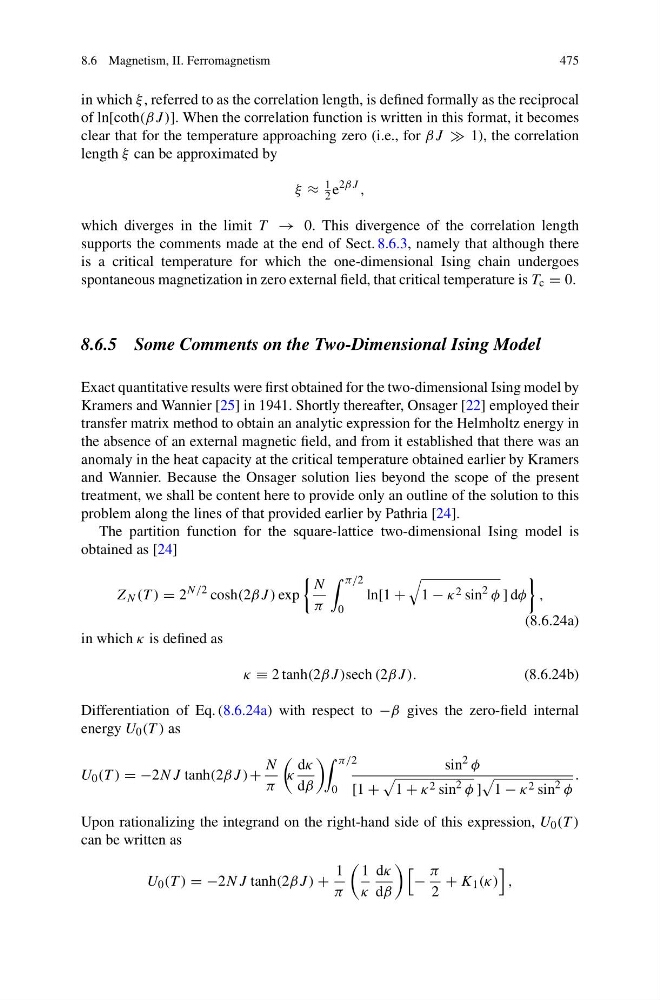
The partition function for the square-lattice two-dimensional Ising model is
obtained as [24]
Z N (T ) = 2
N/2 cosh(2βJ ) exp
N
π
π/2
0
ln[1 +
1 − κ 2 sin
2 φ ] dφ
,
(8.6.24a)
in which κ is defined as
κ ≡ 2 tanh(2βJ )sech (2βJ ).
(8.6.24b)
Differentiation of Eq. (8.6.24a) with respect to −β gives the zero-field internal
energy U 0 (T ) as
U 0 (T ) = −2NJ tanh(2βJ ) +
N
π
κ
dκ
dβ
π/2
0
sin
2 φ
[1 +
1 + κ 2 sin
2 φ ]
1 − κ 2 sin
2 φ
.
Upon rationalizing the integrand on the right-hand side of this expression, U 0 (T )
can be written as
U 0 (T ) = −2NJ tanh(2βJ ) +
1
π
1
κ
dκ
dβ
−
π
2
+ K 1 (κ)
,
475
in which ξ , referred to as the correlation length, is defined formally as the reciprocal
of ln[coth(βJ )]. When the correlation function is written in this format, it becomes
clear that for the temperature approaching zero (i.e., for βJ 1), the correlation
length ξ can be approximated by
ξ ≈
1
2 e
2βJ ,
which diverges in the limit T → 0. This divergence of the correlation length
supports the comments made at the end of Sect. 8.6.3, namely that although there
is a critical temperature for which the one-dimensional Ising chain undergoes
spontaneous magnetization in zero external field, that critical temperature is T c = 0.
8.6.5 Some Comments on the Two-Dimensional Ising Model
Exact quantitative results were first obtained for the two-dimensional Ising model by
Kramers and Wannier [25] in 1941. Shortly thereafter, Onsager [22] employed their
transfer matrix method to obtain an analytic expression for the Helmholtz energy in
the absence of an external magnetic field, and from it established that there was an
anomaly in the heat capacity at the critical temperature obtained earlier by Kramers
and Wannier. Because the Onsager solution lies beyond the scope of the present
treatment, we shall be content here to provide only an outline of the solution to this
problem along the lines of that provided earlier by Pathria [24].
The partition function for the square-lattice two-dimensional Ising model is
obtained as [24]
Z N (T ) = 2
N/2 cosh(2βJ ) exp
N
π
π/2
0
ln[1 +
1 − κ 2 sin
2 φ ] dφ
,
(8.6.24a)
in which κ is defined as
κ ≡ 2 tanh(2βJ )sech (2βJ ).
(8.6.24b)
Differentiation of Eq. (8.6.24a) with respect to −β gives the zero-field internal
energy U 0 (T ) as
U 0 (T ) = −2NJ tanh(2βJ ) +
N
π
κ
dκ
dβ
π/2
0
sin
2 φ
[1 +
1 + κ 2 sin
2 φ ]
1 − κ 2 sin
2 φ
.
Upon rationalizing the integrand on the right-hand side of this expression, U 0 (T )
can be written as
U 0 (T ) = −2NJ tanh(2βJ ) +
1
π
1
κ
dκ
dβ
−
π
2
+ K 1 (κ)
,