

474
8 Electric and Magnetic Phenomena
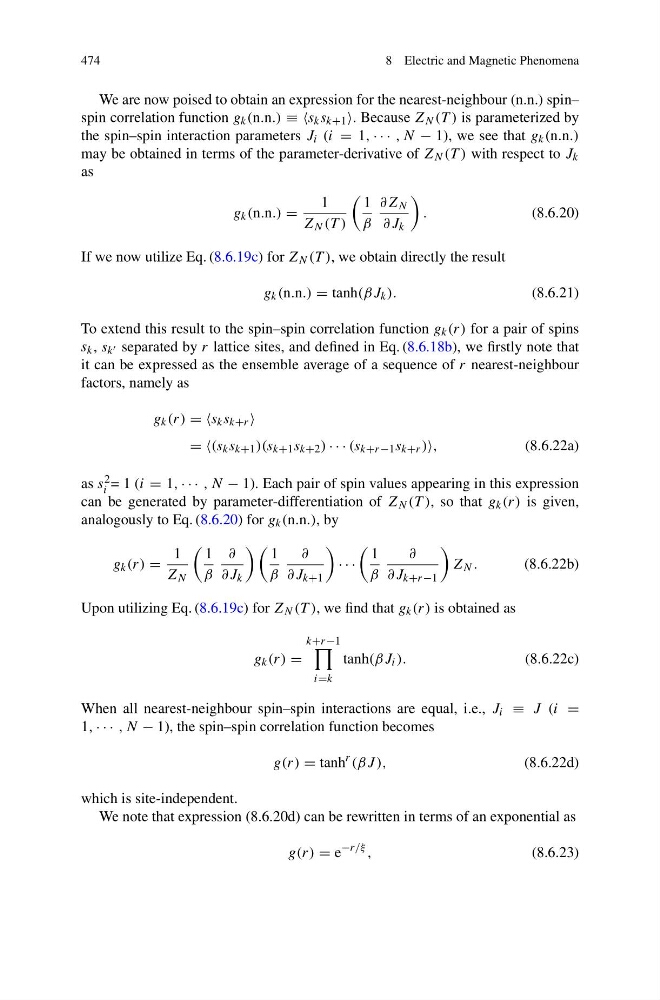
We are now poised to obtain an expression for the nearest-neighbour (n.n.) spin–
spin correlation function g k (n.n.) ≡ ≡s k s k+1 . Because Z N (T ) is parameterized by
the spin–spin interaction parameters J i (i = 1, · · · , N − 1), we see that g k (n.n.)
may be obtained in terms of the parameter-derivative of Z N (T ) with respect to J k
as
g k (n.n.) =
1
Z N (T )
1
β
∂Z N
∂J k
.
(8.6.20)
If we now utilize Eq. (8.6.19c) for Z N (T ), we obtain directly the result
g k (n.n.) = tanh(βJ k ).
(8.6.21)
To extend this result to the spin–spin correlation function g k (r) for a pair of spins
s k , s k separated by r lattice sites, and defined in Eq. (8.6.18b), we firstly note that
it can be expressed as the ensemble average of a sequence of r nearest-neighbour
factors, namely as
g k (r) = =s k s k+r
= =(s k s k+1 )(s k+1 s k+2 ) · · · (s k+r−1 s k+r ),
(8.6.22a)
as s 2
i = 1 (i = 1, · · · , N − 1). Each pair of spin values appearing in this expression
can be generated by parameter-differentiation of Z N (T ), so that g k (r) is given,
analogously to Eq. (8.6.20) for g k (n.n.), by
g k (r) =
1
Z N
1
β
∂
∂J k
1
β
∂
∂J k+1
· · ·
1
β
∂
∂J k+r−1
Z N .
(8.6.22b)
Upon utilizing Eq. (8.6.19c) for Z N (T ), we find that g k (r) is obtained as
g k (r) =
k+r−1
i=k
tanh(βJ i ).
(8.6.22c)
When all nearest-neighbour spin–spin interactions are equal, i.e., J i ≡ J (i =
1, · · · , N − 1), the spin–spin correlation function becomes
g(r) = tanh
r (βJ ),
(8.6.22d)
which is site-independent.
We note that expression (8.6.20d) can be rewritten in terms of an exponential as
g(r) = e
−r/ξ ,
(8.6.23)
8 Electric and Magnetic Phenomena
We are now poised to obtain an expression for the nearest-neighbour (n.n.) spin–
spin correlation function g k (n.n.) ≡ ≡s k s k+1 . Because Z N (T ) is parameterized by
the spin–spin interaction parameters J i (i = 1, · · · , N − 1), we see that g k (n.n.)
may be obtained in terms of the parameter-derivative of Z N (T ) with respect to J k
as
g k (n.n.) =
1
Z N (T )
1
β
∂Z N
∂J k
.
(8.6.20)
If we now utilize Eq. (8.6.19c) for Z N (T ), we obtain directly the result
g k (n.n.) = tanh(βJ k ).
(8.6.21)
To extend this result to the spin–spin correlation function g k (r) for a pair of spins
s k , s k separated by r lattice sites, and defined in Eq. (8.6.18b), we firstly note that
it can be expressed as the ensemble average of a sequence of r nearest-neighbour
factors, namely as
g k (r) = =s k s k+r
= =(s k s k+1 )(s k+1 s k+2 ) · · · (s k+r−1 s k+r ),
(8.6.22a)
as s 2
i = 1 (i = 1, · · · , N − 1). Each pair of spin values appearing in this expression
can be generated by parameter-differentiation of Z N (T ), so that g k (r) is given,
analogously to Eq. (8.6.20) for g k (n.n.), by
g k (r) =
1
Z N
1
β
∂
∂J k
1
β
∂
∂J k+1
· · ·
1
β
∂
∂J k+r−1
Z N .
(8.6.22b)
Upon utilizing Eq. (8.6.19c) for Z N (T ), we find that g k (r) is obtained as
g k (r) =
k+r−1
i=k
tanh(βJ i ).
(8.6.22c)
When all nearest-neighbour spin–spin interactions are equal, i.e., J i ≡ J (i =
1, · · · , N − 1), the spin–spin correlation function becomes
g(r) = tanh
r (βJ ),
(8.6.22d)
which is site-independent.
We note that expression (8.6.20d) can be rewritten in terms of an exponential as
g(r) = e
−r/ξ ,
(8.6.23)