

8.6 Magnetism, II. Ferromagnetism
473
In the absence of an applied magnetic field, we may express the allowed energies
for an Ising chain of N spins in the slightly generalized form
E N = −
N −1
k=1
J k s k s k+1 ,
in which the spin–spin interaction energy between nearest-neighbour spins s k and
s k+1 are allowed to be site-dependent. We may, therefore, express the correlation
function g |k −k| (0, T ) as
g |k −k| (0, T ) = =s k s k (0, T )
=
1
Z N (T )
s 1 =±1
· · ·
s N =±1
s k s k exp
−
N −1
i=1
βJ i s i s i+1
,
with Z N (T ; J 1 , · · · , J N −1 ) given by
Z N (T ; J 1 , · · · , J N −1 ) =
s 1 =±1
· · ·
s N =±1
N −1
i=1
e
βJ i s i s i+1 .
(8.6.19a)
Because s N occurs only once in this expression for Z N for free boundary conditions,
we may perform the summation over s N explicitly as
s N =±1
e
βJ N−1 s N−1 s N = 2 cosh(βJ N −1 s N −1 )
= 2 cosh(βJ N −1 ),
which is independent of the values ±1 assumed by s N −1 . Utilization of this result
in Eq. (8.6.19a) leads to a recurrence relation for the canonical partition function for
the Ising chain, namely
Z N (T ; J 1 , · · · , J N −1 ) = 2 cosh(βJ N −1 )Z N −1 (T ; J 1 , · · · , J N −2 ).
(8.6.19b)
Iteration of this recurrence relation then gives for Z N (T ) the result
Z N (T ; J 1 , · · · , J N −1 ) =
⎛
⎝
s 1 =±1
1
⎞
⎠
N −1
i=1
[2 cosh(βJ i )]
= 2
N
N −1
i=1
cosh(βJ i )
(8.6.19c)
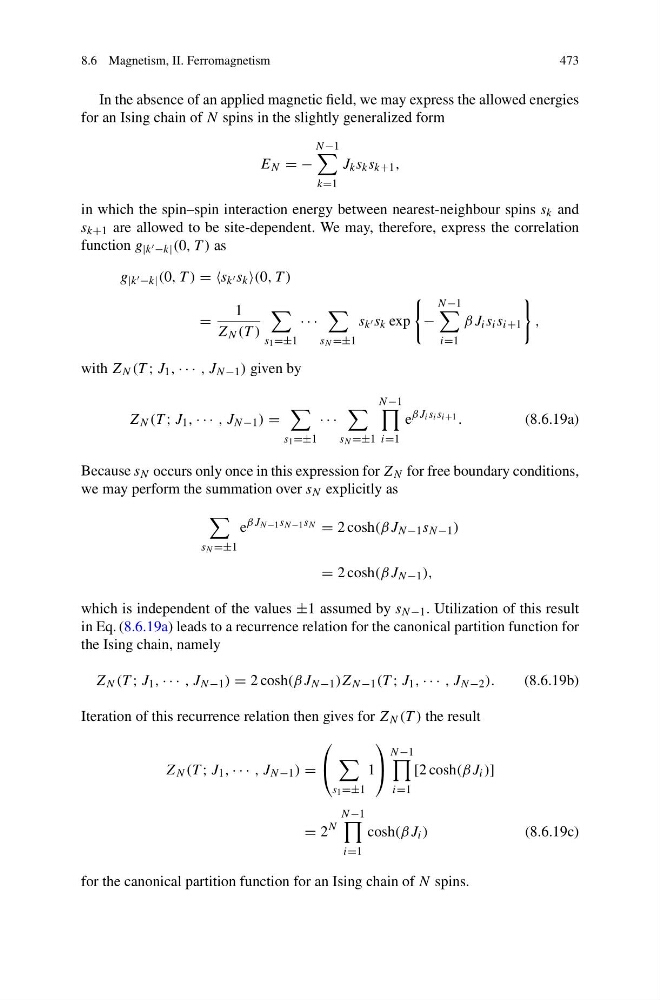
for the canonical partition function for an Ising chain of N spins.
473
In the absence of an applied magnetic field, we may express the allowed energies
for an Ising chain of N spins in the slightly generalized form
E N = −
N −1
k=1
J k s k s k+1 ,
in which the spin–spin interaction energy between nearest-neighbour spins s k and
s k+1 are allowed to be site-dependent. We may, therefore, express the correlation
function g |k −k| (0, T ) as
g |k −k| (0, T ) = =s k s k (0, T )
=
1
Z N (T )
s 1 =±1
· · ·
s N =±1
s k s k exp
−
N −1
i=1
βJ i s i s i+1
,
with Z N (T ; J 1 , · · · , J N −1 ) given by
Z N (T ; J 1 , · · · , J N −1 ) =
s 1 =±1
· · ·
s N =±1
N −1
i=1
e
βJ i s i s i+1 .
(8.6.19a)
Because s N occurs only once in this expression for Z N for free boundary conditions,
we may perform the summation over s N explicitly as
s N =±1
e
βJ N−1 s N−1 s N = 2 cosh(βJ N −1 s N −1 )
= 2 cosh(βJ N −1 ),
which is independent of the values ±1 assumed by s N −1 . Utilization of this result
in Eq. (8.6.19a) leads to a recurrence relation for the canonical partition function for
the Ising chain, namely
Z N (T ; J 1 , · · · , J N −1 ) = 2 cosh(βJ N −1 )Z N −1 (T ; J 1 , · · · , J N −2 ).
(8.6.19b)
Iteration of this recurrence relation then gives for Z N (T ) the result
Z N (T ; J 1 , · · · , J N −1 ) =
⎛
⎝
s 1 =±1
1
⎞
⎠
N −1
i=1
[2 cosh(βJ i )]
= 2
N
N −1
i=1
cosh(βJ i )
(8.6.19c)
for the canonical partition function for an Ising chain of N spins.