

472
8 Electric and Magnetic Phenomena
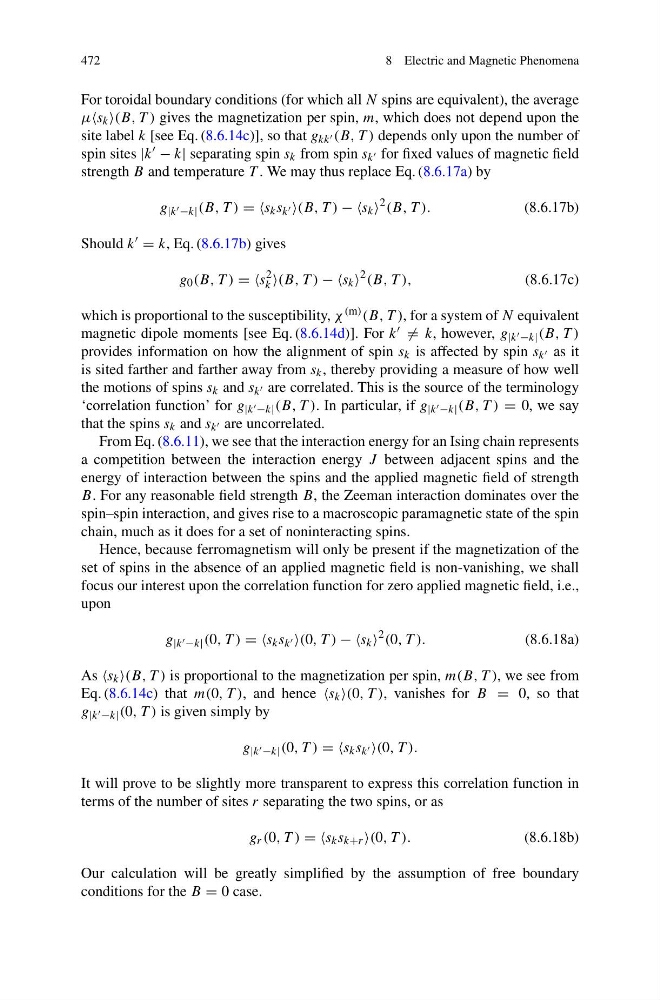
For toroidal boundary conditions (for which all N spins are equivalent), the average
μs k (B, T ) gives the magnetization per spin, m, which does not depend upon the
site label k [see Eq. (8.6.14c)], so that g kk (B, T ) depends only upon the number of
spin sites |k − k| separating spin s k from spin s k for fixed values of magnetic field
strength B and temperature T . We may thus replace Eq. (8.6.17a) by
g |k −k| (B, T ) = =s k s k (B, T ) − −s k
2 (B, T ).
(8.6.17b)
Should k = k, Eq. (8.6.17b) gives
g 0 (B, T ) = =s
2
k (B, T ) − −s k
2 (B, T ),
(8.6.17c)
which is proportional to the susceptibility, χ (m) (B, T ), for a system of N equivalent
magnetic dipole moments [see Eq. (8.6.14d)]. For k = k, however, g |k −k| (B, T )
provides information on how the alignment of spin s k is affected by spin s k as it
is sited farther and farther away from s k , thereby providing a measure of how well
the motions of spins s k and s k are correlated. This is the source of the terminology
‘correlation function’ for g |k −k| (B, T ). In particular, if g |k −k| (B, T ) = 0, we say
that the spins s k and s k are uncorrelated.
From Eq. (8.6.11), we see that the interaction energy for an Ising chain represents
a competition between the interaction energy J between adjacent spins and the
energy of interaction between the spins and the applied magnetic field of strength
B. For any reasonable field strength B, the Zeeman interaction dominates over the
spin–spin interaction, and gives rise to a macroscopic paramagnetic state of the spin
chain, much as it does for a set of noninteracting spins.
Hence, because ferromagnetism will only be present if the magnetization of the
set of spins in the absence of an applied magnetic field is non-vanishing, we shall
focus our interest upon the correlation function for zero applied magnetic field, i.e.,
upon
g |k −k| (0, T ) = =s k s k (0, T ) − −s k
2 (0, T ).
(8.6.18a)
As s k (B, T ) is proportional to the magnetization per spin, m(B, T ), we see from
Eq. (8.6.14c) that m(0, T ), and hence s k (0, T ), vanishes for B = 0, so that
g |k −k| (0, T ) is given simply by
g |k −k| (0, T ) = =s k s k (0, T ).
It will prove to be slightly more transparent to express this correlation function in
terms of the number of sites r separating the two spins, or as
g r (0, T ) = =s k s k+r (0, T ).
(8.6.18b)
Our calculation will be greatly simplified by the assumption of free boundary
conditions for the B = 0 case.
8 Electric and Magnetic Phenomena
For toroidal boundary conditions (for which all N spins are equivalent), the average
μs k (B, T ) gives the magnetization per spin, m, which does not depend upon the
site label k [see Eq. (8.6.14c)], so that g kk (B, T ) depends only upon the number of
spin sites |k − k| separating spin s k from spin s k for fixed values of magnetic field
strength B and temperature T . We may thus replace Eq. (8.6.17a) by
g |k −k| (B, T ) = =s k s k (B, T ) − −s k
2 (B, T ).
(8.6.17b)
Should k = k, Eq. (8.6.17b) gives
g 0 (B, T ) = =s
2
k (B, T ) − −s k
2 (B, T ),
(8.6.17c)
which is proportional to the susceptibility, χ (m) (B, T ), for a system of N equivalent
magnetic dipole moments [see Eq. (8.6.14d)]. For k = k, however, g |k −k| (B, T )
provides information on how the alignment of spin s k is affected by spin s k as it
is sited farther and farther away from s k , thereby providing a measure of how well
the motions of spins s k and s k are correlated. This is the source of the terminology
‘correlation function’ for g |k −k| (B, T ). In particular, if g |k −k| (B, T ) = 0, we say
that the spins s k and s k are uncorrelated.
From Eq. (8.6.11), we see that the interaction energy for an Ising chain represents
a competition between the interaction energy J between adjacent spins and the
energy of interaction between the spins and the applied magnetic field of strength
B. For any reasonable field strength B, the Zeeman interaction dominates over the
spin–spin interaction, and gives rise to a macroscopic paramagnetic state of the spin
chain, much as it does for a set of noninteracting spins.
Hence, because ferromagnetism will only be present if the magnetization of the
set of spins in the absence of an applied magnetic field is non-vanishing, we shall
focus our interest upon the correlation function for zero applied magnetic field, i.e.,
upon
g |k −k| (0, T ) = =s k s k (0, T ) − −s k
2 (0, T ).
(8.6.18a)
As s k (B, T ) is proportional to the magnetization per spin, m(B, T ), we see from
Eq. (8.6.14c) that m(0, T ), and hence s k (0, T ), vanishes for B = 0, so that
g |k −k| (0, T ) is given simply by
g |k −k| (0, T ) = =s k s k (0, T ).
It will prove to be slightly more transparent to express this correlation function in
terms of the number of sites r separating the two spins, or as
g r (0, T ) = =s k s k+r (0, T ).
(8.6.18b)
Our calculation will be greatly simplified by the assumption of free boundary
conditions for the B = 0 case.