

8.6 Magnetism, II. Ferromagnetism
471
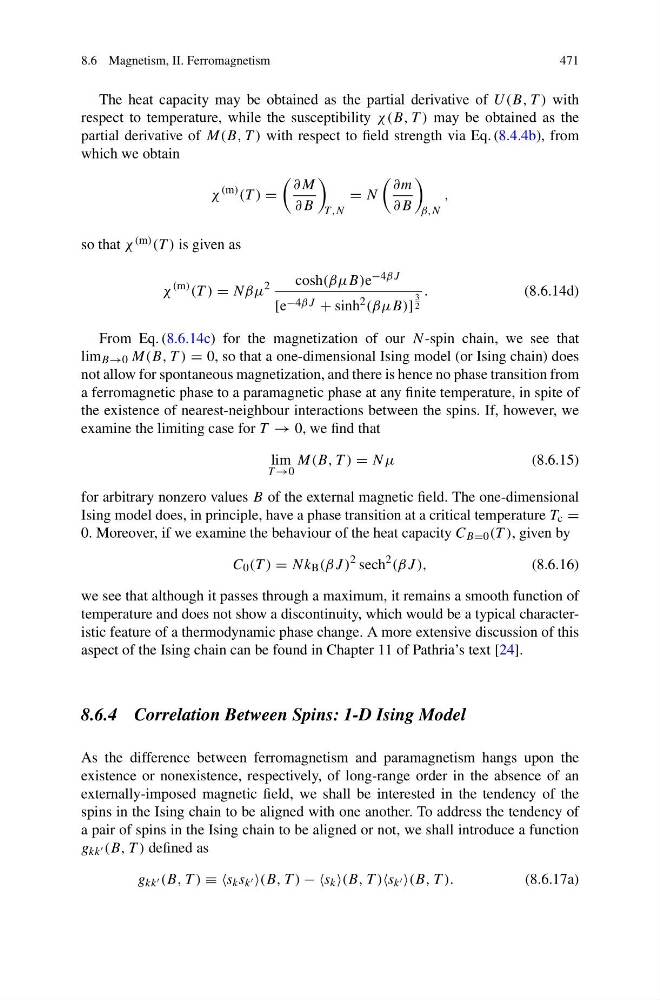
The heat capacity may be obtained as the partial derivative of U(B, T ) with
respect to temperature, while the susceptibility χ(B, T ) may be obtained as the
partial derivative of M(B, T ) with respect to field strength via Eq. (8.4.4b), from
which we obtain
χ
(m) (T ) =
∂M
∂B
T ,N
= N
∂m
∂B
β,N
,
so that χ (m) (T ) is given as
χ
(m) (T ) = Nβμ
2
cosh(βμB)e −4βJ
[e −4βJ + sinh
2 (βμB)]
3
2
.
(8.6.14d)
From Eq. (8.6.14c) for the magnetization of our N -spin chain, we see that
lim B→0 M(B, T ) = 0, so that a one-dimensional Ising model (or Ising chain) does
not allow for spontaneous magnetization, and there is hence no phase transition from
a ferromagnetic phase to a paramagnetic phase at any finite temperature, in spite of
the existence of nearest-neighbour interactions between the spins. If, however, we
examine the limiting case for T → 0, we find that
lim
T →0
M(B, T ) = Nμ
(8.6.15)
for arbitrary nonzero values B of the external magnetic field. The one-dimensional
Ising model does, in principle, have a phase transition at a critical temperature T c =
0. Moreover, if we examine the behaviour of the heat capacity C B=0 (T ), given by
C 0 (T ) = Nk B (βJ )
2 sech
2 (βJ ),
(8.6.16)
we see that although it passes through a maximum, it remains a smooth function of
temperature and does not show a discontinuity, which would be a typical characteristic feature of a thermodynamic phase change. A more extensive discussion of this
aspect of the Ising chain can be found in Chapter 11 of Pathria’s text [24].
8.6.4 Correlation Between Spins: 1-D Ising Model
As the difference between ferromagnetism and paramagnetism hangs upon the
existence or nonexistence, respectively, of long-range order in the absence of an
externally-imposed magnetic field, we shall be interested in the tendency of the
spins in the Ising chain to be aligned with one another. To address the tendency of
a pair of spins in the Ising chain to be aligned or not, we shall introduce a function
g kk (B, T ) defined as
g kk (B, T ) ≡ ≡s k s k (B, T ) − −s k (B, T )s k (B, T ).
(8.6.17a)
471
The heat capacity may be obtained as the partial derivative of U(B, T ) with
respect to temperature, while the susceptibility χ(B, T ) may be obtained as the
partial derivative of M(B, T ) with respect to field strength via Eq. (8.4.4b), from
which we obtain
χ
(m) (T ) =
∂M
∂B
T ,N
= N
∂m
∂B
β,N
,
so that χ (m) (T ) is given as
χ
(m) (T ) = Nβμ
2
cosh(βμB)e −4βJ
[e −4βJ + sinh
2 (βμB)]
3
2
.
(8.6.14d)
From Eq. (8.6.14c) for the magnetization of our N -spin chain, we see that
lim B→0 M(B, T ) = 0, so that a one-dimensional Ising model (or Ising chain) does
not allow for spontaneous magnetization, and there is hence no phase transition from
a ferromagnetic phase to a paramagnetic phase at any finite temperature, in spite of
the existence of nearest-neighbour interactions between the spins. If, however, we
examine the limiting case for T → 0, we find that
lim
T →0
M(B, T ) = Nμ
(8.6.15)
for arbitrary nonzero values B of the external magnetic field. The one-dimensional
Ising model does, in principle, have a phase transition at a critical temperature T c =
0. Moreover, if we examine the behaviour of the heat capacity C B=0 (T ), given by
C 0 (T ) = Nk B (βJ )
2 sech
2 (βJ ),
(8.6.16)
we see that although it passes through a maximum, it remains a smooth function of
temperature and does not show a discontinuity, which would be a typical characteristic feature of a thermodynamic phase change. A more extensive discussion of this
aspect of the Ising chain can be found in Chapter 11 of Pathria’s text [24].
8.6.4 Correlation Between Spins: 1-D Ising Model
As the difference between ferromagnetism and paramagnetism hangs upon the
existence or nonexistence, respectively, of long-range order in the absence of an
externally-imposed magnetic field, we shall be interested in the tendency of the
spins in the Ising chain to be aligned with one another. To address the tendency of
a pair of spins in the Ising chain to be aligned or not, we shall introduce a function
g kk (B, T ) defined as
g kk (B, T ) ≡ ≡s k s k (B, T ) − −s k (B, T )s k (B, T ).
(8.6.17a)