

470
8 Electric and Magnetic Phenomena
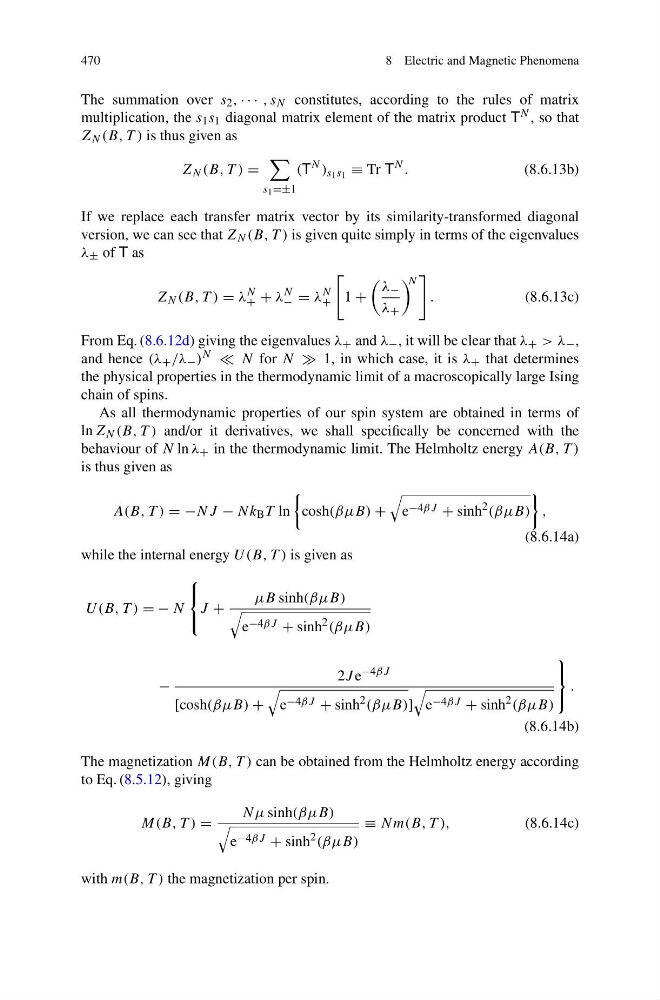
The summation over s 2 , · · · , s N constitutes, according to the rules of matrix
multiplication, the s 1 s 1 diagonal matrix element of the matrix product T N , so that
Z N (B, T ) is thus given as
Z N (B, T ) =
s 1 =±1
(T
N ) s 1 s 1 ≡ Tr T
N .
(8.6.13b)
If we replace each transfer matrix vector by its similarity-transformed diagonal
version, we can see that Z N (B, T ) is given quite simply in terms of the eigenvalues
λ ± of T as
Z N (B, T ) = λ
N
+ + λ
N
− = λ
N
+
1 +
λ −
λ +
N
.
(8.6.13c)
From Eq. (8.6.12d) giving the eigenvalues λ + and λ − , it will be clear that λ + > λ − ,
and hence (λ + /λ − ) N N for N 1, in which case, it is λ + that determines
the physical properties in the thermodynamic limit of a macroscopically large Ising
chain of spins.
As all thermodynamic properties of our spin system are obtained in terms of
ln Z N (B, T ) and/or it derivatives, we shall specifically be concerned with the
behaviour of N ln λ + in the thermodynamic limit. The Helmholtz energy A(B, T )
is thus given as
A(B, T ) = −NJ − Nk B T ln
cosh(βμB) +
e −4βJ + sinh
2 (βμB)
,
(8.6.14a)
while the internal energy U(B, T ) is given as
U(B, T ) = − N
⎧
⎨
⎩
J +
μB sinh(βμB)
e −4βJ + sinh
2 (βμB)
−
2J e −4βJ
[cosh(βμB) +
e −4βJ + sinh
2 (βμB)]
e −4βJ + sinh
2 (βμB)
⎫
⎬
⎭
.
(8.6.14b)
The magnetization M(B, T ) can be obtained from the Helmholtz energy according
to Eq. (8.5.12), giving
M(B, T ) =
Nμ sinh(βμB)
e −4βJ + sinh
2 (βμB)
≡ Nm(B, T ),
(8.6.14c)
with m(B, T ) the magnetization per spin.
8 Electric and Magnetic Phenomena
The summation over s 2 , · · · , s N constitutes, according to the rules of matrix
multiplication, the s 1 s 1 diagonal matrix element of the matrix product T N , so that
Z N (B, T ) is thus given as
Z N (B, T ) =
s 1 =±1
(T
N ) s 1 s 1 ≡ Tr T
N .
(8.6.13b)
If we replace each transfer matrix vector by its similarity-transformed diagonal
version, we can see that Z N (B, T ) is given quite simply in terms of the eigenvalues
λ ± of T as
Z N (B, T ) = λ
N
+ + λ
N
− = λ
N
+
1 +
λ −
λ +
N
.
(8.6.13c)
From Eq. (8.6.12d) giving the eigenvalues λ + and λ − , it will be clear that λ + > λ − ,
and hence (λ + /λ − ) N N for N 1, in which case, it is λ + that determines
the physical properties in the thermodynamic limit of a macroscopically large Ising
chain of spins.
As all thermodynamic properties of our spin system are obtained in terms of
ln Z N (B, T ) and/or it derivatives, we shall specifically be concerned with the
behaviour of N ln λ + in the thermodynamic limit. The Helmholtz energy A(B, T )
is thus given as
A(B, T ) = −NJ − Nk B T ln
cosh(βμB) +
e −4βJ + sinh
2 (βμB)
,
(8.6.14a)
while the internal energy U(B, T ) is given as
U(B, T ) = − N
⎧
⎨
⎩
J +
μB sinh(βμB)
e −4βJ + sinh
2 (βμB)
−
2J e −4βJ
[cosh(βμB) +
e −4βJ + sinh
2 (βμB)]
e −4βJ + sinh
2 (βμB)
⎫
⎬
⎭
.
(8.6.14b)
The magnetization M(B, T ) can be obtained from the Helmholtz energy according
to Eq. (8.5.12), giving
M(B, T ) =
Nμ sinh(βμB)
e −4βJ + sinh
2 (βμB)
≡ Nm(B, T ),
(8.6.14c)
with m(B, T ) the magnetization per spin.