

8.5 Paramagnetism in Spin Systems
461
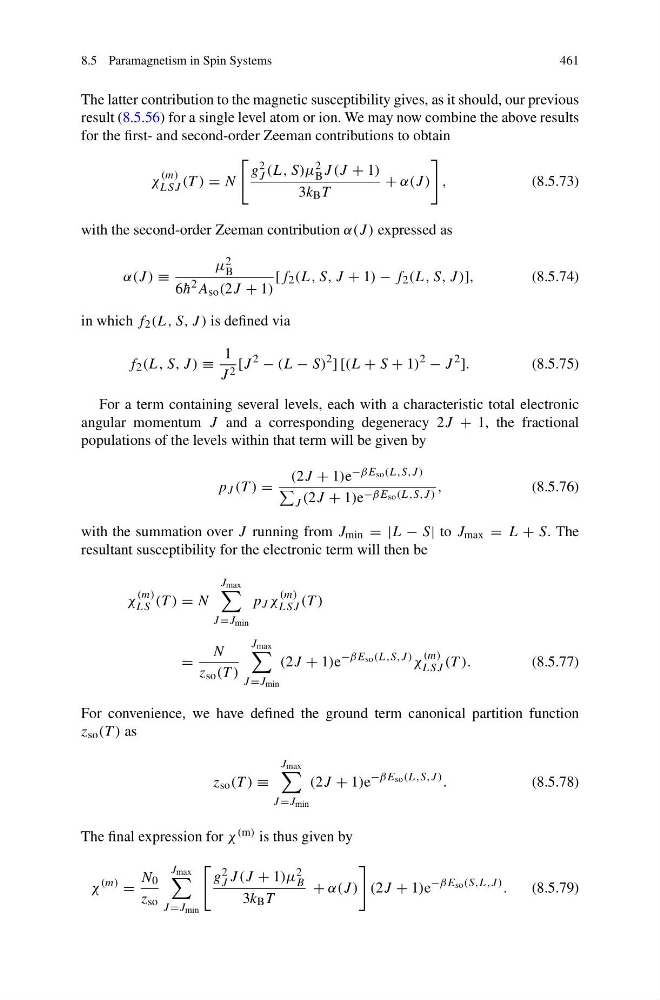
The latter contribution to the magnetic susceptibility gives, as it should, our previous
result (8.5.56) for a single level atom or ion. We may now combine the above results
for the first- and second-order Zeeman contributions to obtain
χ
(m)
LSJ (T ) = N
g 2
J (L, S)μ 2
B J (J + 1)
3k B T
+ α(J )
,
(8.5.73)
with the second-order Zeeman contribution α(J ) expressed as
α(J ) ≡
μ 2
B
6 ¯
h 2 A so (2J + 1)
[f 2 (L, S, J + 1) − f 2 (L, S, J )],
(8.5.74)
in which f 2 (L, S, J ) is defined via
f 2 (L, S, J ) ≡
1
J 2 [J
2
− (L − S)
2
] [(L + S + 1)
2
− J
2
].
(8.5.75)
For a term containing several levels, each with a characteristic total electronic
angular momentum J and a corresponding degeneracy 2J + 1, the fractional
populations of the levels within that term will be given by
p J (T ) =
(2J + 1)e −βE so (L,S,J )
J (2J + 1)e −βE so (L,S,J ) ,
(8.5.76)
with the summation over J running from J min = |L − S| to J max = L + S. The
resultant susceptibility for the electronic term will then be
χ
(m)
LS (T ) = N
J max
J =J min
p J χ
(m)
LSJ (T )
=
N
z so (T )
J max
J =J min
(2J + 1)e
−βE so (L,S,J ) χ
(m)
LSJ (T ).
(8.5.77)
For convenience, we have defined the ground term canonical partition function
z so (T ) as
z so (T ) ≡
J max
J =J min
(2J + 1)e
−βE so (L,S,J ) .
(8.5.78)
The final expression for χ (m) is thus given by
χ
(m)
=
N 0
z so
J max
J =J min
g 2
J J (J + 1)μ 2
B
3k B T
+ α(J )
(2J + 1)e
−βE so (S,L,J ) .
(8.5.79)
461
The latter contribution to the magnetic susceptibility gives, as it should, our previous
result (8.5.56) for a single level atom or ion. We may now combine the above results
for the first- and second-order Zeeman contributions to obtain
χ
(m)
LSJ (T ) = N
g 2
J (L, S)μ 2
B J (J + 1)
3k B T
+ α(J )
,
(8.5.73)
with the second-order Zeeman contribution α(J ) expressed as
α(J ) ≡
μ 2
B
6 ¯
h 2 A so (2J + 1)
[f 2 (L, S, J + 1) − f 2 (L, S, J )],
(8.5.74)
in which f 2 (L, S, J ) is defined via
f 2 (L, S, J ) ≡
1
J 2 [J
2
− (L − S)
2
] [(L + S + 1)
2
− J
2
].
(8.5.75)
For a term containing several levels, each with a characteristic total electronic
angular momentum J and a corresponding degeneracy 2J + 1, the fractional
populations of the levels within that term will be given by
p J (T ) =
(2J + 1)e −βE so (L,S,J )
J (2J + 1)e −βE so (L,S,J ) ,
(8.5.76)
with the summation over J running from J min = |L − S| to J max = L + S. The
resultant susceptibility for the electronic term will then be
χ
(m)
LS (T ) = N
J max
J =J min
p J χ
(m)
LSJ (T )
=
N
z so (T )
J max
J =J min
(2J + 1)e
−βE so (L,S,J ) χ
(m)
LSJ (T ).
(8.5.77)
For convenience, we have defined the ground term canonical partition function
z so (T ) as
z so (T ) ≡
J max
J =J min
(2J + 1)e
−βE so (L,S,J ) .
(8.5.78)
The final expression for χ (m) is thus given by
χ
(m)
=
N 0
z so
J max
J =J min
g 2
J J (J + 1)μ 2
B
3k B T
+ α(J )
(2J + 1)e
−βE so (S,L,J ) .
(8.5.79)