

462
8 Electric and Magnetic Phenomena
An expression for μ 2
eff when more than one J level is thermally accessible can
now be defined in terms of χ
(m)
LS (T ) via
μ
2
eff ≡
3k B T χ
(m)
LS (T )
N 0 μ 2
B
=
1
z so
J max
J =J min
g
2
J (L, S)J (J + 1) +
3k B T α(J )
μ 2
B
(2J + 1)e
−βE so (L,S,J ) .
(8.5.80)
This expression for μ 2
eff was first obtained by Van Vleck [15], and was evaluated in
detail for the Sm 3+ and Eu 3+ ions by Frank [16] in her M.Sc. thesis.
Except for the Sm 3+ and Eu 3+ ions, for which inclusion of the excited levels
of the ground electronic term leads to significant increases over their simple Curie
values for μ eff , no meaningful change from the Curie value is obtained for any other
triply-charged lanthanide ion. This lack of change in the calculated values of μ eff
at a temperature of 293 K for the lanthanide tripositive ions other than Sm 3+ and
Eu 3+ is due to the large energy separations between the levels in the ground terms,
as can be seen from Table 8.2. Not only do larger separations between levels for
these ions lead to very small contributions from excited states in the first term of
Eq. (8.5.79), they also lead to much smaller (even negligible) second-order Zeeman
contributions because of the denominator that appears in the expression for the
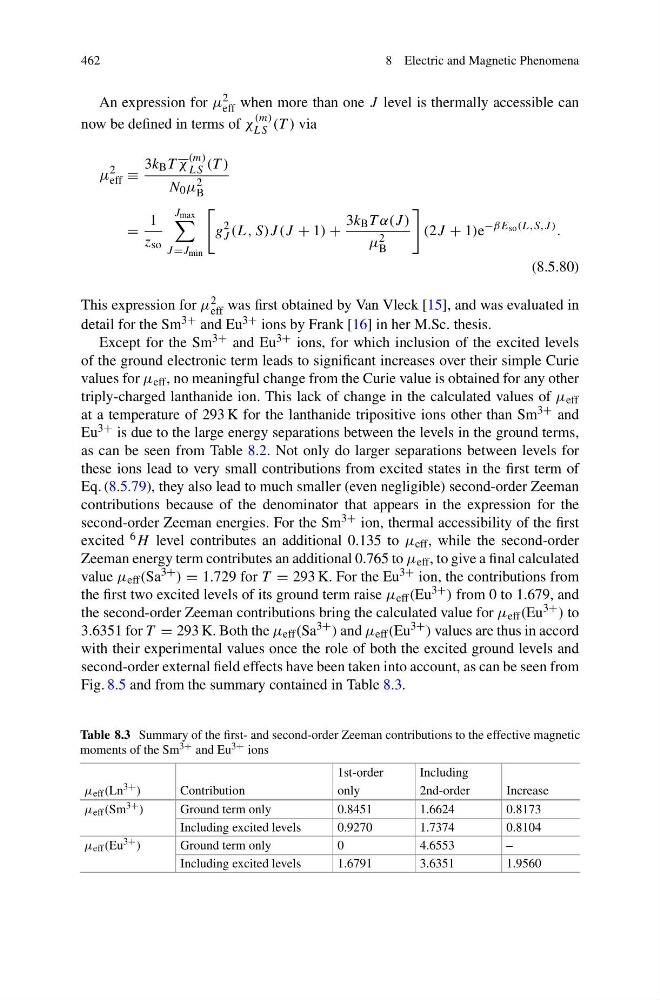
second-order Zeeman energies. For the Sm 3+ ion, thermal accessibility of the first
excited 6 H level contributes an additional 0.135 to μ eff , while the second-order
Zeeman energy term contributes an additional 0.765 to μ eff , to give a final calculated
value μ eff (Sa
3+ ) = 1.729 for T = 293 K. For the Eu 3+ ion, the contributions from
the first two excited levels of its ground term raise μ eff (Eu
3+ ) from 0 to 1.679, and
the second-order Zeeman contributions bring the calculated value for μ eff (Eu
3+ ) to
3.6351 for T = 293 K. Both the μ eff (Sa
3+ ) and μ eff (Eu
3+ ) values are thus in accord
with their experimental values once the role of both the excited ground levels and
second-order external field effects have been taken into account, as can be seen from
Fig. 8.5 and from the summary contained in Table 8.3.
Table 8.3 Summary of the first- and second-order Zeeman contributions to the effective magnetic
moments of the Sm 3+ and Eu 3+ ions
1st-order
Including
μ eff (Ln
3+ )
Contribution
only
2nd-order
Increase
μ eff (Sm
3+ )
Ground term only
0.8451
1.6624
0.8173
Including excited levels
0.9270
1.7374
0.8104
μ eff (Eu
3+ )
Ground term only
0
4.6553
–
Including excited levels
1.6791
3.6351
1.9560
8 Electric and Magnetic Phenomena
An expression for μ 2
eff when more than one J level is thermally accessible can
now be defined in terms of χ
(m)
LS (T ) via
μ
2
eff ≡
3k B T χ
(m)
LS (T )
N 0 μ 2
B
=
1
z so
J max
J =J min
g
2
J (L, S)J (J + 1) +
3k B T α(J )
μ 2
B
(2J + 1)e
−βE so (L,S,J ) .
(8.5.80)
This expression for μ 2
eff was first obtained by Van Vleck [15], and was evaluated in
detail for the Sm 3+ and Eu 3+ ions by Frank [16] in her M.Sc. thesis.
Except for the Sm 3+ and Eu 3+ ions, for which inclusion of the excited levels
of the ground electronic term leads to significant increases over their simple Curie
values for μ eff , no meaningful change from the Curie value is obtained for any other
triply-charged lanthanide ion. This lack of change in the calculated values of μ eff
at a temperature of 293 K for the lanthanide tripositive ions other than Sm 3+ and
Eu 3+ is due to the large energy separations between the levels in the ground terms,
as can be seen from Table 8.2. Not only do larger separations between levels for
these ions lead to very small contributions from excited states in the first term of
Eq. (8.5.79), they also lead to much smaller (even negligible) second-order Zeeman
contributions because of the denominator that appears in the expression for the
second-order Zeeman energies. For the Sm 3+ ion, thermal accessibility of the first
excited 6 H level contributes an additional 0.135 to μ eff , while the second-order
Zeeman energy term contributes an additional 0.765 to μ eff , to give a final calculated
value μ eff (Sa
3+ ) = 1.729 for T = 293 K. For the Eu 3+ ion, the contributions from
the first two excited levels of its ground term raise μ eff (Eu
3+ ) from 0 to 1.679, and
the second-order Zeeman contributions bring the calculated value for μ eff (Eu
3+ ) to
3.6351 for T = 293 K. Both the μ eff (Sa
3+ ) and μ eff (Eu
3+ ) values are thus in accord
with their experimental values once the role of both the excited ground levels and
second-order external field effects have been taken into account, as can be seen from
Fig. 8.5 and from the summary contained in Table 8.3.
Table 8.3 Summary of the first- and second-order Zeeman contributions to the effective magnetic
moments of the Sm 3+ and Eu 3+ ions
1st-order
Including
μ eff (Ln
3+ )
Contribution
only
2nd-order
Increase
μ eff (Sm
3+ )
Ground term only
0.8451
1.6624
0.8173
Including excited levels
0.9270
1.7374
0.8104
μ eff (Eu
3+ )
Ground term only
0
4.6553
–
Including excited levels
1.6791
3.6351
1.9560