

460
8 Electric and Magnetic Phenomena
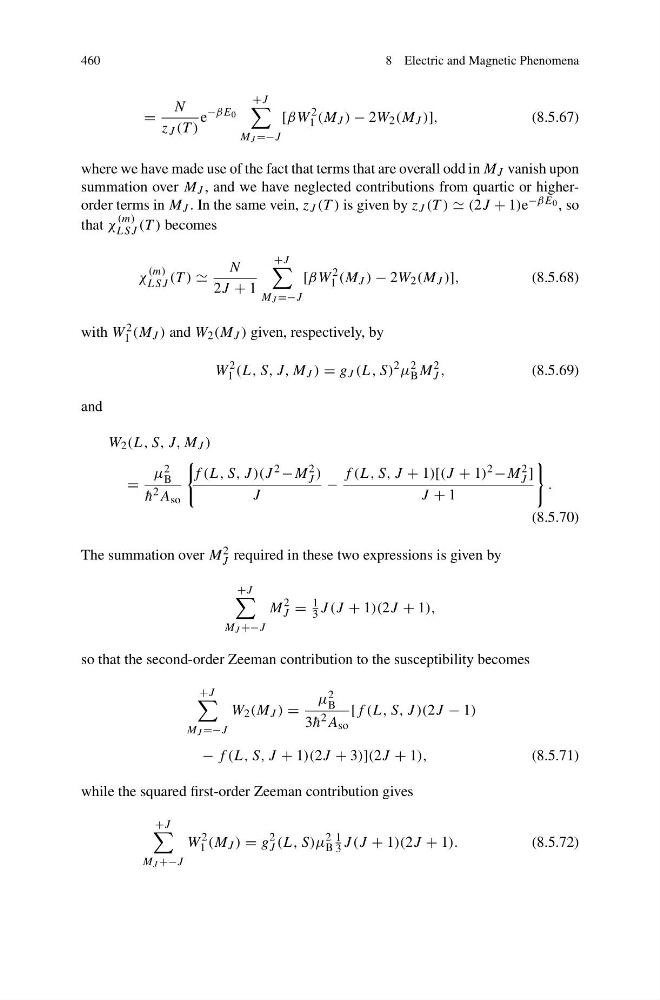
=
N
z J (T )
e
−βE 0
+J
M J =−J
[βW
2
1 (M J ) − 2W 2 (M J )],
(8.5.67)
where we have made use of the fact that terms that are overall odd in M J vanish upon
summation over M J , and we have neglected contributions from quartic or higherorder terms in M J . In the same vein, z J (T ) is given by z J (T ) (2J + 1)e −βE 0 , so
that χ
(m)
LSJ (T ) becomes
χ
(m)
LSJ (T )
N
2J + 1
+J
M J =−J
[βW
2
1 (M J ) − 2W 2 (M J )],
(8.5.68)
with W 2
1 (M J ) and W 2 (M J ) given, respectively, by
W
2
1 (L, S, J, M J ) = g J (L, S)
2 μ
2
B M
2
J ,
(8.5.69)
and
W 2 (L, S, J, M J )
=
μ 2
B
¯
h 2 A so
f (L, S, J )(J 2 −M 2
J )
J
−
f (L, S, J + 1)[(J + 1) 2 −M 2
J ]
J + 1
.
(8.5.70)
The summation over M 2
J required in these two expressions is given by
+J
M J +−J
M
2
J =
1
3 J (J + 1)(2J + 1),
so that the second-order Zeeman contribution to the susceptibility becomes
+J
M J =−J
W 2 (M J ) =
μ 2
B
3 ¯
h 2 A so
[f (L, S, J )(2J − 1)
− f (L, S, J + 1)(2J + 3)](2J + 1),
(8.5.71)
while the squared first-order Zeeman contribution gives
+J
M J +−J
W
2
1 (M J ) = g
2
J (L, S)μ
2
B
1
3 J (J + 1)(2J + 1).
(8.5.72)
8 Electric and Magnetic Phenomena
=
N
z J (T )
e
−βE 0
+J
M J =−J
[βW
2
1 (M J ) − 2W 2 (M J )],
(8.5.67)
where we have made use of the fact that terms that are overall odd in M J vanish upon
summation over M J , and we have neglected contributions from quartic or higherorder terms in M J . In the same vein, z J (T ) is given by z J (T ) (2J + 1)e −βE 0 , so
that χ
(m)
LSJ (T ) becomes
χ
(m)
LSJ (T )
N
2J + 1
+J
M J =−J
[βW
2
1 (M J ) − 2W 2 (M J )],
(8.5.68)
with W 2
1 (M J ) and W 2 (M J ) given, respectively, by
W
2
1 (L, S, J, M J ) = g J (L, S)
2 μ
2
B M
2
J ,
(8.5.69)
and
W 2 (L, S, J, M J )
=
μ 2
B
¯
h 2 A so
f (L, S, J )(J 2 −M 2
J )
J
−
f (L, S, J + 1)[(J + 1) 2 −M 2
J ]
J + 1
.
(8.5.70)
The summation over M 2
J required in these two expressions is given by
+J
M J +−J
M
2
J =
1
3 J (J + 1)(2J + 1),
so that the second-order Zeeman contribution to the susceptibility becomes
+J
M J =−J
W 2 (M J ) =
μ 2
B
3 ¯
h 2 A so
[f (L, S, J )(2J − 1)
− f (L, S, J + 1)(2J + 3)](2J + 1),
(8.5.71)
while the squared first-order Zeeman contribution gives
+J
M J +−J
W
2
1 (M J ) = g
2
J (L, S)μ
2
B
1
3 J (J + 1)(2J + 1).
(8.5.72)