

8.5 Paramagnetism in Spin Systems
459
8.5.6 Magnetic Susceptibilities of Sm 3+ and Eu 3+ Ions
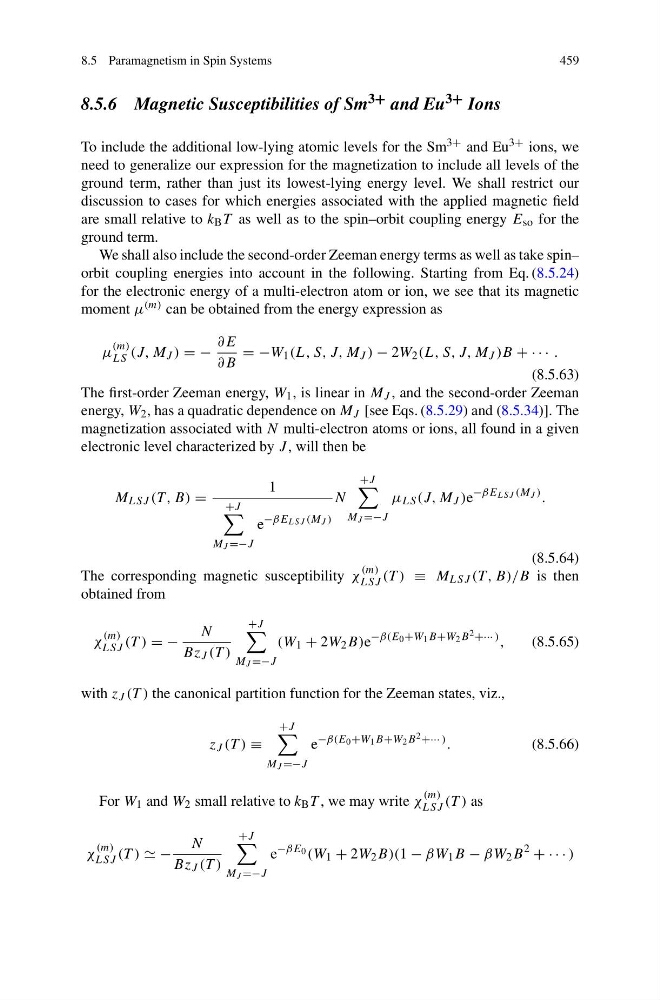
To include the additional low-lying atomic levels for the Sm 3+ and Eu 3+ ions, we
need to generalize our expression for the magnetization to include all levels of the
ground term, rather than just its lowest-lying energy level. We shall restrict our
discussion to cases for which energies associated with the applied magnetic field
are small relative to k B T as well as to the spin–orbit coupling energy E so for the
ground term.
We shall also include the second-order Zeeman energy terms as well as take spin–
orbit coupling energies into account in the following. Starting from Eq. (8.5.24)
for the electronic energy of a multi-electron atom or ion, we see that its magnetic
moment μ (m) can be obtained from the energy expression as
μ
(m)
LS (J, M J ) = −
∂E
∂B
= −W 1 (L, S, J, M J ) − 2W 2 (L, S, J, M J )B + · · · .
(8.5.63)
The first-order Zeeman energy, W 1 , is linear in M J , and the second-order Zeeman
energy, W 2 , has a quadratic dependence on M J [see Eqs. (8.5.29) and (8.5.34)]. The
magnetization associated with N multi-electron atoms or ions, all found in a given
electronic level characterized by J , will then be
M LSJ (T , B) =
1
+J
M J =−J
e
−βE LSJ (M J )
N
+J
M J =−J
μ LS (J, M J )e
−βE LSJ (M J ) .
(8.5.64)
The corresponding magnetic susceptibility χ
(m)
LSJ (T ) ≡ M LSJ (T , B)/B is then
obtained from
χ
(m)
LSJ (T ) = −
N
Bz J (T )
+J
M J =−J
(W 1 + 2W 2 B)e
−β(E 0 +W 1 B+W 2 B 2 +··· ) ,
(8.5.65)
with z J (T ) the canonical partition function for the Zeeman states, viz.,
z J (T ) ≡
+J
M J =−J
e
−β(E 0 +W 1 B+W 2 B 2 +··· ) .
(8.5.66)
For W 1 and W 2 small relative to k B T , we may write χ
(m)
LSJ (T ) as
χ
(m)
LSJ (T ) −
N
Bz J (T )
+J
M J =−J
e
−βE 0 (W 1 + 2W 2 B)(1 − βW 1 B − βW 2 B
2
+ · · · )
459
8.5.6 Magnetic Susceptibilities of Sm 3+ and Eu 3+ Ions
To include the additional low-lying atomic levels for the Sm 3+ and Eu 3+ ions, we
need to generalize our expression for the magnetization to include all levels of the
ground term, rather than just its lowest-lying energy level. We shall restrict our
discussion to cases for which energies associated with the applied magnetic field
are small relative to k B T as well as to the spin–orbit coupling energy E so for the
ground term.
We shall also include the second-order Zeeman energy terms as well as take spin–
orbit coupling energies into account in the following. Starting from Eq. (8.5.24)
for the electronic energy of a multi-electron atom or ion, we see that its magnetic
moment μ (m) can be obtained from the energy expression as
μ
(m)
LS (J, M J ) = −
∂E
∂B
= −W 1 (L, S, J, M J ) − 2W 2 (L, S, J, M J )B + · · · .
(8.5.63)
The first-order Zeeman energy, W 1 , is linear in M J , and the second-order Zeeman
energy, W 2 , has a quadratic dependence on M J [see Eqs. (8.5.29) and (8.5.34)]. The
magnetization associated with N multi-electron atoms or ions, all found in a given
electronic level characterized by J , will then be
M LSJ (T , B) =
1
+J
M J =−J
e
−βE LSJ (M J )
N
+J
M J =−J
μ LS (J, M J )e
−βE LSJ (M J ) .
(8.5.64)
The corresponding magnetic susceptibility χ
(m)
LSJ (T ) ≡ M LSJ (T , B)/B is then
obtained from
χ
(m)
LSJ (T ) = −
N
Bz J (T )
+J
M J =−J
(W 1 + 2W 2 B)e
−β(E 0 +W 1 B+W 2 B 2 +··· ) ,
(8.5.65)
with z J (T ) the canonical partition function for the Zeeman states, viz.,
z J (T ) ≡
+J
M J =−J
e
−β(E 0 +W 1 B+W 2 B 2 +··· ) .
(8.5.66)
For W 1 and W 2 small relative to k B T , we may write χ
(m)
LSJ (T ) as
χ
(m)
LSJ (T ) −
N
Bz J (T )
+J
M J =−J
e
−βE 0 (W 1 + 2W 2 B)(1 − βW 1 B − βW 2 B
2
+ · · · )