

458
8 Electric and Magnetic Phenomena
Δ
0
1000
2000
3000
4000
5000
6000
7000
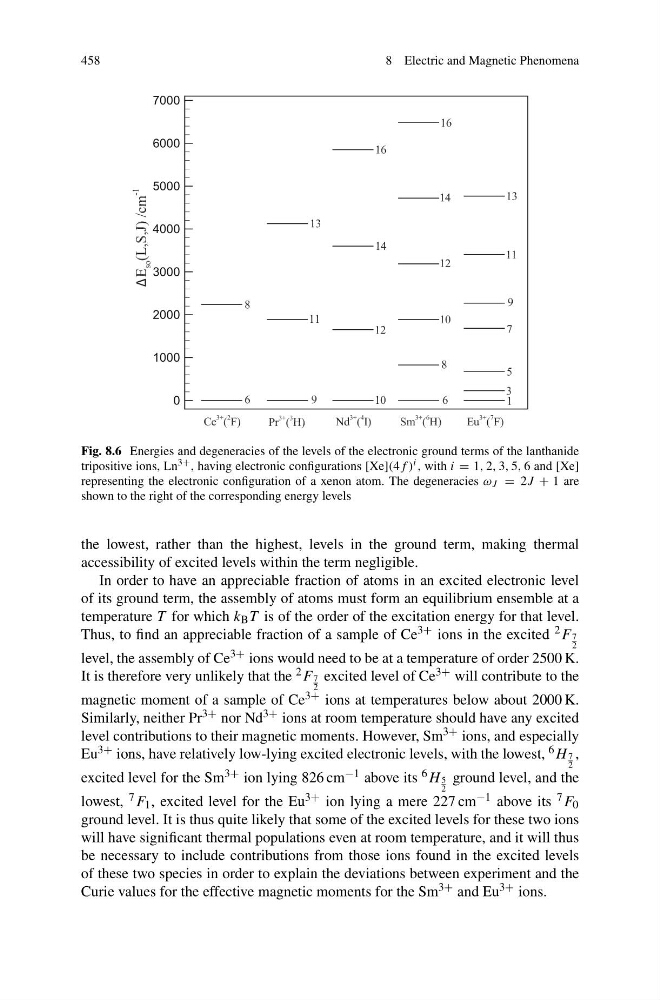
Fig. 8.6 Energies and degeneracies of the levels of the electronic ground terms of the lanthanide
tripositive ions, Ln 3+ , having electronic configurations [Xe](4f ) i , with i = 1, 2, 3, 5, 6 and [Xe]
representing the electronic configuration of a xenon atom. The degeneracies ω J = 2J + 1 are
shown to the right of the corresponding energy levels
the lowest, rather than the highest, levels in the ground term, making thermal
accessibility of excited levels within the term negligible.
In order to have an appreciable fraction of atoms in an excited electronic level
of its ground term, the assembly of atoms must form an equilibrium ensemble at a
temperature T for which k B T is of the order of the excitation energy for that level.
Thus, to find an appreciable fraction of a sample of Ce 3+ ions in the excited 2 F 7
2
level, the assembly of Ce 3+ ions would need to be at a temperature of order 2500 K.
It is therefore very unlikely that the 2 F 7
2
excited level of Ce 3+ will contribute to the
magnetic moment of a sample of Ce 3+ ions at temperatures below about 2000 K.
Similarly, neither Pr 3+ nor Nd 3+ ions at room temperature should have any excited
level contributions to their magnetic moments. However, Sm 3+ ions, and especially
Eu 3+ ions, have relatively low-lying excited electronic levels, with the lowest, 6 H 7
2
,
excited level for the Sm 3+ ion lying 826 cm −1 above its 6 H 5
2
ground level, and the
lowest, 7 F 1 , excited level for the Eu 3+ ion lying a mere 227 cm −1 above its 7 F 0
ground level. It is thus quite likely that some of the excited levels for these two ions
will have significant thermal populations even at room temperature, and it will thus
be necessary to include contributions from those ions found in the excited levels
of these two species in order to explain the deviations between experiment and the
Curie values for the effective magnetic moments for the Sm 3+ and Eu 3+ ions.
8 Electric and Magnetic Phenomena
Δ
0
1000
2000
3000
4000
5000
6000
7000
Fig. 8.6 Energies and degeneracies of the levels of the electronic ground terms of the lanthanide
tripositive ions, Ln 3+ , having electronic configurations [Xe](4f ) i , with i = 1, 2, 3, 5, 6 and [Xe]
representing the electronic configuration of a xenon atom. The degeneracies ω J = 2J + 1 are
shown to the right of the corresponding energy levels
the lowest, rather than the highest, levels in the ground term, making thermal
accessibility of excited levels within the term negligible.
In order to have an appreciable fraction of atoms in an excited electronic level
of its ground term, the assembly of atoms must form an equilibrium ensemble at a
temperature T for which k B T is of the order of the excitation energy for that level.
Thus, to find an appreciable fraction of a sample of Ce 3+ ions in the excited 2 F 7
2
level, the assembly of Ce 3+ ions would need to be at a temperature of order 2500 K.
It is therefore very unlikely that the 2 F 7
2
excited level of Ce 3+ will contribute to the
magnetic moment of a sample of Ce 3+ ions at temperatures below about 2000 K.
Similarly, neither Pr 3+ nor Nd 3+ ions at room temperature should have any excited
level contributions to their magnetic moments. However, Sm 3+ ions, and especially
Eu 3+ ions, have relatively low-lying excited electronic levels, with the lowest, 6 H 7
2
,
excited level for the Sm 3+ ion lying 826 cm −1 above its 6 H 5
2
ground level, and the
lowest, 7 F 1 , excited level for the Eu 3+ ion lying a mere 227 cm −1 above its 7 F 0
ground level. It is thus quite likely that some of the excited levels for these two ions
will have significant thermal populations even at room temperature, and it will thus
be necessary to include contributions from those ions found in the excited levels
of these two species in order to explain the deviations between experiment and the
Curie values for the effective magnetic moments for the Sm 3+ and Eu 3+ ions.