

8.5 Paramagnetism in Spin Systems
457
How far above the ground level energy an excited level lies is determined by the
difference between the spin–orbit energies E so (S, L, J ) of the excited and ground
levels of the ion. Because the values of L and S for a given term do not change, this
difference may be simplified to
E so (J, J min ) =
1
2 ¯
h
2 A so [J (J + 1) − J min (J min + 1)].
(8.5.62)
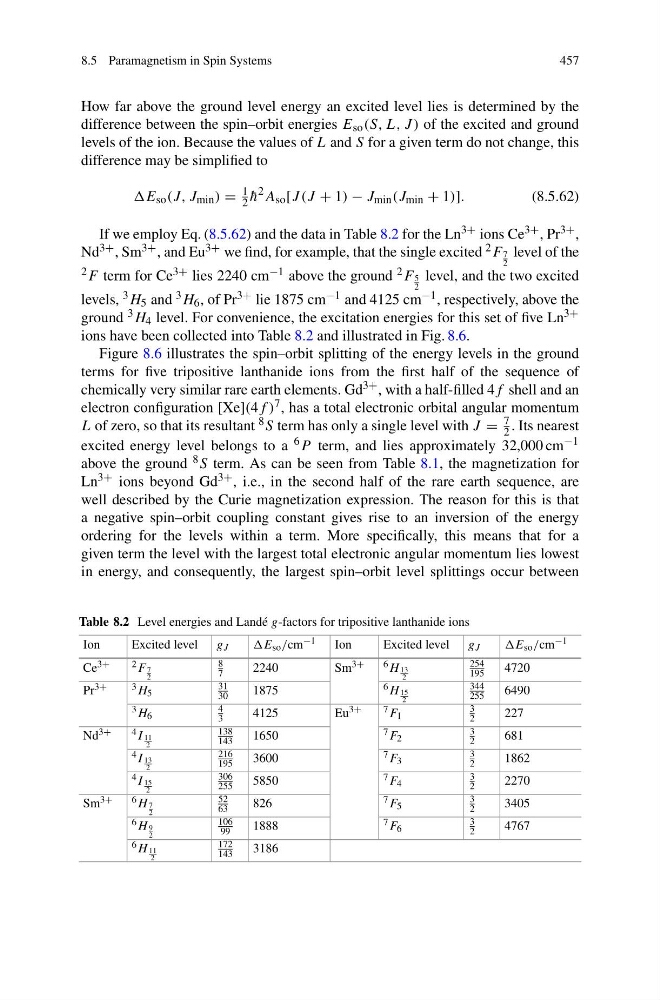
If we employ Eq. (8.5.62) and the data in Table 8.2 for the Ln 3+ ions Ce 3+ , Pr 3+ ,
Nd 3+ , Sm 3+ , and Eu 3+ we find, for example, that the single excited 2 F 7
2
level of the
2 F term for Ce 3+ lies 2240 cm −1 above the ground 2 F 5
2
level, and the two excited
levels, 3 H 5 and 3 H 6 , of Pr 3+ lie 1875 cm −1 and 4125 cm −1 , respectively, above the
ground 3 H 4 level. For convenience, the excitation energies for this set of five Ln 3+
ions have been collected into Table 8.2 and illustrated in Fig. 8.6.
Figure 8.6 illustrates the spin–orbit splitting of the energy levels in the ground
terms for five tripositive lanthanide ions from the first half of the sequence of
chemically very similar rare earth elements. Gd 3+ , with a half-filled 4f shell and an
electron configuration [Xe](4f ) 7 , has a total electronic orbital angular momentum
L of zero, so that its resultant 8 S term has only a single level with J =
7
2 . Its nearest
excited energy level belongs to a 6 P term, and lies approximately 32,000 cm −1
above the ground 8 S term. As can be seen from Table 8.1, the magnetization for
Ln 3+ ions beyond Gd 3+ , i.e., in the second half of the rare earth sequence, are
well described by the Curie magnetization expression. The reason for this is that
a negative spin–orbit coupling constant gives rise to an inversion of the energy
ordering for the levels within a term. More specifically, this means that for a
given term the level with the largest total electronic angular momentum lies lowest
in energy, and consequently, the largest spin–orbit level splittings occur between
Table 8.2 Level energies and Landé g-factors for tripositive lanthanide ions
Ion
Excited level g J
E so /cm −1
Ion
Excited level g J
E so /cm −1
Ce 3+
2 F 7
2
8
7
2240
Sm 3+
6 H 13
2
254
195
4720
Pr 3+
3 H 5
31
30
1875
6 H 15
2
344
255
6490
3 H 6
4
3
4125
Eu 3+
7 F 1
3
2
227
Nd 3+
4 I 11
2
138
143
1650
7 F 2
3
2
681
4 I 13
2
216
195
3600
7 F 3
3
2
1862
4 I 15
2
306
255
5850
7 F 4
3
2
2270
Sm 3+
6 H 7
2
52
63
826
7 F 5
3
2
3405
6 H 9
2
106
99
1888
7 F 6
3
2
4767
6 H 11
2
172
143
3186
457
How far above the ground level energy an excited level lies is determined by the
difference between the spin–orbit energies E so (S, L, J ) of the excited and ground
levels of the ion. Because the values of L and S for a given term do not change, this
difference may be simplified to
E so (J, J min ) =
1
2 ¯
h
2 A so [J (J + 1) − J min (J min + 1)].
(8.5.62)
If we employ Eq. (8.5.62) and the data in Table 8.2 for the Ln 3+ ions Ce 3+ , Pr 3+ ,
Nd 3+ , Sm 3+ , and Eu 3+ we find, for example, that the single excited 2 F 7
2
level of the
2 F term for Ce 3+ lies 2240 cm −1 above the ground 2 F 5
2
level, and the two excited
levels, 3 H 5 and 3 H 6 , of Pr 3+ lie 1875 cm −1 and 4125 cm −1 , respectively, above the
ground 3 H 4 level. For convenience, the excitation energies for this set of five Ln 3+
ions have been collected into Table 8.2 and illustrated in Fig. 8.6.
Figure 8.6 illustrates the spin–orbit splitting of the energy levels in the ground
terms for five tripositive lanthanide ions from the first half of the sequence of
chemically very similar rare earth elements. Gd 3+ , with a half-filled 4f shell and an
electron configuration [Xe](4f ) 7 , has a total electronic orbital angular momentum
L of zero, so that its resultant 8 S term has only a single level with J =
7
2 . Its nearest
excited energy level belongs to a 6 P term, and lies approximately 32,000 cm −1
above the ground 8 S term. As can be seen from Table 8.1, the magnetization for
Ln 3+ ions beyond Gd 3+ , i.e., in the second half of the rare earth sequence, are
well described by the Curie magnetization expression. The reason for this is that
a negative spin–orbit coupling constant gives rise to an inversion of the energy
ordering for the levels within a term. More specifically, this means that for a
given term the level with the largest total electronic angular momentum lies lowest
in energy, and consequently, the largest spin–orbit level splittings occur between
Table 8.2 Level energies and Landé g-factors for tripositive lanthanide ions
Ion
Excited level g J
E so /cm −1
Ion
Excited level g J
E so /cm −1
Ce 3+
2 F 7
2
8
7
2240
Sm 3+
6 H 13
2
254
195
4720
Pr 3+
3 H 5
31
30
1875
6 H 15
2
344
255
6490
3 H 6
4
3
4125
Eu 3+
7 F 1
3
2
227
Nd 3+
4 I 11
2
138
143
1650
7 F 2
3
2
681
4 I 13
2
216
195
3600
7 F 3
3
2
1862
4 I 15
2
306
255
5850
7 F 4
3
2
2270
Sm 3+
6 H 7
2
52
63
826
7 F 5
3
2
3405
6 H 9
2
106
99
1888
7 F 6
3
2
4767
6 H 11
2
172
143
3186