

456
8 Electric and Magnetic Phenomena
μ μ
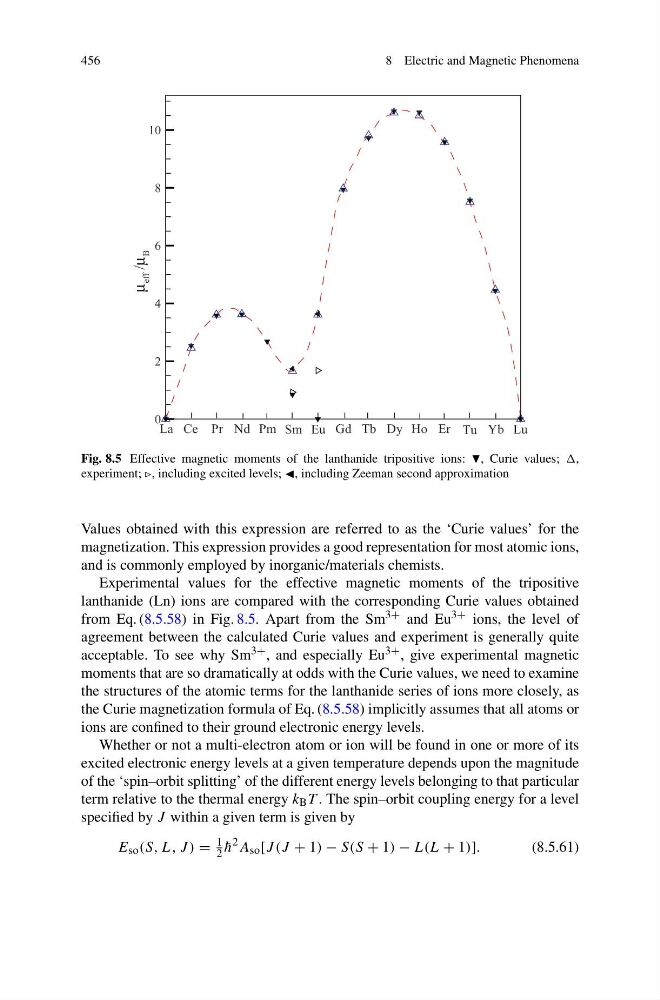
Fig. 8.5 Effective magnetic moments of the lanthanide tripositive ions: , Curie values; ,
experiment; , including excited levels; , including Zeeman second approximation
Values obtained with this expression are referred to as the ‘Curie values’ for the
magnetization. This expression provides a good representation for most atomic ions,
and is commonly employed by inorganic/materials chemists.
Experimental values for the effective magnetic moments of the tripositive
lanthanide (Ln) ions are compared with the corresponding Curie values obtained
from Eq. (8.5.58) in Fig. 8.5. Apart from the Sm 3+ and Eu 3+ ions, the level of
agreement between the calculated Curie values and experiment is generally quite
acceptable. To see why Sm 3+ , and especially Eu 3+ , give experimental magnetic
moments that are so dramatically at odds with the Curie values, we need to examine
the structures of the atomic terms for the lanthanide series of ions more closely, as
the Curie magnetization formula of Eq. (8.5.58) implicitly assumes that all atoms or
ions are confined to their ground electronic energy levels.
Whether or not a multi-electron atom or ion will be found in one or more of its
excited electronic energy levels at a given temperature depends upon the magnitude
of the ‘spin–orbit splitting’ of the different energy levels belonging to that particular
term relative to the thermal energy k B T . The spin–orbit coupling energy for a level
specified by J within a given term is given by
E so (S, L, J ) =
1
2 ¯
h
2 A so [J (J + 1) − S(S + 1) − L(L + 1)].
(8.5.61)
8 Electric and Magnetic Phenomena
μ μ
Fig. 8.5 Effective magnetic moments of the lanthanide tripositive ions: , Curie values; ,
experiment; , including excited levels; , including Zeeman second approximation
Values obtained with this expression are referred to as the ‘Curie values’ for the
magnetization. This expression provides a good representation for most atomic ions,
and is commonly employed by inorganic/materials chemists.
Experimental values for the effective magnetic moments of the tripositive
lanthanide (Ln) ions are compared with the corresponding Curie values obtained
from Eq. (8.5.58) in Fig. 8.5. Apart from the Sm 3+ and Eu 3+ ions, the level of
agreement between the calculated Curie values and experiment is generally quite
acceptable. To see why Sm 3+ , and especially Eu 3+ , give experimental magnetic
moments that are so dramatically at odds with the Curie values, we need to examine
the structures of the atomic terms for the lanthanide series of ions more closely, as
the Curie magnetization formula of Eq. (8.5.58) implicitly assumes that all atoms or
ions are confined to their ground electronic energy levels.
Whether or not a multi-electron atom or ion will be found in one or more of its
excited electronic energy levels at a given temperature depends upon the magnitude
of the ‘spin–orbit splitting’ of the different energy levels belonging to that particular
term relative to the thermal energy k B T . The spin–orbit coupling energy for a level
specified by J within a given term is given by
E so (S, L, J ) =
1
2 ¯
h
2 A so [J (J + 1) − S(S + 1) − L(L + 1)].
(8.5.61)