

8.5 Paramagnetism in Spin Systems
453
μ
∞
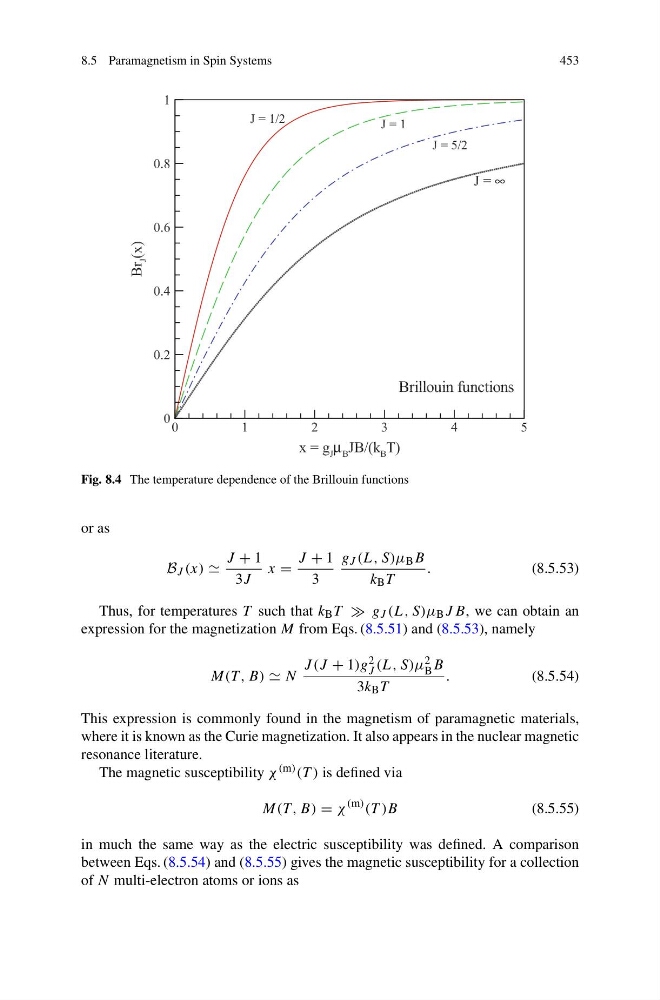
Fig. 8.4 The temperature dependence of the Brillouin functions
or as
B J (x)
J + 1
3J
x =
J + 1
3
g J (L, S)μ B B
k B T
.
(8.5.53)
Thus, for temperatures T such that k B T g J (L, S)μ B J B, we can obtain an
expression for the magnetization M from Eqs. (8.5.51) and (8.5.53), namely
M(T , B) N
J (J + 1)g 2
J (L, S)μ 2
B B
3k B T
.
(8.5.54)
This expression is commonly found in the magnetism of paramagnetic materials,
where it is known as the Curie magnetization. It also appears in the nuclear magnetic
resonance literature.
The magnetic susceptibility χ (m) (T ) is defined via
M(T , B) = χ
(m) (T )B
(8.5.55)
in much the same way as the electric susceptibility was defined. A comparison
between Eqs. (8.5.54) and (8.5.55) gives the magnetic susceptibility for a collection
of N multi-electron atoms or ions as
453
μ
∞
Fig. 8.4 The temperature dependence of the Brillouin functions
or as
B J (x)
J + 1
3J
x =
J + 1
3
g J (L, S)μ B B
k B T
.
(8.5.53)
Thus, for temperatures T such that k B T g J (L, S)μ B J B, we can obtain an
expression for the magnetization M from Eqs. (8.5.51) and (8.5.53), namely
M(T , B) N
J (J + 1)g 2
J (L, S)μ 2
B B
3k B T
.
(8.5.54)
This expression is commonly found in the magnetism of paramagnetic materials,
where it is known as the Curie magnetization. It also appears in the nuclear magnetic
resonance literature.
The magnetic susceptibility χ (m) (T ) is defined via
M(T , B) = χ
(m) (T )B
(8.5.55)
in much the same way as the electric susceptibility was defined. A comparison
between Eqs. (8.5.54) and (8.5.55) gives the magnetic susceptibility for a collection
of N multi-electron atoms or ions as