

454
8 Electric and Magnetic Phenomena
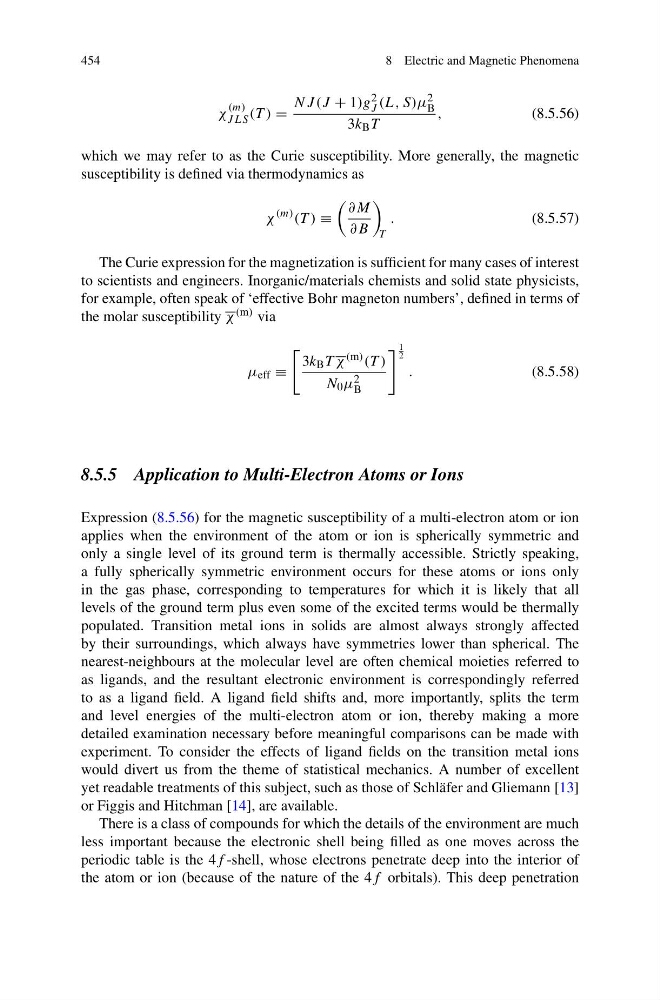
χ
(m)
J LS (T ) =
NJ (J + 1)g 2
J (L, S)μ 2
B
3k B T
,
(8.5.56)
which we may refer to as the Curie susceptibility. More generally, the magnetic
susceptibility is defined via thermodynamics as
χ
(m) (T ) ≡
∂M
∂B
T
.
(8.5.57)
The Curie expression for the magnetization is sufficient for many cases of interest
to scientists and engineers. Inorganic/materials chemists and solid state physicists,
for example, often speak of ‘effective Bohr magneton numbers’, defined in terms of
the molar susceptibility χ (m) via
μ eff ≡
3k B T χ (m) (T )
N 0 μ 2
B
1
2
.
(8.5.58)
8.5.5 Application to Multi-Electron Atoms or Ions
Expression (8.5.56) for the magnetic susceptibility of a multi-electron atom or ion
applies when the environment of the atom or ion is spherically symmetric and
only a single level of its ground term is thermally accessible. Strictly speaking,
a fully spherically symmetric environment occurs for these atoms or ions only
in the gas phase, corresponding to temperatures for which it is likely that all
levels of the ground term plus even some of the excited terms would be thermally
populated. Transition metal ions in solids are almost always strongly affected
by their surroundings, which always have symmetries lower than spherical. The
nearest-neighbours at the molecular level are often chemical moieties referred to
as ligands, and the resultant electronic environment is correspondingly referred
to as a ligand field. A ligand field shifts and, more importantly, splits the term
and level energies of the multi-electron atom or ion, thereby making a more
detailed examination necessary before meaningful comparisons can be made with
experiment. To consider the effects of ligand fields on the transition metal ions
would divert us from the theme of statistical mechanics. A number of excellent
yet readable treatments of this subject, such as those of Schläfer and Gliemann [13]
or Figgis and Hitchman [14], are available.
There is a class of compounds for which the details of the environment are much
less important because the electronic shell being filled as one moves across the
periodic table is the 4f -shell, whose electrons penetrate deep into the interior of
the atom or ion (because of the nature of the 4f orbitals). This deep penetration
8 Electric and Magnetic Phenomena
χ
(m)
J LS (T ) =
NJ (J + 1)g 2
J (L, S)μ 2
B
3k B T
,
(8.5.56)
which we may refer to as the Curie susceptibility. More generally, the magnetic
susceptibility is defined via thermodynamics as
χ
(m) (T ) ≡
∂M
∂B
T
.
(8.5.57)
The Curie expression for the magnetization is sufficient for many cases of interest
to scientists and engineers. Inorganic/materials chemists and solid state physicists,
for example, often speak of ‘effective Bohr magneton numbers’, defined in terms of
the molar susceptibility χ (m) via
μ eff ≡
3k B T χ (m) (T )
N 0 μ 2
B
1
2
.
(8.5.58)
8.5.5 Application to Multi-Electron Atoms or Ions
Expression (8.5.56) for the magnetic susceptibility of a multi-electron atom or ion
applies when the environment of the atom or ion is spherically symmetric and
only a single level of its ground term is thermally accessible. Strictly speaking,
a fully spherically symmetric environment occurs for these atoms or ions only
in the gas phase, corresponding to temperatures for which it is likely that all
levels of the ground term plus even some of the excited terms would be thermally
populated. Transition metal ions in solids are almost always strongly affected
by their surroundings, which always have symmetries lower than spherical. The
nearest-neighbours at the molecular level are often chemical moieties referred to
as ligands, and the resultant electronic environment is correspondingly referred
to as a ligand field. A ligand field shifts and, more importantly, splits the term
and level energies of the multi-electron atom or ion, thereby making a more
detailed examination necessary before meaningful comparisons can be made with
experiment. To consider the effects of ligand fields on the transition metal ions
would divert us from the theme of statistical mechanics. A number of excellent
yet readable treatments of this subject, such as those of Schläfer and Gliemann [13]
or Figgis and Hitchman [14], are available.
There is a class of compounds for which the details of the environment are much
less important because the electronic shell being filled as one moves across the
periodic table is the 4f -shell, whose electrons penetrate deep into the interior of
the atom or ion (because of the nature of the 4f orbitals). This deep penetration