

444
8 Electric and Magnetic Phenomena
so that the internal energy U mag associated with our spin system is given by
U spin (T ) = Nk B T
2
∂ ln z spin
∂T
V
= −Nk B T
2
2μB 0 sinh(βμB 0 )
k B T 2 [2 cosh(βμB 0 ) + 1]
= −NμB 0
tanh(βμB 0 )
1 +
1
2 sech(βμB 0 )
.
Notice that, if we compare this result for U spin (T ) with the expression for the
magnetization M, we find that U spin (T ) = −MB 0 , which is as we should expect.
We may directly write down an expression for the entropy of our spin system using
our statistical thermodynamic expression
S spin =
U spin
T
+ k B ln z
N
spin ,
to obtain
S spin = Nk B
ln[2 cosh(βμB 0 ) + 1] −
μB 0
k B T
tanh(βμB 0 )
1 +
1
2 sech(βμB 0 )
.
Although the expression for the heat capacity for a spin-1 system is rather complicated, it is instructive to see that it does not behave as a function of temperature
any differently than does the simpler case of a spin1
2 system. The heat capacity at
constant volume can be obtained as the partial derivative with respect to temperature
of U spin (T ), viz.,
C B = Nk B
μB 0
k B T
2 sech(βμB 0 )
sech(βμB 0 ) +
1
2
1 +
1
2 sech(βμB 0 )
2
.
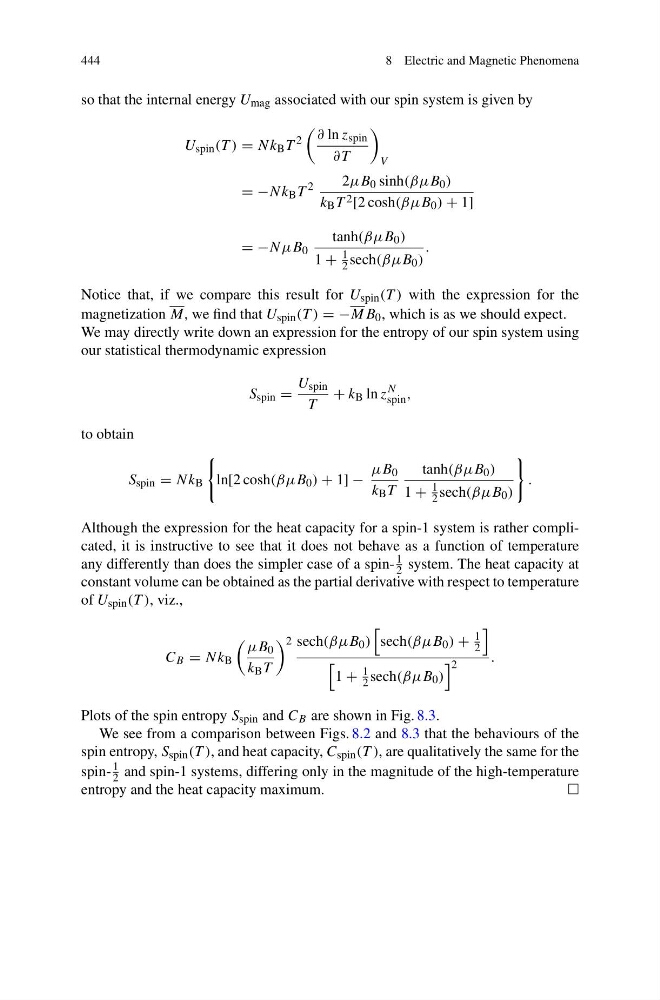
Plots of the spin entropy S spin and C B are shown in Fig. 8.3.
We see from a comparison between Figs. 8.2 and 8.3 that the behaviours of the
spin entropy, S spin (T ), and heat capacity, C spin (T ), are qualitatively the same for the
spin1
2 and spin-1 systems, differing only in the magnitude of the high-temperature
entropy and the heat capacity maximum.
8 Electric and Magnetic Phenomena
so that the internal energy U mag associated with our spin system is given by
U spin (T ) = Nk B T
2
∂ ln z spin
∂T
V
= −Nk B T
2
2μB 0 sinh(βμB 0 )
k B T 2 [2 cosh(βμB 0 ) + 1]
= −NμB 0
tanh(βμB 0 )
1 +
1
2 sech(βμB 0 )
.
Notice that, if we compare this result for U spin (T ) with the expression for the
magnetization M, we find that U spin (T ) = −MB 0 , which is as we should expect.
We may directly write down an expression for the entropy of our spin system using
our statistical thermodynamic expression
S spin =
U spin
T
+ k B ln z
N
spin ,
to obtain
S spin = Nk B
ln[2 cosh(βμB 0 ) + 1] −
μB 0
k B T
tanh(βμB 0 )
1 +
1
2 sech(βμB 0 )
.
Although the expression for the heat capacity for a spin-1 system is rather complicated, it is instructive to see that it does not behave as a function of temperature
any differently than does the simpler case of a spin1
2 system. The heat capacity at
constant volume can be obtained as the partial derivative with respect to temperature
of U spin (T ), viz.,
C B = Nk B
μB 0
k B T
2 sech(βμB 0 )
sech(βμB 0 ) +
1
2
1 +
1
2 sech(βμB 0 )
2
.
Plots of the spin entropy S spin and C B are shown in Fig. 8.3.
We see from a comparison between Figs. 8.2 and 8.3 that the behaviours of the
spin entropy, S spin (T ), and heat capacity, C spin (T ), are qualitatively the same for the
spin1
2 and spin-1 systems, differing only in the magnitude of the high-temperature
entropy and the heat capacity maximum.