

8.5 Paramagnetism in Spin Systems
445
μ
μ
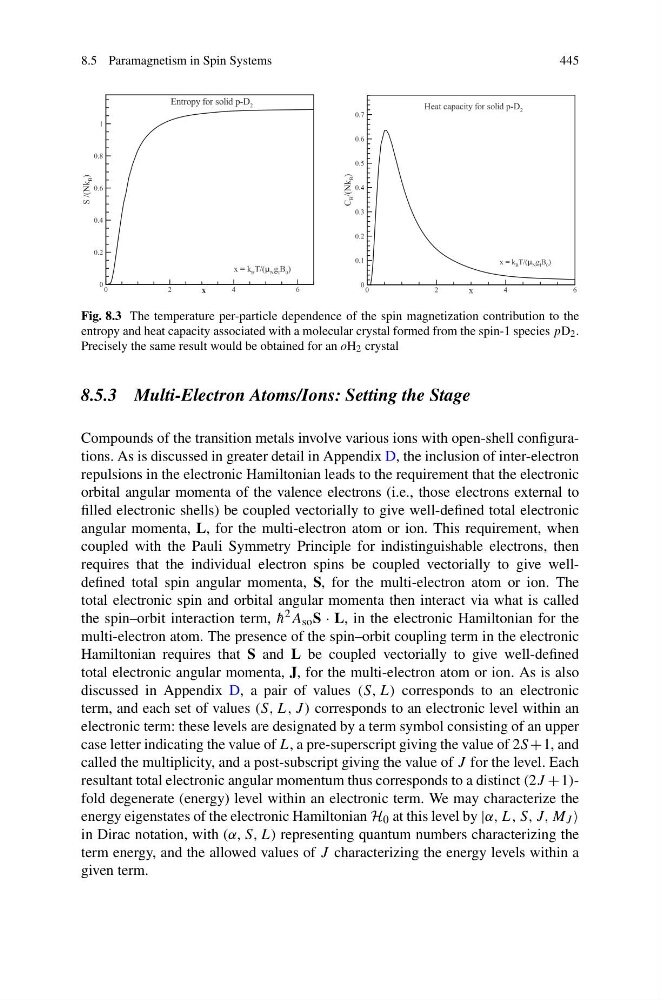
Fig. 8.3 The temperature per-particle dependence of the spin magnetization contribution to the
entropy and heat capacity associated with a molecular crystal formed from the spin-1 species pD 2 .
Precisely the same result would be obtained for an oH 2 crystal
8.5.3 Multi-Electron Atoms/Ions: Setting the Stage
Compounds of the transition metals involve various ions with open-shell configurations. As is discussed in greater detail in Appendix D, the inclusion of inter-electron
repulsions in the electronic Hamiltonian leads to the requirement that the electronic
orbital angular momenta of the valence electrons (i.e., those electrons external to
filled electronic shells) be coupled vectorially to give well-defined total electronic
angular momenta, L, for the multi-electron atom or ion. This requirement, when
coupled with the Pauli Symmetry Principle for indistinguishable electrons, then
requires that the individual electron spins be coupled vectorially to give welldefined total spin angular momenta, S, for the multi-electron atom or ion. The
total electronic spin and orbital angular momenta then interact via what is called
the spin–orbit interaction term, ¯
h 2 A so S · L, in the electronic Hamiltonian for the
multi-electron atom. The presence of the spin–orbit coupling term in the electronic
Hamiltonian requires that S and L be coupled vectorially to give well-defined
total electronic angular momenta, J, for the multi-electron atom or ion. As is also
discussed in Appendix D, a pair of values (S, L) corresponds to an electronic
term, and each set of values (S, L, J ) corresponds to an electronic level within an
electronic term: these levels are designated by a term symbol consisting of an upper
case letter indicating the value of L, a pre-superscript giving the value of 2S +1, and
called the multiplicity, and a post-subscript giving the value of J for the level. Each
resultant total electronic angular momentum thus corresponds to a distinct (2J + 1)fold degenerate (energy) level within an electronic term. We may characterize the
energy eigenstates of the electronic Hamiltonian H 0 at this level by |α, L, S, J, M J
in Dirac notation, with (α, S, L) representing quantum numbers characterizing the
term energy, and the allowed values of J characterizing the energy levels within a
given term.
445
μ
μ
Fig. 8.3 The temperature per-particle dependence of the spin magnetization contribution to the
entropy and heat capacity associated with a molecular crystal formed from the spin-1 species pD 2 .
Precisely the same result would be obtained for an oH 2 crystal
8.5.3 Multi-Electron Atoms/Ions: Setting the Stage
Compounds of the transition metals involve various ions with open-shell configurations. As is discussed in greater detail in Appendix D, the inclusion of inter-electron
repulsions in the electronic Hamiltonian leads to the requirement that the electronic
orbital angular momenta of the valence electrons (i.e., those electrons external to
filled electronic shells) be coupled vectorially to give well-defined total electronic
angular momenta, L, for the multi-electron atom or ion. This requirement, when
coupled with the Pauli Symmetry Principle for indistinguishable electrons, then
requires that the individual electron spins be coupled vectorially to give welldefined total spin angular momenta, S, for the multi-electron atom or ion. The
total electronic spin and orbital angular momenta then interact via what is called
the spin–orbit interaction term, ¯
h 2 A so S · L, in the electronic Hamiltonian for the
multi-electron atom. The presence of the spin–orbit coupling term in the electronic
Hamiltonian requires that S and L be coupled vectorially to give well-defined
total electronic angular momenta, J, for the multi-electron atom or ion. As is also
discussed in Appendix D, a pair of values (S, L) corresponds to an electronic
term, and each set of values (S, L, J ) corresponds to an electronic level within an
electronic term: these levels are designated by a term symbol consisting of an upper
case letter indicating the value of L, a pre-superscript giving the value of 2S +1, and
called the multiplicity, and a post-subscript giving the value of J for the level. Each
resultant total electronic angular momentum thus corresponds to a distinct (2J + 1)fold degenerate (energy) level within an electronic term. We may characterize the
energy eigenstates of the electronic Hamiltonian H 0 at this level by |α, L, S, J, M J
in Dirac notation, with (α, S, L) representing quantum numbers characterizing the
term energy, and the allowed values of J characterizing the energy levels within a
given term.