

8.5 Paramagnetism in Spin Systems
443
p +1 =
e βμB 0
z spin (β)
,
p 0 =
1
z spin (β)
,
p −1 =
e −βμB 0
z spin (β)
.
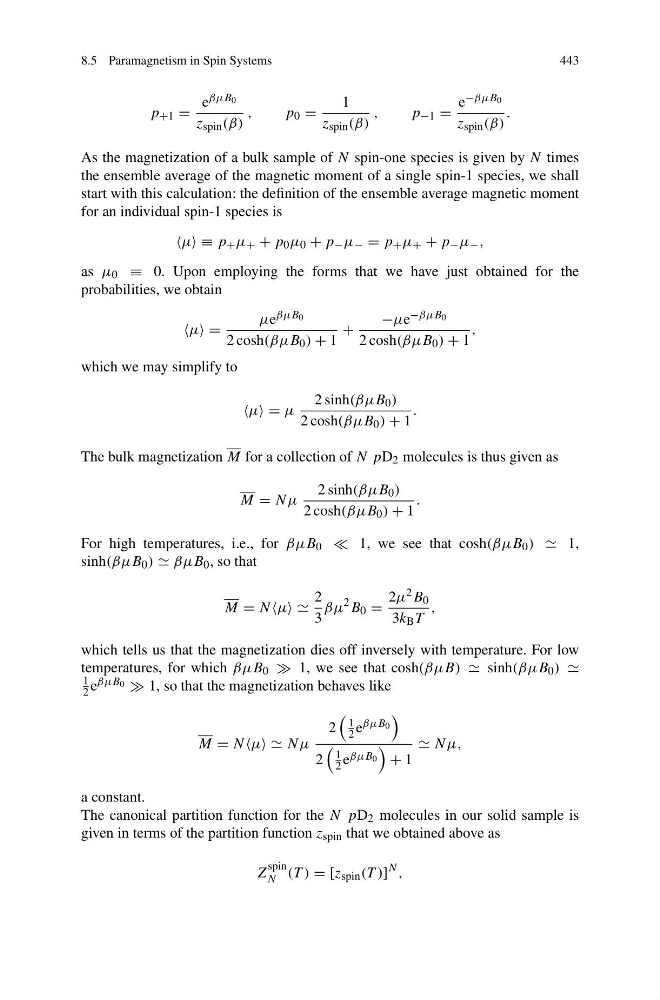
As the magnetization of a bulk sample of N spin-one species is given by N times
the ensemble average of the magnetic moment of a single spin-1 species, we shall
start with this calculation: the definition of the ensemble average magnetic moment
for an individual spin-1 species is
μ ≡ p + μ + + p 0 μ 0 + p − μ − = p + μ + + p − μ − ,
as μ 0 ≡ 0. Upon employing the forms that we have just obtained for the
probabilities, we obtain
μ =
μe βμB 0
2 cosh(βμB 0 ) + 1
+
−μe −βμB 0
2 cosh(βμB 0 ) + 1
,
which we may simplify to
μ = μ
2 sinh(βμB 0 )
2 cosh(βμB 0 ) + 1
.
The bulk magnetization M for a collection of N pD 2 molecules is thus given as
M = Nμ
2 sinh(βμB 0 )
2 cosh(βμB 0 ) + 1
.
For high temperatures, i.e., for βμB 0 1, we see that cosh(βμB 0 ) 1,
sinh(βμB 0 ) βμB 0 , so that
M = Nμ
2
3
βμ
2 B 0 =
2μ 2 B 0
3k B T
,
which tells us that the magnetization dies off inversely with temperature. For low
temperatures, for which βμB 0 1, we see that cosh(βμB) sinh(βμB 0 )
1
2 e βμB 0 1, so that the magnetization behaves like
M = Nμ Nμ
2
1
2 e βμB 0
2
1
2 e βμB 0
+ 1
Nμ,
a constant.
The canonical partition function for the N pD 2 molecules in our solid sample is
given in terms of the partition function z spin that we obtained above as
Z
spin
N (T ) = [z spin (T )]
N ,
443
p +1 =
e βμB 0
z spin (β)
,
p 0 =
1
z spin (β)
,
p −1 =
e −βμB 0
z spin (β)
.
As the magnetization of a bulk sample of N spin-one species is given by N times
the ensemble average of the magnetic moment of a single spin-1 species, we shall
start with this calculation: the definition of the ensemble average magnetic moment
for an individual spin-1 species is
μ ≡ p + μ + + p 0 μ 0 + p − μ − = p + μ + + p − μ − ,
as μ 0 ≡ 0. Upon employing the forms that we have just obtained for the
probabilities, we obtain
μ =
μe βμB 0
2 cosh(βμB 0 ) + 1
+
−μe −βμB 0
2 cosh(βμB 0 ) + 1
,
which we may simplify to
μ = μ
2 sinh(βμB 0 )
2 cosh(βμB 0 ) + 1
.
The bulk magnetization M for a collection of N pD 2 molecules is thus given as
M = Nμ
2 sinh(βμB 0 )
2 cosh(βμB 0 ) + 1
.
For high temperatures, i.e., for βμB 0 1, we see that cosh(βμB 0 ) 1,
sinh(βμB 0 ) βμB 0 , so that
M = Nμ
2
3
βμ
2 B 0 =
2μ 2 B 0
3k B T
,
which tells us that the magnetization dies off inversely with temperature. For low
temperatures, for which βμB 0 1, we see that cosh(βμB) sinh(βμB 0 )
1
2 e βμB 0 1, so that the magnetization behaves like
M = Nμ Nμ
2
1
2 e βμB 0
2
1
2 e βμB 0
+ 1
Nμ,
a constant.
The canonical partition function for the N pD 2 molecules in our solid sample is
given in terms of the partition function z spin that we obtained above as
Z
spin
N (T ) = [z spin (T )]
N ,