

442
8 Electric and Magnetic Phenomena
χ
(m)
T
=
∂M z
∂B 0
T
= N(
1
2 g I μ N )
2 βsech
2 (
1
2 βg I μ N B 0 ),
while expression (8.5.20) gives
χ
(m)
T
=
β
N
(
1
2 g I μ N )
2
[1 − tanh
2 (
1
2 βg I μ N B 0 )]
which, upon application of the identity 1 − tanh
2 x = sech
2 x, gives the same final
result.
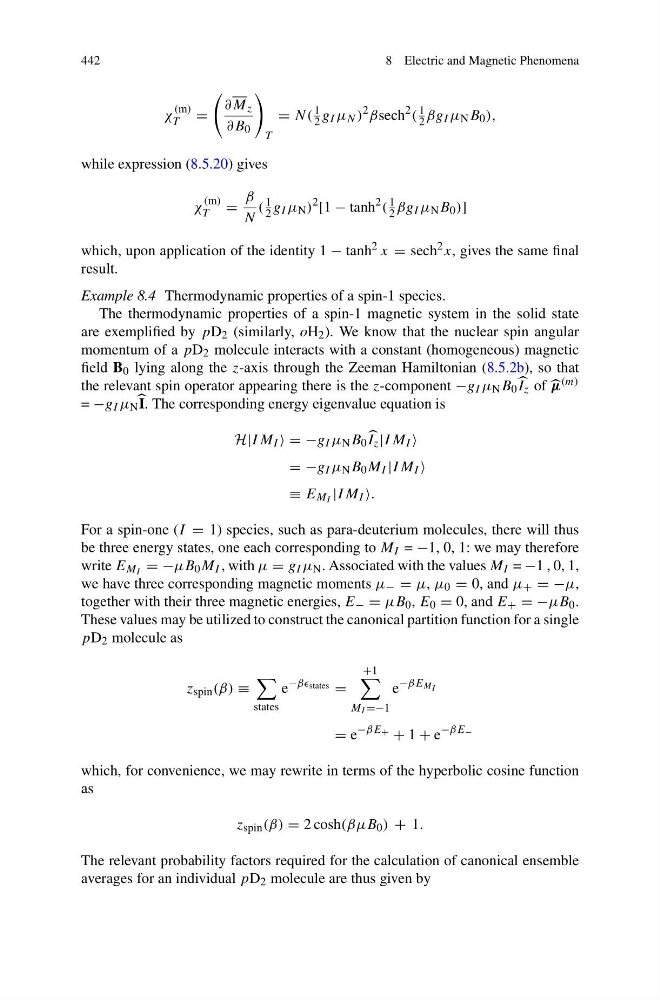
Example 8.4 Thermodynamic properties of a spin-1 species.
The thermodynamic properties of a spin-1 magnetic system in the solid state
are exemplified by pD 2 (similarly, oH 2 ). We know that the nuclear spin angular
momentum of a pD 2 molecule interacts with a constant (homogeneous) magnetic
field B 0 lying along the z-axis through the Zeeman Hamiltonian (8.5.2b), so that
the relevant spin operator appearing there is the z-component −g I μ N B 0
I z of μ (m)
= −g I μ N I. The corresponding energy eigenvalue equation is
H|I M I = −g I μ N B 0
I z |I M I
= −g I μ N B 0 M I |I M I
≡ E M I |I M I .
For a spin-one (I = 1) species, such as para-deuterium molecules, there will thus
be three energy states, one each corresponding to M I = −1, 0, 1: we may therefore
write E M I = −μB 0 M I , with μ = g I μ N . Associated with the values M I = −1 , 0, 1,
we have three corresponding magnetic moments μ − = μ, μ 0 = 0, and μ + = −μ,
together with their three magnetic energies, E − = μB 0 , E 0 = 0, and E + = −μB 0 .
These values may be utilized to construct the canonical partition function for a single
pD 2 molecule as
z spin (β) ≡
states
e
−ββ states =
+1
M I =−1
e
−βE M I
= e
−βE + + 1 + e
−βE −
which, for convenience, we may rewrite in terms of the hyperbolic cosine function
as
z spin (β) = 2 cosh(βμB 0 ) + 1.
The relevant probability factors required for the calculation of canonical ensemble
averages for an individual pD 2 molecule are thus given by
8 Electric and Magnetic Phenomena
χ
(m)
T
=
∂M z
∂B 0
T
= N(
1
2 g I μ N )
2 βsech
2 (
1
2 βg I μ N B 0 ),
while expression (8.5.20) gives
χ
(m)
T
=
β
N
(
1
2 g I μ N )
2
[1 − tanh
2 (
1
2 βg I μ N B 0 )]
which, upon application of the identity 1 − tanh
2 x = sech
2 x, gives the same final
result.
Example 8.4 Thermodynamic properties of a spin-1 species.
The thermodynamic properties of a spin-1 magnetic system in the solid state
are exemplified by pD 2 (similarly, oH 2 ). We know that the nuclear spin angular
momentum of a pD 2 molecule interacts with a constant (homogeneous) magnetic
field B 0 lying along the z-axis through the Zeeman Hamiltonian (8.5.2b), so that
the relevant spin operator appearing there is the z-component −g I μ N B 0
I z of μ (m)
= −g I μ N I. The corresponding energy eigenvalue equation is
H|I M I = −g I μ N B 0
I z |I M I
= −g I μ N B 0 M I |I M I
≡ E M I |I M I .
For a spin-one (I = 1) species, such as para-deuterium molecules, there will thus
be three energy states, one each corresponding to M I = −1, 0, 1: we may therefore
write E M I = −μB 0 M I , with μ = g I μ N . Associated with the values M I = −1 , 0, 1,
we have three corresponding magnetic moments μ − = μ, μ 0 = 0, and μ + = −μ,
together with their three magnetic energies, E − = μB 0 , E 0 = 0, and E + = −μB 0 .
These values may be utilized to construct the canonical partition function for a single
pD 2 molecule as
z spin (β) ≡
states
e
−ββ states =
+1
M I =−1
e
−βE M I
= e
−βE + + 1 + e
−βE −
which, for convenience, we may rewrite in terms of the hyperbolic cosine function
as
z spin (β) = 2 cosh(βμB 0 ) + 1.
The relevant probability factors required for the calculation of canonical ensemble
averages for an individual pD 2 molecule are thus given by