

8.5 Paramagnetism in Spin Systems
441
It may be shown (see Problem 8.5) that the macroscopic magnetic moment of a
magnetizable thermodynamic system may be obtained from the Helmholtz energy
A mag (T , V , B 0 ) given by the Legendre transform
A mag (T , V , B 0 ) = U mag (S, V , M) − T S − B 0 · M
(8.5.17a)
as
M = −
∂A mag
∂B 0
T ,V
.
(8.5.17b)
Thus, we may obtain the magnetic moment M(B, T ) associated with the system of
N spins under consideration here from the fundamental canonical ensemble relation,
A spin (N, T ) = −k B T ln Z spin (N, T ),
in general as
M(B 0 , T ) = Nk B T
∂z spin
∂B 0
T ,V
.
(8.5.18)
More specifically, for an isotropic medium subjected to a uniaxial magnetic field, so
that B 0 , M are collinear and B 0 · M ≡ B 0 M, as
M(B 0 , T ) = Nk B T
1
z spin
∂z spin
∂B 0
T ,V
.
(8.5.19)
We may utilize relation (8.4.8) to obtain a formal expression for χ
(m)
T (N, B, T ) as
χ
(m)
T (N, B, T ) = Nk B T
−
1
z 2
spin
∂z spin
∂B 0
2
+
1
z spin
∂ 2 z spin
∂B 2
0
.
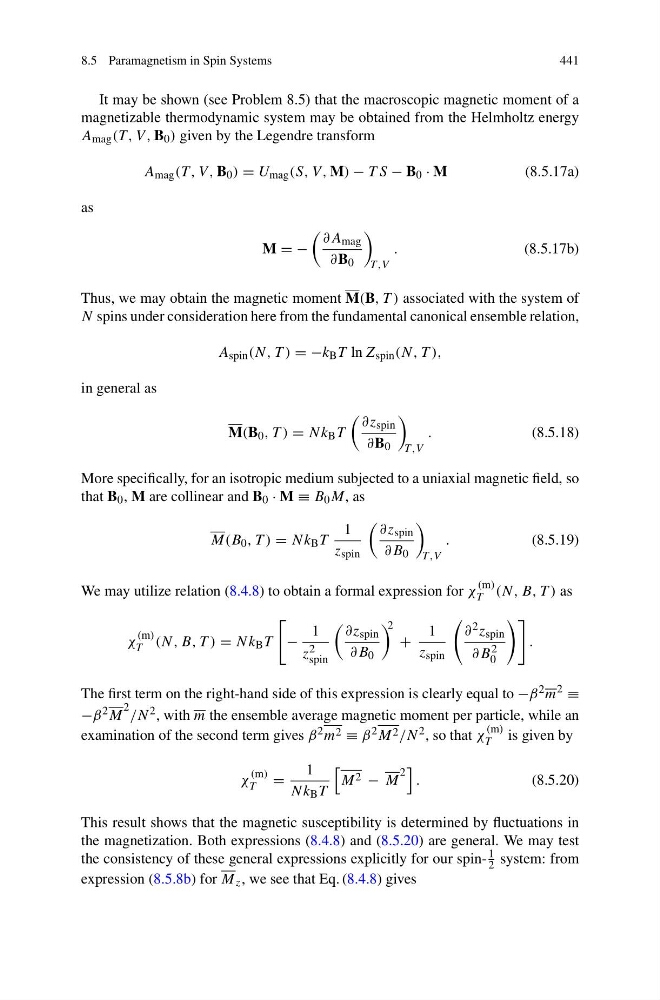
The first term on the right-hand side of this expression is clearly equal to −β 2 m
2
≡
−β 2 M
2 /N 2 , with m the ensemble average magnetic moment per particle, while an
examination of the second term gives β 2 m 2 ≡ β 2 M 2 /N 2 , so that χ
(m)
T
is given by
χ
(m)
T
=
1
Nk B T
M 2 − M
2
.
(8.5.20)
This result shows that the magnetic susceptibility is determined by fluctuations in
the magnetization. Both expressions (8.4.8) and (8.5.20) are general. We may test
the consistency of these general expressions explicitly for our spin1
2 system: from
expression (8.5.8b) for M z , we see that Eq. (8.4.8) gives
441
It may be shown (see Problem 8.5) that the macroscopic magnetic moment of a
magnetizable thermodynamic system may be obtained from the Helmholtz energy
A mag (T , V , B 0 ) given by the Legendre transform
A mag (T , V , B 0 ) = U mag (S, V , M) − T S − B 0 · M
(8.5.17a)
as
M = −
∂A mag
∂B 0
T ,V
.
(8.5.17b)
Thus, we may obtain the magnetic moment M(B, T ) associated with the system of
N spins under consideration here from the fundamental canonical ensemble relation,
A spin (N, T ) = −k B T ln Z spin (N, T ),
in general as
M(B 0 , T ) = Nk B T
∂z spin
∂B 0
T ,V
.
(8.5.18)
More specifically, for an isotropic medium subjected to a uniaxial magnetic field, so
that B 0 , M are collinear and B 0 · M ≡ B 0 M, as
M(B 0 , T ) = Nk B T
1
z spin
∂z spin
∂B 0
T ,V
.
(8.5.19)
We may utilize relation (8.4.8) to obtain a formal expression for χ
(m)
T (N, B, T ) as
χ
(m)
T (N, B, T ) = Nk B T
−
1
z 2
spin
∂z spin
∂B 0
2
+
1
z spin
∂ 2 z spin
∂B 2
0
.
The first term on the right-hand side of this expression is clearly equal to −β 2 m
2
≡
−β 2 M
2 /N 2 , with m the ensemble average magnetic moment per particle, while an
examination of the second term gives β 2 m 2 ≡ β 2 M 2 /N 2 , so that χ
(m)
T
is given by
χ
(m)
T
=
1
Nk B T
M 2 − M
2
.
(8.5.20)
This result shows that the magnetic susceptibility is determined by fluctuations in
the magnetization. Both expressions (8.4.8) and (8.5.20) are general. We may test
the consistency of these general expressions explicitly for our spin1
2 system: from
expression (8.5.8b) for M z , we see that Eq. (8.4.8) gives