

440
8 Electric and Magnetic Phenomena
0
2
4
6
8
10
0
0.1
0.2
0.3
0.4
0.5
0.6
0.7
k B T/(μ N g I B 0 )
Property
S/(Nk B )
C B /(Nk B )
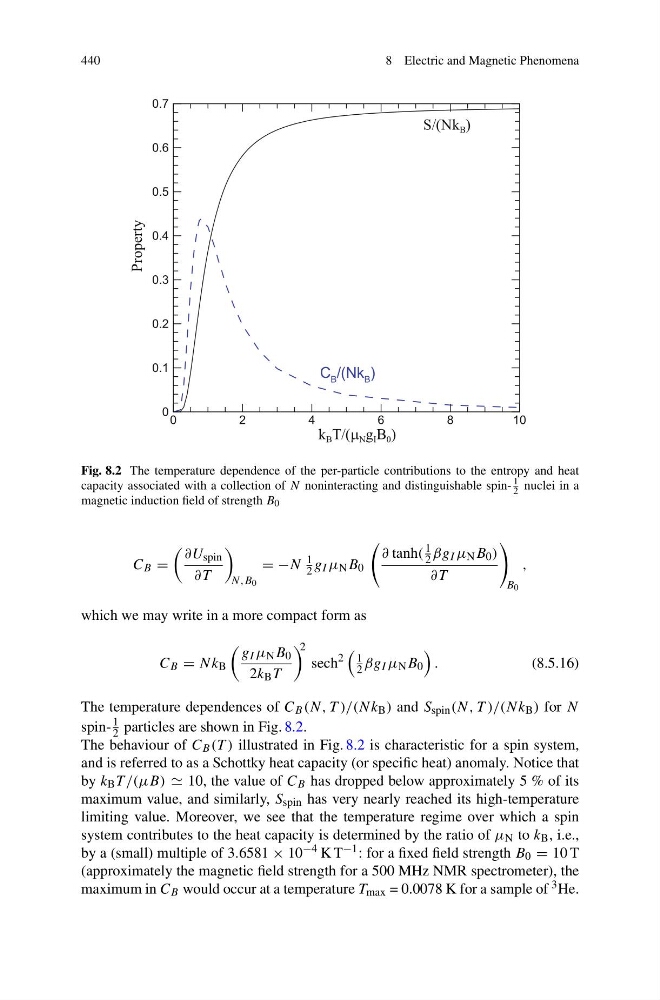
Fig. 8.2 The temperature dependence of the per-particle contributions to the entropy and heat
capacity associated with a collection of N noninteracting and distinguishable spin1
2 nuclei in a
magnetic induction field of strength B 0
C B =
∂U spin
∂T
N,B 0
= −N
1
2 g I μ N B 0
∂ tanh(
1
2 βg I μ N B 0 )
∂T
B 0
,
which we may write in a more compact form as
C B = Nk B
g I μ N B 0
2k B T
2
sech
2
1
2 βg I μ N B 0
.
(8.5.16)
The temperature dependences of C B (N, T )/(Nk B ) and S spin (N, T )/(Nk B ) for N
spin1
2 particles are shown in Fig. 8.2.
The behaviour of C B (T ) illustrated in Fig. 8.2 is characteristic for a spin system,
and is referred to as a Schottky heat capacity (or specific heat) anomaly. Notice that
by k B T /(μB) 10, the value of C B has dropped below approximately 5 % of its
maximum value, and similarly, S spin has very nearly reached its high-temperature
limiting value. Moreover, we see that the temperature regime over which a spin
system contributes to the heat capacity is determined by the ratio of μ N to k B , i.e.,
by a (small) multiple of 3.6581 × 10 −4 K T −1 : for a fixed field strength B 0 = 10 T
(approximately the magnetic field strength for a 500 MHz NMR spectrometer), the
maximum in C B would occur at a temperature T max = 0.0078 K for a sample of 3 He.
8 Electric and Magnetic Phenomena
0
2
4
6
8
10
0
0.1
0.2
0.3
0.4
0.5
0.6
0.7
k B T/(μ N g I B 0 )
Property
S/(Nk B )
C B /(Nk B )
Fig. 8.2 The temperature dependence of the per-particle contributions to the entropy and heat
capacity associated with a collection of N noninteracting and distinguishable spin1
2 nuclei in a
magnetic induction field of strength B 0
C B =
∂U spin
∂T
N,B 0
= −N
1
2 g I μ N B 0
∂ tanh(
1
2 βg I μ N B 0 )
∂T
B 0
,
which we may write in a more compact form as
C B = Nk B
g I μ N B 0
2k B T
2
sech
2
1
2 βg I μ N B 0
.
(8.5.16)
The temperature dependences of C B (N, T )/(Nk B ) and S spin (N, T )/(Nk B ) for N
spin1
2 particles are shown in Fig. 8.2.
The behaviour of C B (T ) illustrated in Fig. 8.2 is characteristic for a spin system,
and is referred to as a Schottky heat capacity (or specific heat) anomaly. Notice that
by k B T /(μB) 10, the value of C B has dropped below approximately 5 % of its
maximum value, and similarly, S spin has very nearly reached its high-temperature
limiting value. Moreover, we see that the temperature regime over which a spin
system contributes to the heat capacity is determined by the ratio of μ N to k B , i.e.,
by a (small) multiple of 3.6581 × 10 −4 K T −1 : for a fixed field strength B 0 = 10 T
(approximately the magnetic field strength for a 500 MHz NMR spectrometer), the
maximum in C B would occur at a temperature T max = 0.0078 K for a sample of 3 He.