

8.5 Paramagnetism in Spin Systems
439
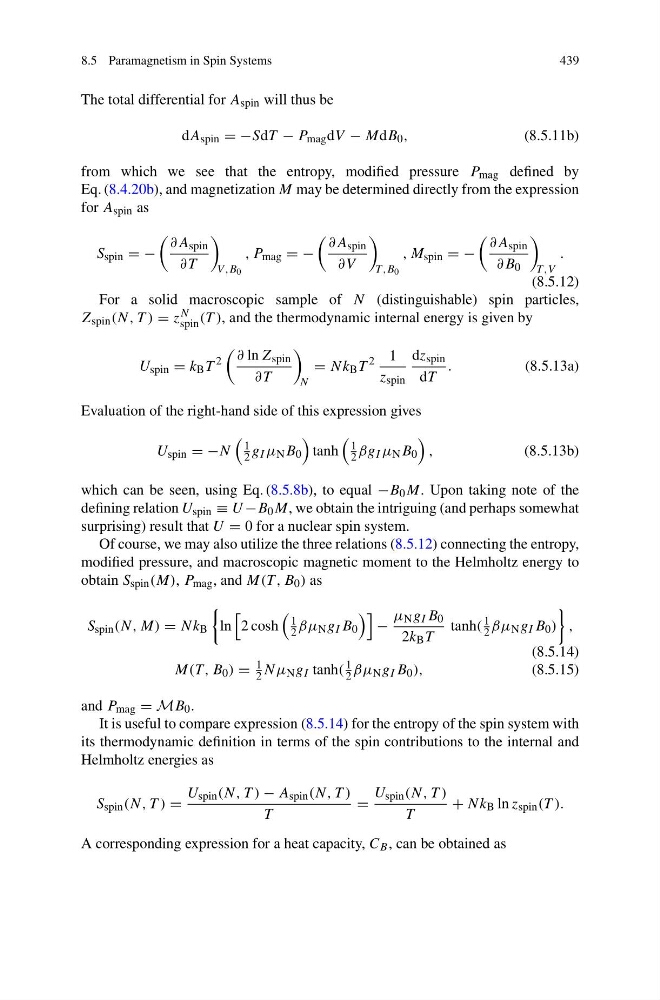
The total differential for A spin will thus be
dA spin = −SdT − P mag dV − MdB 0 ,
(8.5.11b)
from which we see that the entropy, modified pressure P mag defined by
Eq. (8.4.20b), and magnetization M may be determined directly from the expression
for A spin as
S spin = −
∂A spin
∂T
V ,B 0
, P mag = −
∂A spin
∂V
T ,B 0
, M spin = −
∂A spin
∂B 0
T ,V
.
(8.5.12)
For a solid macroscopic sample of N (distinguishable) spin particles,
Z spin (N, T ) = z N
spin (T ), and the thermodynamic internal energy is given by
U spin = k B T
2
∂ ln Z spin
∂T
N
= Nk B T
2 1
z spin
dz spin
dT
.
(8.5.13a)
Evaluation of the right-hand side of this expression gives
U spin = −N
1
2 g I μ N B 0
tanh
1
2 βg I μ N B 0
,
(8.5.13b)
which can be seen, using Eq. (8.5.8b), to equal −B 0 M. Upon taking note of the
defining relation U spin ≡ U −B 0 M, we obtain the intriguing (and perhaps somewhat
surprising) result that U = 0 for a nuclear spin system.
Of course, we may also utilize the three relations (8.5.12) connecting the entropy,
modified pressure, and macroscopic magnetic moment to the Helmholtz energy to
obtain S spin (M), P mag , and M(T , B 0 ) as
S spin (N, M) = Nk B
ln
2 cosh
1
2 βμ N g I B 0
−
μ N g I B 0
2k B T
tanh(
1
2 βμ N g I B 0 )
,
(8.5.14)
M(T , B 0 ) =
1
2 Nμ N g I tanh(
1
2 βμ N g I B 0 ),
(8.5.15)
and P mag = MB 0 .
It is useful to compare expression (8.5.14) for the entropy of the spin system with
its thermodynamic definition in terms of the spin contributions to the internal and
Helmholtz energies as
S spin (N, T ) =
U spin (N, T ) − A spin (N, T )
T
=
U spin (N, T )
T
+ Nk B ln z spin (T ).
A corresponding expression for a heat capacity, C B , can be obtained as
439
The total differential for A spin will thus be
dA spin = −SdT − P mag dV − MdB 0 ,
(8.5.11b)
from which we see that the entropy, modified pressure P mag defined by
Eq. (8.4.20b), and magnetization M may be determined directly from the expression
for A spin as
S spin = −
∂A spin
∂T
V ,B 0
, P mag = −
∂A spin
∂V
T ,B 0
, M spin = −
∂A spin
∂B 0
T ,V
.
(8.5.12)
For a solid macroscopic sample of N (distinguishable) spin particles,
Z spin (N, T ) = z N
spin (T ), and the thermodynamic internal energy is given by
U spin = k B T
2
∂ ln Z spin
∂T
N
= Nk B T
2 1
z spin
dz spin
dT
.
(8.5.13a)
Evaluation of the right-hand side of this expression gives
U spin = −N
1
2 g I μ N B 0
tanh
1
2 βg I μ N B 0
,
(8.5.13b)
which can be seen, using Eq. (8.5.8b), to equal −B 0 M. Upon taking note of the
defining relation U spin ≡ U −B 0 M, we obtain the intriguing (and perhaps somewhat
surprising) result that U = 0 for a nuclear spin system.
Of course, we may also utilize the three relations (8.5.12) connecting the entropy,
modified pressure, and macroscopic magnetic moment to the Helmholtz energy to
obtain S spin (M), P mag , and M(T , B 0 ) as
S spin (N, M) = Nk B
ln
2 cosh
1
2 βμ N g I B 0
−
μ N g I B 0
2k B T
tanh(
1
2 βμ N g I B 0 )
,
(8.5.14)
M(T , B 0 ) =
1
2 Nμ N g I tanh(
1
2 βμ N g I B 0 ),
(8.5.15)
and P mag = MB 0 .
It is useful to compare expression (8.5.14) for the entropy of the spin system with
its thermodynamic definition in terms of the spin contributions to the internal and
Helmholtz energies as
S spin (N, T ) =
U spin (N, T ) − A spin (N, T )
T
=
U spin (N, T )
T
+ Nk B ln z spin (T ).
A corresponding expression for a heat capacity, C B , can be obtained as