

8.5 Paramagnetism in Spin Systems
435
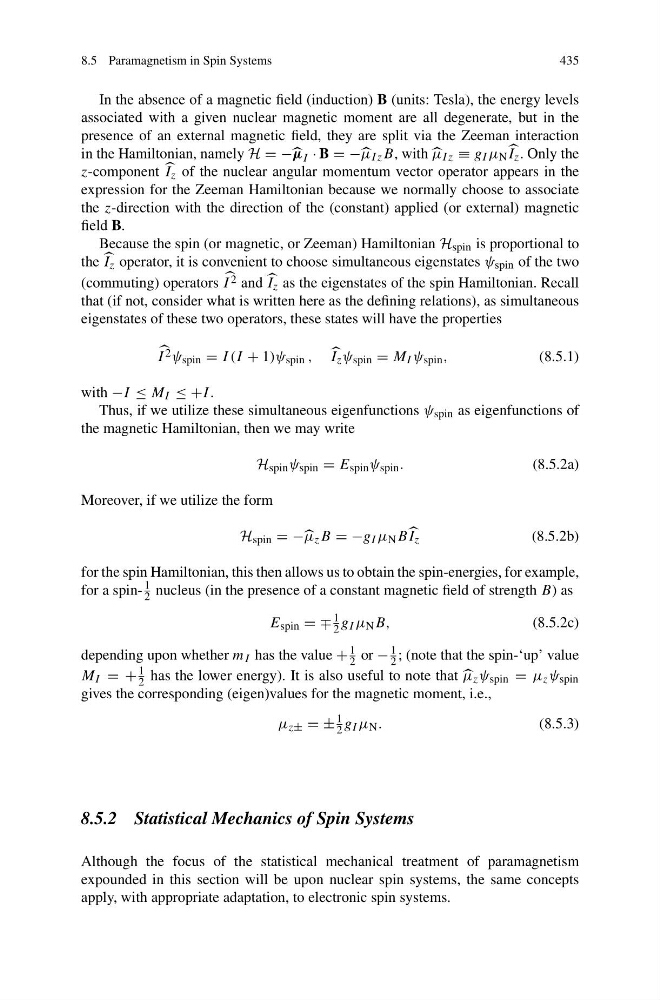
In the absence of a magnetic field (induction) B (units: Tesla), the energy levels
associated with a given nuclear magnetic moment are all degenerate, but in the
presence of an external magnetic field, they are split via the Zeeman interaction
in the Hamiltonian, namely H = − μ I · B = − μ I z B, with μ I z ≡ g I μ N
I z . Only the
z-component
I z of the nuclear angular momentum vector operator appears in the
expression for the Zeeman Hamiltonian because we normally choose to associate
the z-direction with the direction of the (constant) applied (or external) magnetic
field B.
Because the spin (or magnetic, or Zeeman) Hamiltonian H spin is proportional to
the
I z operator, it is convenient to choose simultaneous eigenstates ψ spin of the two
(commuting) operators
I 2 and
I z as the eigenstates of the spin Hamiltonian. Recall
that (if not, consider what is written here as the defining relations), as simultaneous
eigenstates of these two operators, these states will have the properties
I 2 ψ spin = I (I + 1)ψ spin ,
I z ψ spin = M I ψ spin ,
(8.5.1)
with −I ≤ M I ≤ +I .
Thus, if we utilize these simultaneous eigenfunctions ψ spin as eigenfunctions of
the magnetic Hamiltonian, then we may write
H spin ψ spin = E spin ψ spin .
(8.5.2a)
Moreover, if we utilize the form
H spin = − μ z B = −g I μ N B
I z
(8.5.2b)
for the spin Hamiltonian, this then allows us to obtain the spin-energies, for example,
for a spin1
2 nucleus (in the presence of a constant magnetic field of strength B) as
E spin = ∓
1
2 g I μ N B,
(8.5.2c)
depending upon whether m I has the value +
1
2 or −
1
2 ; (note that the spin-‘up’ value
M I = +
1
2 has the lower energy). It is also useful to note that μ z ψ spin = μ z ψ spin
gives the corresponding (eigen)values for the magnetic moment, i.e.,
μ z± = ±
1
2 g I μ N .
(8.5.3)
8.5.2 Statistical Mechanics of Spin Systems
Although the focus of the statistical mechanical treatment of paramagnetism
expounded in this section will be upon nuclear spin systems, the same concepts
apply, with appropriate adaptation, to electronic spin systems.
435
In the absence of a magnetic field (induction) B (units: Tesla), the energy levels
associated with a given nuclear magnetic moment are all degenerate, but in the
presence of an external magnetic field, they are split via the Zeeman interaction
in the Hamiltonian, namely H = − μ I · B = − μ I z B, with μ I z ≡ g I μ N
I z . Only the
z-component
I z of the nuclear angular momentum vector operator appears in the
expression for the Zeeman Hamiltonian because we normally choose to associate
the z-direction with the direction of the (constant) applied (or external) magnetic
field B.
Because the spin (or magnetic, or Zeeman) Hamiltonian H spin is proportional to
the
I z operator, it is convenient to choose simultaneous eigenstates ψ spin of the two
(commuting) operators
I 2 and
I z as the eigenstates of the spin Hamiltonian. Recall
that (if not, consider what is written here as the defining relations), as simultaneous
eigenstates of these two operators, these states will have the properties
I 2 ψ spin = I (I + 1)ψ spin ,
I z ψ spin = M I ψ spin ,
(8.5.1)
with −I ≤ M I ≤ +I .
Thus, if we utilize these simultaneous eigenfunctions ψ spin as eigenfunctions of
the magnetic Hamiltonian, then we may write
H spin ψ spin = E spin ψ spin .
(8.5.2a)
Moreover, if we utilize the form
H spin = − μ z B = −g I μ N B
I z
(8.5.2b)
for the spin Hamiltonian, this then allows us to obtain the spin-energies, for example,
for a spin1
2 nucleus (in the presence of a constant magnetic field of strength B) as
E spin = ∓
1
2 g I μ N B,
(8.5.2c)
depending upon whether m I has the value +
1
2 or −
1
2 ; (note that the spin-‘up’ value
M I = +
1
2 has the lower energy). It is also useful to note that μ z ψ spin = μ z ψ spin
gives the corresponding (eigen)values for the magnetic moment, i.e.,
μ z± = ±
1
2 g I μ N .
(8.5.3)
8.5.2 Statistical Mechanics of Spin Systems
Although the focus of the statistical mechanical treatment of paramagnetism
expounded in this section will be upon nuclear spin systems, the same concepts
apply, with appropriate adaptation, to electronic spin systems.