

436
8 Electric and Magnetic Phenomena
Much of the behaviours characterizing spin systems can be illustrated by an
examination of the simplest exemplar of a spin system, namely a spin1
2 species,
such as a 3 He or 129 Xe atom, 3 which has nuclear spin angular momentum I of
magnitude
√
3
2 ¯
h, corresponding to the nuclear angular momentum quantum number
I =
1
2 . We may use the results obtained in Sect. 8.5.1 to treat such a system.
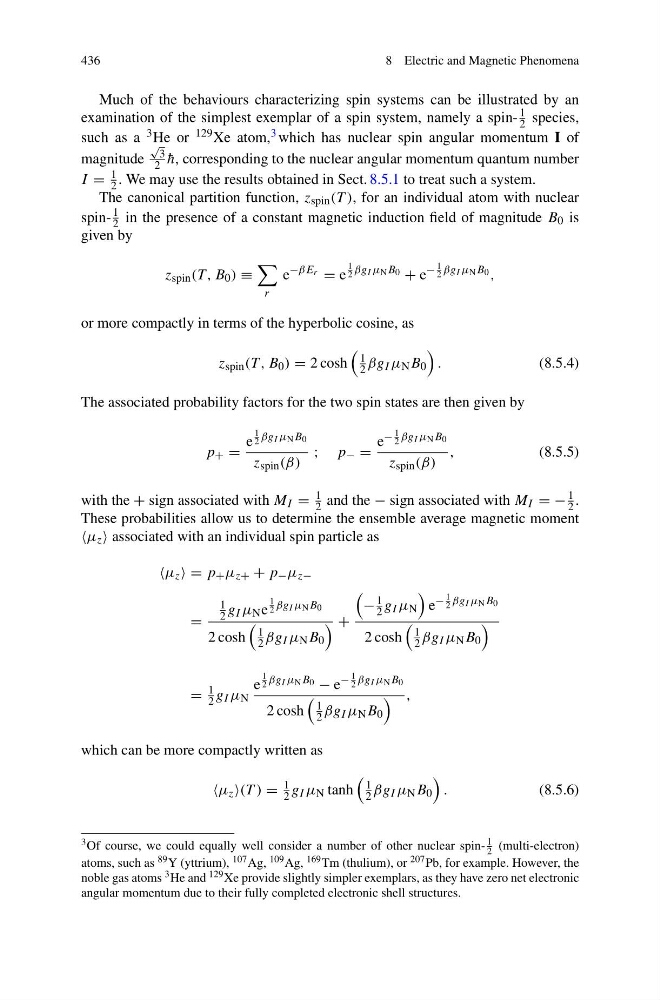
The canonical partition function, z spin (T ), for an individual atom with nuclear
spin1
2 in the presence of a constant magnetic induction field of magnitude B 0 is
given by
z spin (T , B 0 ) ≡
r
e
−βE r = e
1
2 βg I μ N B 0 + e
−
1
2 βg I μ N B 0 ,
or more compactly in terms of the hyperbolic cosine, as
z spin (T , B 0 ) = 2 cosh
1
2 βg I μ N B 0
.
(8.5.4)
The associated probability factors for the two spin states are then given by
p + =
e
1
2 βg I μ N B 0
z spin (β)
; p − =
e
−
1
2 βg I μ N B 0
z spin (β)
,
(8.5.5)
with the + sign associated with M I =
1
2 and the − sign associated with M I = −
1
2 .
These probabilities allow us to determine the ensemble average magnetic moment
μ z associated with an individual spin particle as
μ z = p + μ z+ + p − μ z−
=
1
2 g I μ N e
1
2 βg I μ N B 0
2 cosh
1
2 βg I μ N B 0
+
−
1
2 g I μ N
e
−
1
2 βg I μ N B 0
2 cosh
1
2 βg I μ N B 0
=
1
2 g I μ N
e
1
2 βg I μ N B 0 − e
−
1
2 βg I μ N B 0
2 cosh
1
2 βg I μ N B 0
,
which can be more compactly written as
μ z (T ) =
1
2 g I μ N tanh
1
2 βg I μ N B 0
.
(8.5.6)
3 Of course, we could equally well consider a number of other nuclear spin1
2 (multi-electron)
atoms, such as 89 Y (yttrium), 107 Ag, 109 Ag, 169 Tm (thulium), or 207 Pb, for example. However, the
noble gas atoms 3 He and 129 Xe provide slightly simpler exemplars, as they have zero net electronic
angular momentum due to their fully completed electronic shell structures.
8 Electric and Magnetic Phenomena
Much of the behaviours characterizing spin systems can be illustrated by an
examination of the simplest exemplar of a spin system, namely a spin1
2 species,
such as a 3 He or 129 Xe atom, 3 which has nuclear spin angular momentum I of
magnitude
√
3
2 ¯
h, corresponding to the nuclear angular momentum quantum number
I =
1
2 . We may use the results obtained in Sect. 8.5.1 to treat such a system.
The canonical partition function, z spin (T ), for an individual atom with nuclear
spin1
2 in the presence of a constant magnetic induction field of magnitude B 0 is
given by
z spin (T , B 0 ) ≡
r
e
−βE r = e
1
2 βg I μ N B 0 + e
−
1
2 βg I μ N B 0 ,
or more compactly in terms of the hyperbolic cosine, as
z spin (T , B 0 ) = 2 cosh
1
2 βg I μ N B 0
.
(8.5.4)
The associated probability factors for the two spin states are then given by
p + =
e
1
2 βg I μ N B 0
z spin (β)
; p − =
e
−
1
2 βg I μ N B 0
z spin (β)
,
(8.5.5)
with the + sign associated with M I =
1
2 and the − sign associated with M I = −
1
2 .
These probabilities allow us to determine the ensemble average magnetic moment
μ z associated with an individual spin particle as
μ z = p + μ z+ + p − μ z−
=
1
2 g I μ N e
1
2 βg I μ N B 0
2 cosh
1
2 βg I μ N B 0
+
−
1
2 g I μ N
e
−
1
2 βg I μ N B 0
2 cosh
1
2 βg I μ N B 0
=
1
2 g I μ N
e
1
2 βg I μ N B 0 − e
−
1
2 βg I μ N B 0
2 cosh
1
2 βg I μ N B 0
,
which can be more compactly written as
μ z (T ) =
1
2 g I μ N tanh
1
2 βg I μ N B 0
.
(8.5.6)
3 Of course, we could equally well consider a number of other nuclear spin1
2 (multi-electron)
atoms, such as 89 Y (yttrium), 107 Ag, 109 Ag, 169 Tm (thulium), or 207 Pb, for example. However, the
noble gas atoms 3 He and 129 Xe provide slightly simpler exemplars, as they have zero net electronic
angular momentum due to their fully completed electronic shell structures.