

434
8 Electric and Magnetic Phenomena
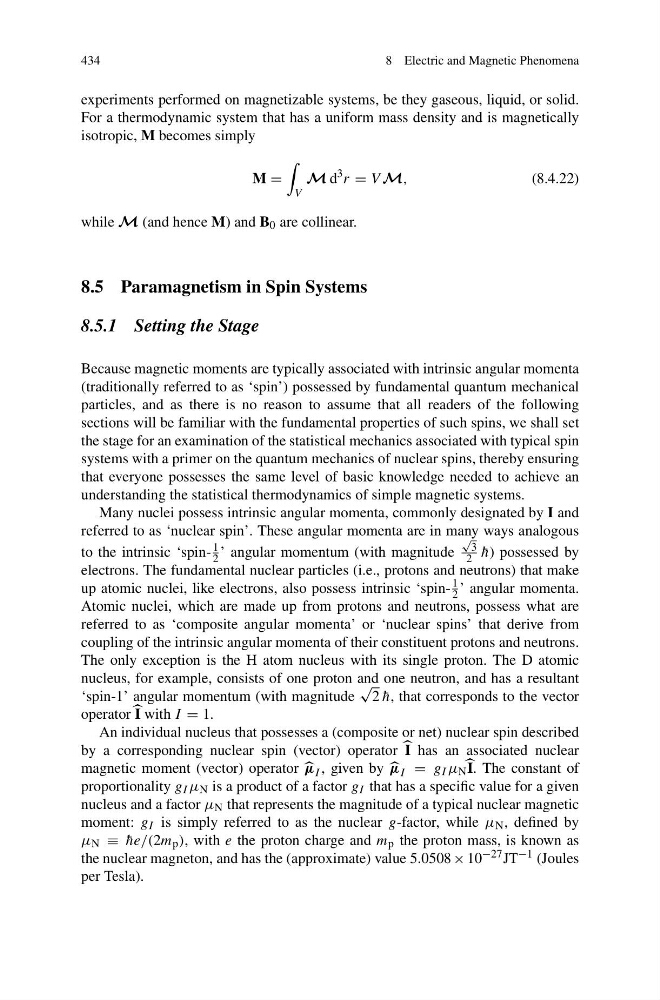
experiments performed on magnetizable systems, be they gaseous, liquid, or solid.
For a thermodynamic system that has a uniform mass density and is magnetically
isotropic, M becomes simply
M =
V
M d
3 r = V M,
(8.4.22)
while M (and hence M) and B 0 are collinear.
8.5 Paramagnetism in Spin Systems
8.5.1 Setting the Stage
Because magnetic moments are typically associated with intrinsic angular momenta
(traditionally referred to as ‘spin’) possessed by fundamental quantum mechanical
particles, and as there is no reason to assume that all readers of the following
sections will be familiar with the fundamental properties of such spins, we shall set
the stage for an examination of the statistical mechanics associated with typical spin
systems with a primer on the quantum mechanics of nuclear spins, thereby ensuring
that everyone possesses the same level of basic knowledge needed to achieve an
understanding the statistical thermodynamics of simple magnetic systems.
Many nuclei possess intrinsic angular momenta, commonly designated by I and
referred to as ‘nuclear spin’. These angular momenta are in many ways analogous
to the intrinsic ‘spin1
2 ’ angular momentum (with magnitude
√
3
2 ¯
h) possessed by
electrons. The fundamental nuclear particles (i.e., protons and neutrons) that make
up atomic nuclei, like electrons, also possess intrinsic ‘spin1
2 ’ angular momenta.
Atomic nuclei, which are made up from protons and neutrons, possess what are
referred to as ‘composite angular momenta’ or ‘nuclear spins’ that derive from
coupling of the intrinsic angular momenta of their constituent protons and neutrons.
The only exception is the H atom nucleus with its single proton. The D atomic
nucleus, for example, consists of one proton and one neutron, and has a resultant
‘spin-1’ angular momentum (with magnitude
√
2 ¯
h, that corresponds to the vector
operator I with I = 1.
An individual nucleus that possesses a (composite or net) nuclear spin described
by a corresponding nuclear spin (vector) operator I has an associated nuclear
magnetic moment (vector) operator μ I , given by μ I = g I μ N I. The constant of
proportionality g I μ N is a product of a factor g I that has a specific value for a given
nucleus and a factor μ N that represents the magnitude of a typical nuclear magnetic
moment: g I is simply referred to as the nuclear g-factor, while μ N , defined by
μ N ≡ ¯
he/(2m p ), with e the proton charge and m p the proton mass, is known as
the nuclear magneton, and has the (approximate) value 5.0508 × 10 −27 JT −1 (Joules
per Tesla).
8 Electric and Magnetic Phenomena
experiments performed on magnetizable systems, be they gaseous, liquid, or solid.
For a thermodynamic system that has a uniform mass density and is magnetically
isotropic, M becomes simply
M =
V
M d
3 r = V M,
(8.4.22)
while M (and hence M) and B 0 are collinear.
8.5 Paramagnetism in Spin Systems
8.5.1 Setting the Stage
Because magnetic moments are typically associated with intrinsic angular momenta
(traditionally referred to as ‘spin’) possessed by fundamental quantum mechanical
particles, and as there is no reason to assume that all readers of the following
sections will be familiar with the fundamental properties of such spins, we shall set
the stage for an examination of the statistical mechanics associated with typical spin
systems with a primer on the quantum mechanics of nuclear spins, thereby ensuring
that everyone possesses the same level of basic knowledge needed to achieve an
understanding the statistical thermodynamics of simple magnetic systems.
Many nuclei possess intrinsic angular momenta, commonly designated by I and
referred to as ‘nuclear spin’. These angular momenta are in many ways analogous
to the intrinsic ‘spin1
2 ’ angular momentum (with magnitude
√
3
2 ¯
h) possessed by
electrons. The fundamental nuclear particles (i.e., protons and neutrons) that make
up atomic nuclei, like electrons, also possess intrinsic ‘spin1
2 ’ angular momenta.
Atomic nuclei, which are made up from protons and neutrons, possess what are
referred to as ‘composite angular momenta’ or ‘nuclear spins’ that derive from
coupling of the intrinsic angular momenta of their constituent protons and neutrons.
The only exception is the H atom nucleus with its single proton. The D atomic
nucleus, for example, consists of one proton and one neutron, and has a resultant
‘spin-1’ angular momentum (with magnitude
√
2 ¯
h, that corresponds to the vector
operator I with I = 1.
An individual nucleus that possesses a (composite or net) nuclear spin described
by a corresponding nuclear spin (vector) operator I has an associated nuclear
magnetic moment (vector) operator μ I , given by μ I = g I μ N I. The constant of
proportionality g I μ N is a product of a factor g I that has a specific value for a given
nucleus and a factor μ N that represents the magnitude of a typical nuclear magnetic
moment: g I is simply referred to as the nuclear g-factor, while μ N , defined by
μ N ≡ ¯
he/(2m p ), with e the proton charge and m p the proton mass, is known as
the nuclear magneton, and has the (approximate) value 5.0508 × 10 −27 JT −1 (Joules
per Tesla).