

8.4 Magnetism, I. Paramagnetism
433
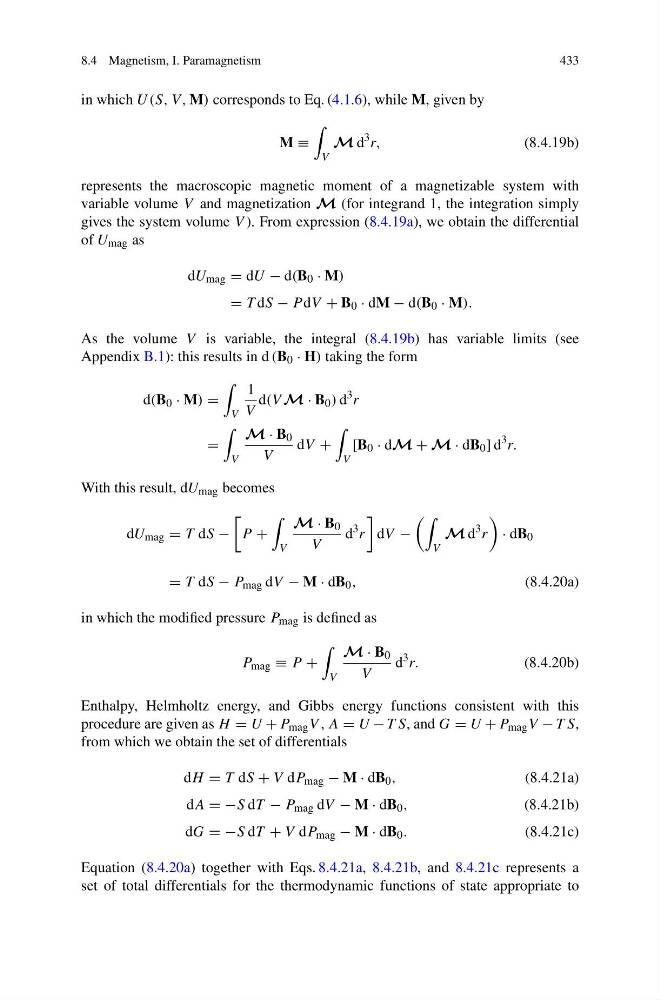
in which U(S, V , M) corresponds to Eq. (4.1.6), while M, given by
M ≡
V
M d
3 r,
(8.4.19b)
represents the macroscopic magnetic moment of a magnetizable system with
variable volume V and magnetization M (for integrand 1, the integration simply
gives the system volume V ). From expression (8.4.19a), we obtain the differential
of U mag as
dU mag = dU − d(B 0 · M)
= T dS − P dV + B 0 · dM − d(B 0 · M).
As the volume V is variable, the integral (8.4.19b) has variable limits (see
Appendix B.1): this results in d (B 0 · H) taking the form
d(B 0 · M) =
V
1
V
d(V M · B 0 ) d
3 r
=
V
M · B 0
V
dV +
V
[B 0 · dM + M · dB 0 ] d
3 r.
With this result, dU mag becomes
dU mag = T dS −
P +
V
M · B 0
V
d
3 r
dV −
V
M d
3 r
· dB 0
= T dS − P mag dV − M · dB 0 ,
(8.4.20a)
in which the modified pressure P mag is defined as
P mag ≡ P +
V
M · B 0
V
d
3 r.
(8.4.20b)
Enthalpy, Helmholtz energy, and Gibbs energy functions consistent with this
procedure are given as H = U + P mag V , A = U − T S, and G = U + P mag V − T S,
from which we obtain the set of differentials
dH = T dS + V dP mag − M · dB 0 ,
(8.4.21a)
dA = −S dT − P mag dV − M · dB 0 ,
(8.4.21b)
dG = −S dT + V dP mag − M · dB 0 .
(8.4.21c)
Equation (8.4.20a) together with Eqs. 8.4.21a, 8.4.21b, and 8.4.21c represents a
set of total differentials for the thermodynamic functions of state appropriate to
433
in which U(S, V , M) corresponds to Eq. (4.1.6), while M, given by
M ≡
V
M d
3 r,
(8.4.19b)
represents the macroscopic magnetic moment of a magnetizable system with
variable volume V and magnetization M (for integrand 1, the integration simply
gives the system volume V ). From expression (8.4.19a), we obtain the differential
of U mag as
dU mag = dU − d(B 0 · M)
= T dS − P dV + B 0 · dM − d(B 0 · M).
As the volume V is variable, the integral (8.4.19b) has variable limits (see
Appendix B.1): this results in d (B 0 · H) taking the form
d(B 0 · M) =
V
1
V
d(V M · B 0 ) d
3 r
=
V
M · B 0
V
dV +
V
[B 0 · dM + M · dB 0 ] d
3 r.
With this result, dU mag becomes
dU mag = T dS −
P +
V
M · B 0
V
d
3 r
dV −
V
M d
3 r
· dB 0
= T dS − P mag dV − M · dB 0 ,
(8.4.20a)
in which the modified pressure P mag is defined as
P mag ≡ P +
V
M · B 0
V
d
3 r.
(8.4.20b)
Enthalpy, Helmholtz energy, and Gibbs energy functions consistent with this
procedure are given as H = U + P mag V , A = U − T S, and G = U + P mag V − T S,
from which we obtain the set of differentials
dH = T dS + V dP mag − M · dB 0 ,
(8.4.21a)
dA = −S dT − P mag dV − M · dB 0 ,
(8.4.21b)
dG = −S dT + V dP mag − M · dB 0 .
(8.4.21c)
Equation (8.4.20a) together with Eqs. 8.4.21a, 8.4.21b, and 8.4.21c represents a
set of total differentials for the thermodynamic functions of state appropriate to