

430
8 Electric and Magnetic Phenomena
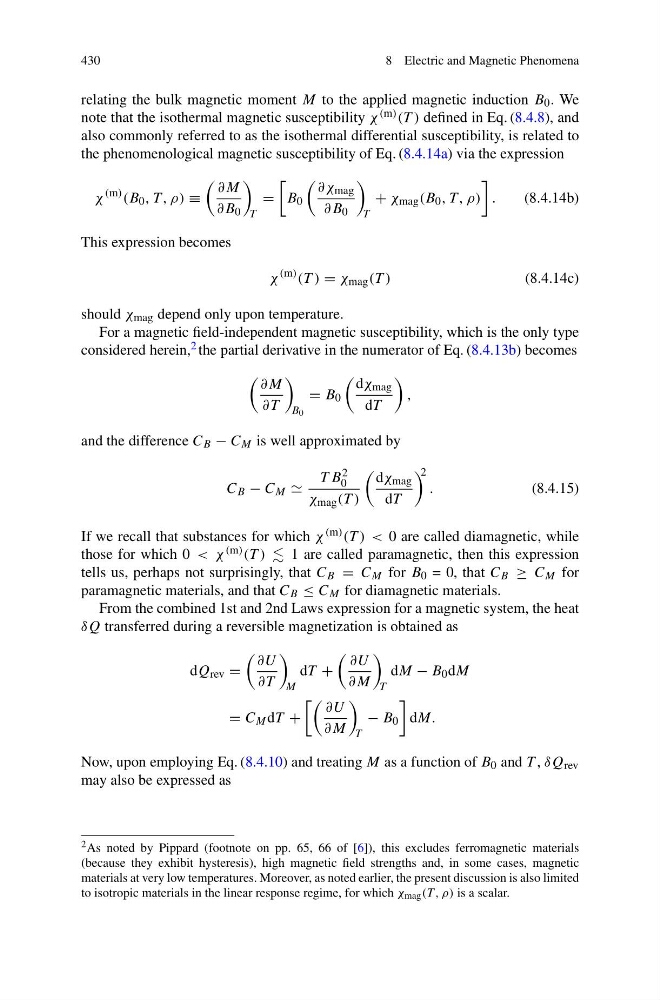
relating the bulk magnetic moment M to the applied magnetic induction B 0 . We
note that the isothermal magnetic susceptibility χ (m) (T ) defined in Eq. (8.4.8), and
also commonly referred to as the isothermal differential susceptibility, is related to
the phenomenological magnetic susceptibility of Eq. (8.4.14a) via the expression
χ
(m) (B 0 , T , ρ) ≡
∂M
∂B 0
T
=
B 0
∂χ mag
∂B 0
T
+ χ mag (B 0 , T , ρ)
.
(8.4.14b)
This expression becomes
χ
(m) (T ) = χ mag (T )
(8.4.14c)
should χ mag depend only upon temperature.
For a magnetic field-independent magnetic susceptibility, which is the only type
considered herein, 2 the partial derivative in the numerator of Eq. (8.4.13b) becomes
∂M
∂T
B 0
= B 0
dχ mag
dT
,
and the difference C B − C M is well approximated by
C B − C M
T B 2
0
χ mag (T )
dχ mag
dT
2
.
(8.4.15)
If we recall that substances for which χ (m) (T ) < 0 are called diamagnetic, while
those for which 0 < χ (m) (T ) 1 are called paramagnetic, then this expression
tells us, perhaps not surprisingly, that C B = C M for B 0 = 0, that C B ≥ C M for
paramagnetic materials, and that C B ≤ C M for diamagnetic materials.
From the combined 1st and 2nd Laws expression for a magnetic system, the heat
δQ transferred during a reversible magnetization is obtained as
dQ rev =
∂U
∂T
M
dT +
∂U
∂M
T
dM − B 0 dM
= C M dT +
∂U
∂M
T
− B 0
dM.
Now, upon employing Eq. (8.4.10) and treating M as a function of B 0 and T , δQ rev
may also be expressed as
2 As noted by Pippard (footnote on pp. 65, 66 of [6]), this excludes ferromagnetic materials
(because they exhibit hysteresis), high magnetic field strengths and, in some cases, magnetic
materials at very low temperatures. Moreover, as noted earlier, the present discussion is also limited
to isotropic materials in the linear response regime, for which χ mag (T , ρ) is a scalar.
8 Electric and Magnetic Phenomena
relating the bulk magnetic moment M to the applied magnetic induction B 0 . We
note that the isothermal magnetic susceptibility χ (m) (T ) defined in Eq. (8.4.8), and
also commonly referred to as the isothermal differential susceptibility, is related to
the phenomenological magnetic susceptibility of Eq. (8.4.14a) via the expression
χ
(m) (B 0 , T , ρ) ≡
∂M
∂B 0
T
=
B 0
∂χ mag
∂B 0
T
+ χ mag (B 0 , T , ρ)
.
(8.4.14b)
This expression becomes
χ
(m) (T ) = χ mag (T )
(8.4.14c)
should χ mag depend only upon temperature.
For a magnetic field-independent magnetic susceptibility, which is the only type
considered herein, 2 the partial derivative in the numerator of Eq. (8.4.13b) becomes
∂M
∂T
B 0
= B 0
dχ mag
dT
,
and the difference C B − C M is well approximated by
C B − C M
T B 2
0
χ mag (T )
dχ mag
dT
2
.
(8.4.15)
If we recall that substances for which χ (m) (T ) < 0 are called diamagnetic, while
those for which 0 < χ (m) (T ) 1 are called paramagnetic, then this expression
tells us, perhaps not surprisingly, that C B = C M for B 0 = 0, that C B ≥ C M for
paramagnetic materials, and that C B ≤ C M for diamagnetic materials.
From the combined 1st and 2nd Laws expression for a magnetic system, the heat
δQ transferred during a reversible magnetization is obtained as
dQ rev =
∂U
∂T
M
dT +
∂U
∂M
T
dM − B 0 dM
= C M dT +
∂U
∂M
T
− B 0
dM.
Now, upon employing Eq. (8.4.10) and treating M as a function of B 0 and T , δQ rev
may also be expressed as
2 As noted by Pippard (footnote on pp. 65, 66 of [6]), this excludes ferromagnetic materials
(because they exhibit hysteresis), high magnetic field strengths and, in some cases, magnetic
materials at very low temperatures. Moreover, as noted earlier, the present discussion is also limited
to isotropic materials in the linear response regime, for which χ mag (T , ρ) is a scalar.