

8.4 Magnetism, I. Paramagnetism
429
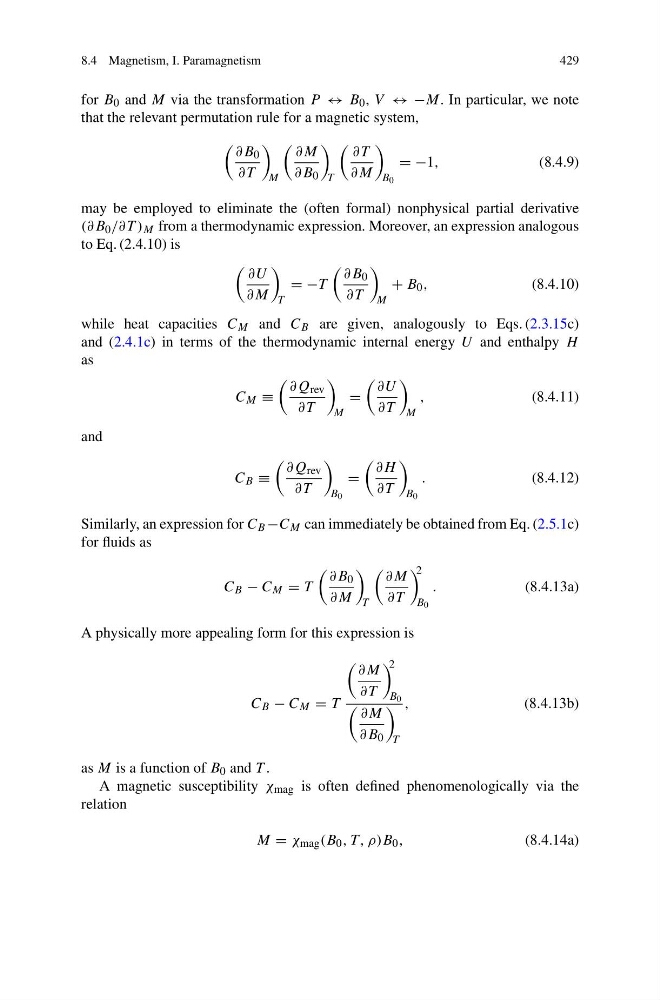
for B 0 and M via the transformation P ↔ B 0 , V ↔ −M. In particular, we note
that the relevant permutation rule for a magnetic system,
∂B 0
∂T
M
∂M
∂B 0
T
∂T
∂M
B 0
= −1,
(8.4.9)
may be employed to eliminate the (often formal) nonphysical partial derivative
(∂B 0 /∂T ) M from a thermodynamic expression. Moreover, an expression analogous
to Eq. (2.4.10) is
∂U
∂M
T
= −T
∂B 0
∂T
M
+ B 0 ,
(8.4.10)
while heat capacities C M and C B are given, analogously to Eqs. (2.3.15c)
and (2.4.1c) in terms of the thermodynamic internal energy U and enthalpy H
as
C M ≡
∂Q rev
∂T
M
=
∂U
∂T
M
,
(8.4.11)
and
C B ≡
∂Q rev
∂T
B 0
=
∂H
∂T
B 0
.
(8.4.12)
Similarly, an expression for C B −C M can immediately be obtained from Eq. (2.5.1c)
for fluids as
C B − C M = T
∂B 0
∂M
T
∂M
∂T
2
B 0
.
(8.4.13a)
A physically more appealing form for this expression is
C B − C M = T
∂M
∂T
2
B 0
∂M
∂B 0
T
,
(8.4.13b)
as M is a function of B 0 and T .
A magnetic susceptibility χ mag is often defined phenomenologically via the
relation
M = χ mag (B 0 , T , ρ)B 0 ,
(8.4.14a)
429
for B 0 and M via the transformation P ↔ B 0 , V ↔ −M. In particular, we note
that the relevant permutation rule for a magnetic system,
∂B 0
∂T
M
∂M
∂B 0
T
∂T
∂M
B 0
= −1,
(8.4.9)
may be employed to eliminate the (often formal) nonphysical partial derivative
(∂B 0 /∂T ) M from a thermodynamic expression. Moreover, an expression analogous
to Eq. (2.4.10) is
∂U
∂M
T
= −T
∂B 0
∂T
M
+ B 0 ,
(8.4.10)
while heat capacities C M and C B are given, analogously to Eqs. (2.3.15c)
and (2.4.1c) in terms of the thermodynamic internal energy U and enthalpy H
as
C M ≡
∂Q rev
∂T
M
=
∂U
∂T
M
,
(8.4.11)
and
C B ≡
∂Q rev
∂T
B 0
=
∂H
∂T
B 0
.
(8.4.12)
Similarly, an expression for C B −C M can immediately be obtained from Eq. (2.5.1c)
for fluids as
C B − C M = T
∂B 0
∂M
T
∂M
∂T
2
B 0
.
(8.4.13a)
A physically more appealing form for this expression is
C B − C M = T
∂M
∂T
2
B 0
∂M
∂B 0
T
,
(8.4.13b)
as M is a function of B 0 and T .
A magnetic susceptibility χ mag is often defined phenomenologically via the
relation
M = χ mag (B 0 , T , ρ)B 0 ,
(8.4.14a)