

8.4 Magnetism, I. Paramagnetism
431
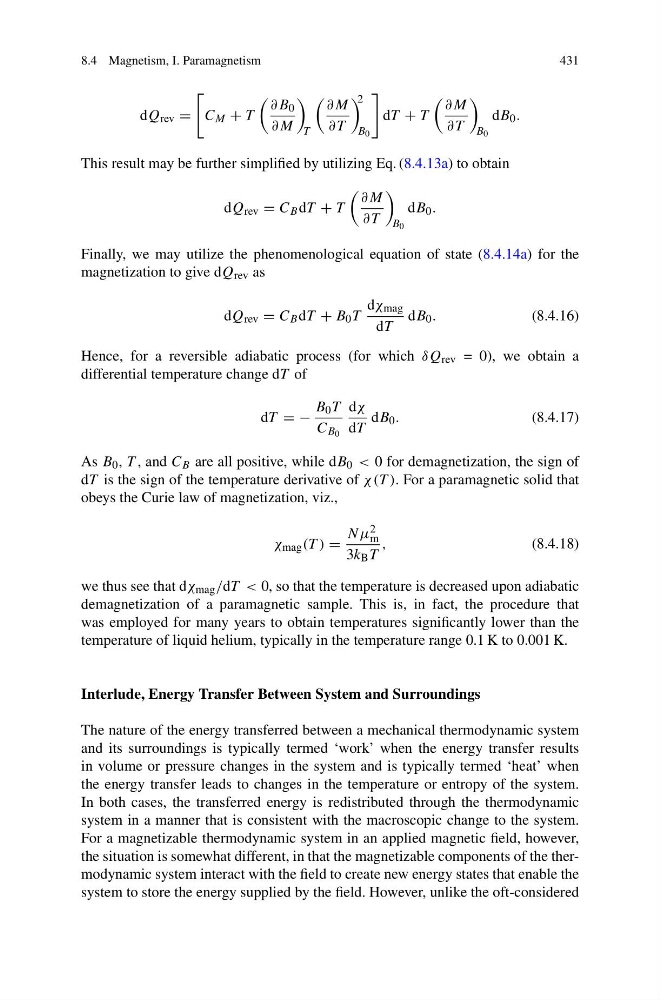
dQ rev =
C M + T
∂B 0
∂M
T
∂M
∂T
2
B 0
dT + T
∂M
∂T
B 0
dB 0 .
This result may be further simplified by utilizing Eq. (8.4.13a) to obtain
dQ rev = C B dT + T
∂M
∂T
B 0
dB 0 .
Finally, we may utilize the phenomenological equation of state (8.4.14a) for the
magnetization to give dQ rev as
dQ rev = C B dT + B 0 T
dχ mag
dT
dB 0 .
(8.4.16)
Hence, for a reversible adiabatic process (for which δQ rev = 0), we obtain a
differential temperature change dT of
dT = −
B 0 T
C B 0
dχ
dT
dB 0 .
(8.4.17)
As B 0 , T , and C B are all positive, while dB 0 < 0 for demagnetization, the sign of
dT is the sign of the temperature derivative of χ(T ). For a paramagnetic solid that
obeys the Curie law of magnetization, viz.,
χ mag (T ) =
Nμ 2
m
3k B T
,
(8.4.18)
we thus see that dχ mag /dT < 0, so that the temperature is decreased upon adiabatic
demagnetization of a paramagnetic sample. This is, in fact, the procedure that
was employed for many years to obtain temperatures significantly lower than the
temperature of liquid helium, typically in the temperature range 0.1 K to 0.001 K.
Interlude, Energy Transfer Between System and Surroundings
The nature of the energy transferred between a mechanical thermodynamic system
and its surroundings is typically termed ‘work’ when the energy transfer results
in volume or pressure changes in the system and is typically termed ‘heat’ when
the energy transfer leads to changes in the temperature or entropy of the system.
In both cases, the transferred energy is redistributed through the thermodynamic
system in a manner that is consistent with the macroscopic change to the system.
For a magnetizable thermodynamic system in an applied magnetic field, however,
the situation is somewhat different, in that the magnetizable components of the thermodynamic system interact with the field to create new energy states that enable the
system to store the energy supplied by the field. However, unlike the oft-considered
431
dQ rev =
C M + T
∂B 0
∂M
T
∂M
∂T
2
B 0
dT + T
∂M
∂T
B 0
dB 0 .
This result may be further simplified by utilizing Eq. (8.4.13a) to obtain
dQ rev = C B dT + T
∂M
∂T
B 0
dB 0 .
Finally, we may utilize the phenomenological equation of state (8.4.14a) for the
magnetization to give dQ rev as
dQ rev = C B dT + B 0 T
dχ mag
dT
dB 0 .
(8.4.16)
Hence, for a reversible adiabatic process (for which δQ rev = 0), we obtain a
differential temperature change dT of
dT = −
B 0 T
C B 0
dχ
dT
dB 0 .
(8.4.17)
As B 0 , T , and C B are all positive, while dB 0 < 0 for demagnetization, the sign of
dT is the sign of the temperature derivative of χ(T ). For a paramagnetic solid that
obeys the Curie law of magnetization, viz.,
χ mag (T ) =
Nμ 2
m
3k B T
,
(8.4.18)
we thus see that dχ mag /dT < 0, so that the temperature is decreased upon adiabatic
demagnetization of a paramagnetic sample. This is, in fact, the procedure that
was employed for many years to obtain temperatures significantly lower than the
temperature of liquid helium, typically in the temperature range 0.1 K to 0.001 K.
Interlude, Energy Transfer Between System and Surroundings
The nature of the energy transferred between a mechanical thermodynamic system
and its surroundings is typically termed ‘work’ when the energy transfer results
in volume or pressure changes in the system and is typically termed ‘heat’ when
the energy transfer leads to changes in the temperature or entropy of the system.
In both cases, the transferred energy is redistributed through the thermodynamic
system in a manner that is consistent with the macroscopic change to the system.
For a magnetizable thermodynamic system in an applied magnetic field, however,
the situation is somewhat different, in that the magnetizable components of the thermodynamic system interact with the field to create new energy states that enable the
system to store the energy supplied by the field. However, unlike the oft-considered