

8.3 Dielectric Constant of a Polar Gas
423
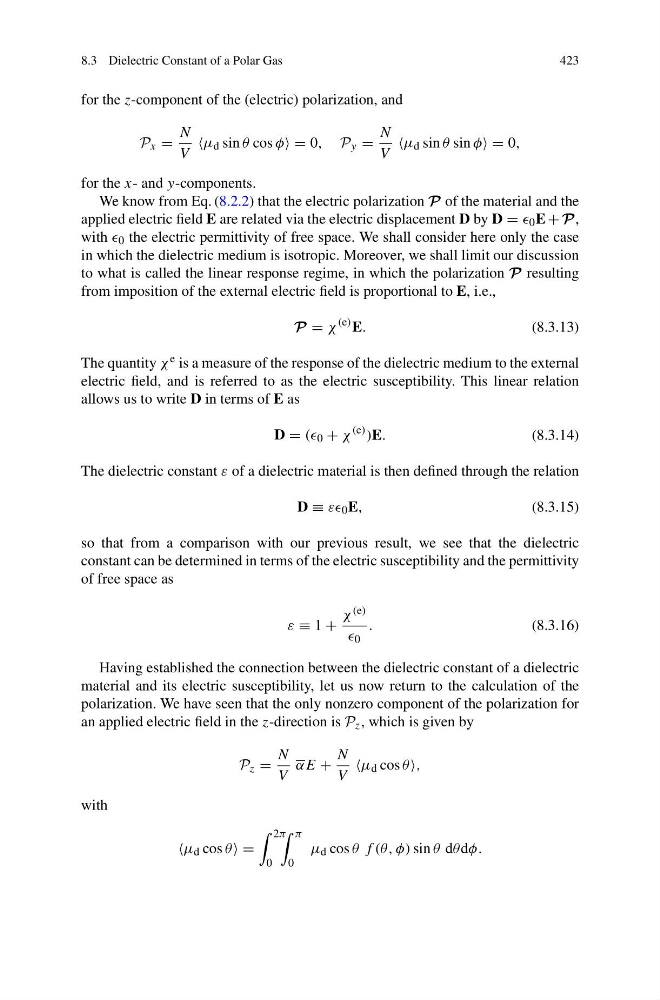
for the z-component of the (electric) polarization, and
P x =
N
V
μ d sin θ cos φ = 0, P y =
N
V
μ d sin θ sin φ = 0,
for the x- and y-components.
We know from Eq. (8.2.2) that the electric polarization P of the material and the
applied electric field E are related via the electric displacement D by D = 0 E + P,
with 0 the electric permittivity of free space. We shall consider here only the case
in which the dielectric medium is isotropic. Moreover, we shall limit our discussion
to what is called the linear response regime, in which the polarization P resulting
from imposition of the external electric field is proportional to E, i.e.,
P = χ
(e) E.
(8.3.13)
The quantity χ e is a measure of the response of the dielectric medium to the external
electric field, and is referred to as the electric susceptibility. This linear relation
allows us to write D in terms of E as
D = (( 0 + χ
(e) )E.
(8.3.14)
The dielectric constant ε of a dielectric material is then defined through the relation
D ≡ εε 0 E,
(8.3.15)
so that from a comparison with our previous result, we see that the dielectric
constant can be determined in terms of the electric susceptibility and the permittivity
of free space as
ε ≡ 1 +
χ (e)
0
.
(8.3.16)
Having established the connection between the dielectric constant of a dielectric
material and its electric susceptibility, let us now return to the calculation of the
polarization. We have seen that the only nonzero component of the polarization for
an applied electric field in the z-direction is P z , which is given by
P z =
N
V
αE +
N
V
μ d cos θ ,
with
μ d cos θ =
2π
0
π
0
μ d cos θ f (θ, φ) sin θ dθ dφ.
423
for the z-component of the (electric) polarization, and
P x =
N
V
μ d sin θ cos φ = 0, P y =
N
V
μ d sin θ sin φ = 0,
for the x- and y-components.
We know from Eq. (8.2.2) that the electric polarization P of the material and the
applied electric field E are related via the electric displacement D by D = 0 E + P,
with 0 the electric permittivity of free space. We shall consider here only the case
in which the dielectric medium is isotropic. Moreover, we shall limit our discussion
to what is called the linear response regime, in which the polarization P resulting
from imposition of the external electric field is proportional to E, i.e.,
P = χ
(e) E.
(8.3.13)
The quantity χ e is a measure of the response of the dielectric medium to the external
electric field, and is referred to as the electric susceptibility. This linear relation
allows us to write D in terms of E as
D = (( 0 + χ
(e) )E.
(8.3.14)
The dielectric constant ε of a dielectric material is then defined through the relation
D ≡ εε 0 E,
(8.3.15)
so that from a comparison with our previous result, we see that the dielectric
constant can be determined in terms of the electric susceptibility and the permittivity
of free space as
ε ≡ 1 +
χ (e)
0
.
(8.3.16)
Having established the connection between the dielectric constant of a dielectric
material and its electric susceptibility, let us now return to the calculation of the
polarization. We have seen that the only nonzero component of the polarization for
an applied electric field in the z-direction is P z , which is given by
P z =
N
V
αE +
N
V
μ d cos θ ,
with
μ d cos θ =
2π
0
π
0
μ d cos θ f (θ, φ) sin θ dθ dφ.