

424
8 Electric and Magnetic Phenomena
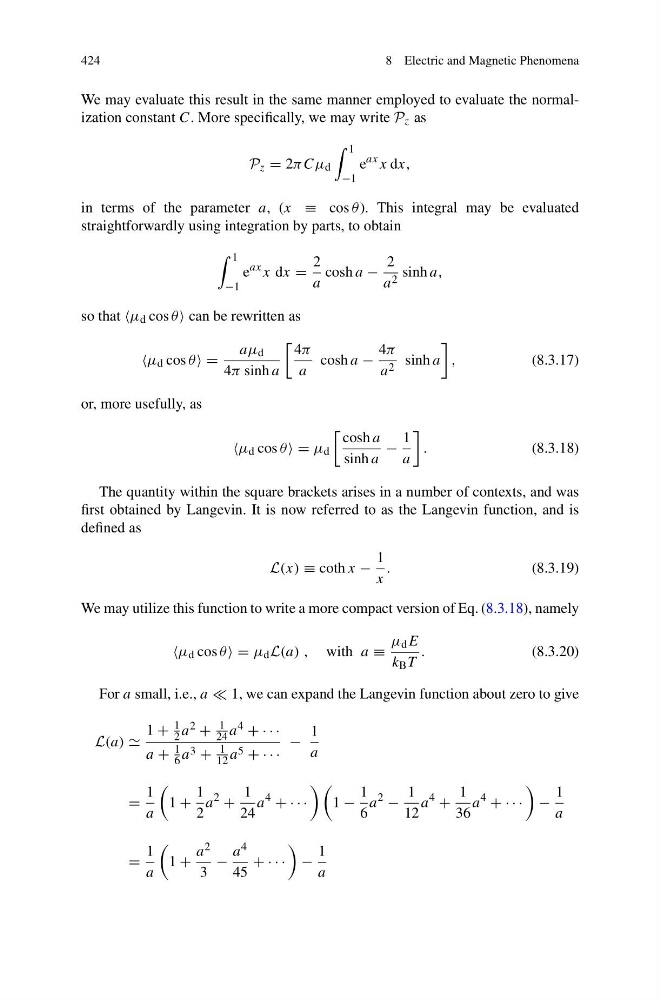
We may evaluate this result in the same manner employed to evaluate the normalization constant C. More specifically, we may write P z as
P z = 2πCμ d
1
−1
e
ax x dx,
in terms of the parameter a, (x ≡ cos θ ). This integral may be evaluated
straightforwardly using integration by parts, to obtain
1
−1
e
ax x dx =
2
a
cosh a −
2
a 2 sinh a,
so that μ d cos θ can be rewritten as
μ d cos θ =
aμ d
4π sinh a
4π
a
cosh a −
4π
a 2 sinh a
,
(8.3.17)
or, more usefully, as
μ d cos θ = μ d
cosh a
sinh a
−
1
a
.
(8.3.18)
The quantity within the square brackets arises in a number of contexts, and was
first obtained by Langevin. It is now referred to as the Langevin function, and is
defined as
L(x) ≡ coth x −
1
x
.
(8.3.19)
We may utilize this function to write a more compact version of Eq. (8.3.18), namely
μ d cos θ = μ d L(a) , with a ≡
μ d E
k B T
.
(8.3.20)
For a small, i.e., a 1, we can expand the Langevin function about zero to give
L(a)
1 +
1
2 a 2 +
1
24 a 4 + · · ·
a +
1
6 a 3 +
1
12 a 5 + · · ·
−
1
a
=
1
a
1 +
1
2
a
2
+
1
24
a
4
+ · · ·
1 −
1
6
a
2
−
1
12
a
4
+
1
36
a
4
+ · · ·
−
1
a
=
1
a
1 +
a 2
3
−
a 4
45
+ · · ·
−
1
a
8 Electric and Magnetic Phenomena
We may evaluate this result in the same manner employed to evaluate the normalization constant C. More specifically, we may write P z as
P z = 2πCμ d
1
−1
e
ax x dx,
in terms of the parameter a, (x ≡ cos θ ). This integral may be evaluated
straightforwardly using integration by parts, to obtain
1
−1
e
ax x dx =
2
a
cosh a −
2
a 2 sinh a,
so that μ d cos θ can be rewritten as
μ d cos θ =
aμ d
4π sinh a
4π
a
cosh a −
4π
a 2 sinh a
,
(8.3.17)
or, more usefully, as
μ d cos θ = μ d
cosh a
sinh a
−
1
a
.
(8.3.18)
The quantity within the square brackets arises in a number of contexts, and was
first obtained by Langevin. It is now referred to as the Langevin function, and is
defined as
L(x) ≡ coth x −
1
x
.
(8.3.19)
We may utilize this function to write a more compact version of Eq. (8.3.18), namely
μ d cos θ = μ d L(a) , with a ≡
μ d E
k B T
.
(8.3.20)
For a small, i.e., a 1, we can expand the Langevin function about zero to give
L(a)
1 +
1
2 a 2 +
1
24 a 4 + · · ·
a +
1
6 a 3 +
1
12 a 5 + · · ·
−
1
a
=
1
a
1 +
1
2
a
2
+
1
24
a
4
+ · · ·
1 −
1
6
a
2
−
1
12
a
4
+
1
36
a
4
+ · · ·
−
1
a
=
1
a
1 +
a 2
3
−
a 4
45
+ · · ·
−
1
a