

422
8 Electric and Magnetic Phenomena
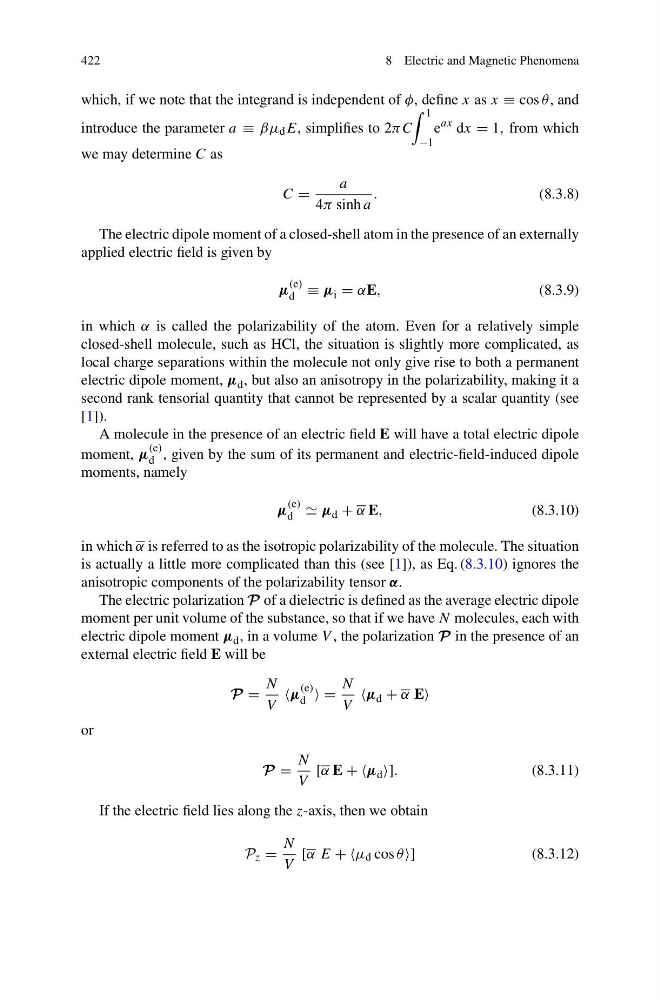
which, if we note that the integrand is independent of φ, define x as x ≡ cos θ , and
introduce the parameter a ≡ βμ d E, simplifies to 2πC
1
−1
e
ax dx = 1, from which
we may determine C as
C =
a
4π sinh a
.
(8.3.8)
The electric dipole moment of a closed-shell atom in the presence of an externally
applied electric field is given by
μ
(e)
d ≡ μ i = αE,
(8.3.9)
in which α is called the polarizability of the atom. Even for a relatively simple
closed-shell molecule, such as HCl, the situation is slightly more complicated, as
local charge separations within the molecule not only give rise to both a permanent
electric dipole moment, μ d , but also an anisotropy in the polarizability, making it a
second rank tensorial quantity that cannot be represented by a scalar quantity (see
[1]).
A molecule in the presence of an electric field E will have a total electric dipole
moment, μ
(e)
d , given by the sum of its permanent and electric-field-induced dipole
moments, namely
μ
(e)
d μ d + α E,
(8.3.10)
in which α is referred to as the isotropic polarizability of the molecule. The situation
is actually a little more complicated than this (see [1]), as Eq. (8.3.10) ignores the
anisotropic components of the polarizability tensor α.
The electric polarization P of a dielectric is defined as the average electric dipole
moment per unit volume of the substance, so that if we have N molecules, each with
electric dipole moment μ d , in a volume V , the polarization P in the presence of an
external electric field E will be
P =
N
V
μ
(e)
d =
N
V
μ d + α E
or
P =
N
V
[α E + +μ d ].
(8.3.11)
If the electric field lies along the z-axis, then we obtain
P z =
N
V
[α E + +μ d cos θ ]
(8.3.12)
8 Electric and Magnetic Phenomena
which, if we note that the integrand is independent of φ, define x as x ≡ cos θ , and
introduce the parameter a ≡ βμ d E, simplifies to 2πC
1
−1
e
ax dx = 1, from which
we may determine C as
C =
a
4π sinh a
.
(8.3.8)
The electric dipole moment of a closed-shell atom in the presence of an externally
applied electric field is given by
μ
(e)
d ≡ μ i = αE,
(8.3.9)
in which α is called the polarizability of the atom. Even for a relatively simple
closed-shell molecule, such as HCl, the situation is slightly more complicated, as
local charge separations within the molecule not only give rise to both a permanent
electric dipole moment, μ d , but also an anisotropy in the polarizability, making it a
second rank tensorial quantity that cannot be represented by a scalar quantity (see
[1]).
A molecule in the presence of an electric field E will have a total electric dipole
moment, μ
(e)
d , given by the sum of its permanent and electric-field-induced dipole
moments, namely
μ
(e)
d μ d + α E,
(8.3.10)
in which α is referred to as the isotropic polarizability of the molecule. The situation
is actually a little more complicated than this (see [1]), as Eq. (8.3.10) ignores the
anisotropic components of the polarizability tensor α.
The electric polarization P of a dielectric is defined as the average electric dipole
moment per unit volume of the substance, so that if we have N molecules, each with
electric dipole moment μ d , in a volume V , the polarization P in the presence of an
external electric field E will be
P =
N
V
μ
(e)
d =
N
V
μ d + α E
or
P =
N
V
[α E + +μ d ].
(8.3.11)
If the electric field lies along the z-axis, then we obtain
P z =
N
V
[α E + +μ d cos θ ]
(8.3.12)