

8.3 Dielectric Constant of a Polar Gas
421
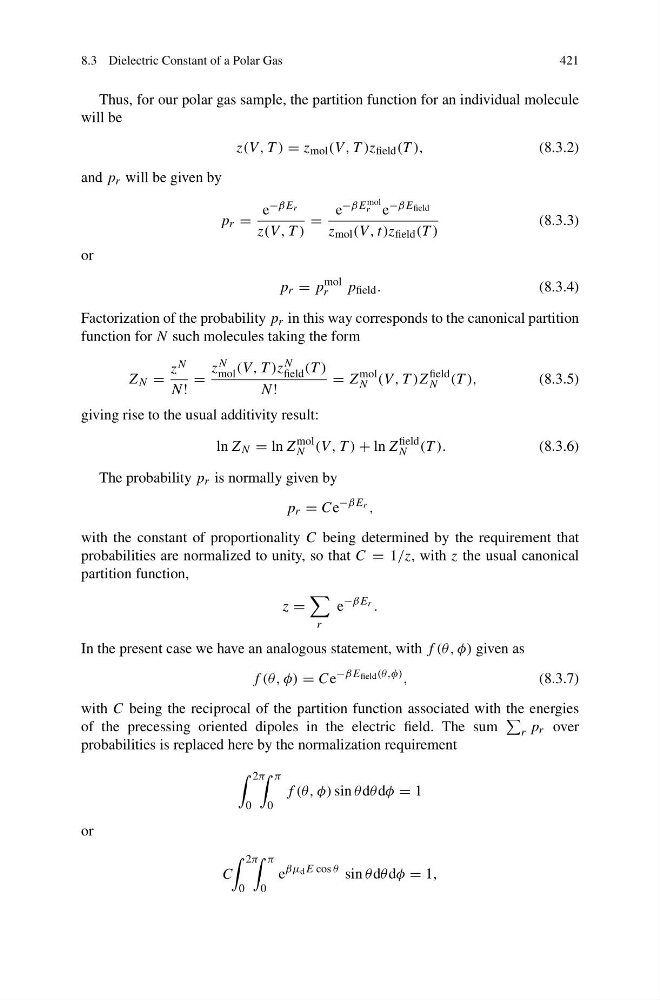
Thus, for our polar gas sample, the partition function for an individual molecule
will be
z(V , T ) = z mol (V , T )z field (T ),
(8.3.2)
and p r will be given by
p r =
e −βE r
z(V , T )
=
e −βE mol
r e −βE field
z mol (V , t)z field (T )
(8.3.3)
or
p r = p
mol
r
p field .
(8.3.4)
Factorization of the probability p r in this way corresponds to the canonical partition
function for N such molecules taking the form
Z N =
z N
N !
=
z N
mol (V , T )z N
field (T )
N!
= Z
mol
N (V , T )Z
field
N (T ),
(8.3.5)
giving rise to the usual additivity result:
ln Z N = ln Z
mol
N (V , T ) + ln Z
field
N (T ).
(8.3.6)
The probability p r is normally given by
p r = Ce
−βE r ,
with the constant of proportionality C being determined by the requirement that
probabilities are normalized to unity, so that C = 1/z, with z the usual canonical
partition function,
z =
r
e
−βE r .
In the present case we have an analogous statement, with f (θ, φ) given as
f (θ, φ) = Ce
−βE field (θ,φ) ,
(8.3.7)
with C being the reciprocal of the partition function associated with the energies
of the precessing oriented dipoles in the electric field. The sum
r p r over
probabilities is replaced here by the normalization requirement
2π
0
π
0
f (θ, φ) sin θ dθ dφ = 1
or
C
2π
0
π
0
e
βμ d E cos θ sin θ dθ dφ = 1,
421
Thus, for our polar gas sample, the partition function for an individual molecule
will be
z(V , T ) = z mol (V , T )z field (T ),
(8.3.2)
and p r will be given by
p r =
e −βE r
z(V , T )
=
e −βE mol
r e −βE field
z mol (V , t)z field (T )
(8.3.3)
or
p r = p
mol
r
p field .
(8.3.4)
Factorization of the probability p r in this way corresponds to the canonical partition
function for N such molecules taking the form
Z N =
z N
N !
=
z N
mol (V , T )z N
field (T )
N!
= Z
mol
N (V , T )Z
field
N (T ),
(8.3.5)
giving rise to the usual additivity result:
ln Z N = ln Z
mol
N (V , T ) + ln Z
field
N (T ).
(8.3.6)
The probability p r is normally given by
p r = Ce
−βE r ,
with the constant of proportionality C being determined by the requirement that
probabilities are normalized to unity, so that C = 1/z, with z the usual canonical
partition function,
z =
r
e
−βE r .
In the present case we have an analogous statement, with f (θ, φ) given as
f (θ, φ) = Ce
−βE field (θ,φ) ,
(8.3.7)
with C being the reciprocal of the partition function associated with the energies
of the precessing oriented dipoles in the electric field. The sum
r p r over
probabilities is replaced here by the normalization requirement
2π
0
π
0
f (θ, φ) sin θ dθ dφ = 1
or
C
2π
0
π
0
e
βμ d E cos θ sin θ dθ dφ = 1,