

420
8 Electric and Magnetic Phenomena
around the Cl nucleus: such a charge separation leads naturally to a permanent
electric dipole moment μ d .
The energy of a polar molecule is changed in an applied electric field by an
amount that depends upon both the strength of the applied field and the magnitude
of the permanent dipole moment of the molecule. The effect of the external electric
field on the molecule is known as the Stark effect (and is the electric analogon of
the Zeeman effect associated with an external magnetic field). You may have already
encountered the Stark effect in a quantum mechanics course: however, if not, all that
we really need for our purposes is to know that the interaction energy is, in general,
given by
E field = −μ
(e)
d · E = −μ
(e)
d E cos θ,
(8.3.1)
with the precise form to be taken by μ
(e)
d to be specified later.
8.3.2 Canonical Ensemble Description of a Dielectric
Thermodynamic System
Since the energy of an individual molecule depends upon how it is aligned with
respect to the field direction, we may ask how such oriented molecules would be
distributed when they are at thermal equilibrium in the presence of the applied
electric field. To do this, we shall make use of the canonical distribution, which, as
we know, gives Boltzmann probabilities, p r , having the form p r ∝ e −βE r for r in
principle discrete. We shall, however, treat this problem classically, consistent with
our given for the interaction energy E field expressed in Eq. (8.3.1): what we mean
by this is that we shall use the form μ d cos θ , which is a classical expression, rather
than employ the z-component (operator), μ
(e)
dz , of the electric dipole moment vector
operator, as would be required were we to wish to obtain a full quantum-mechanical
description.
For a classical description, we shall replace p r (with r discrete) by f (θ), and
call f a distribution function; we shall also replace the summation over r by an
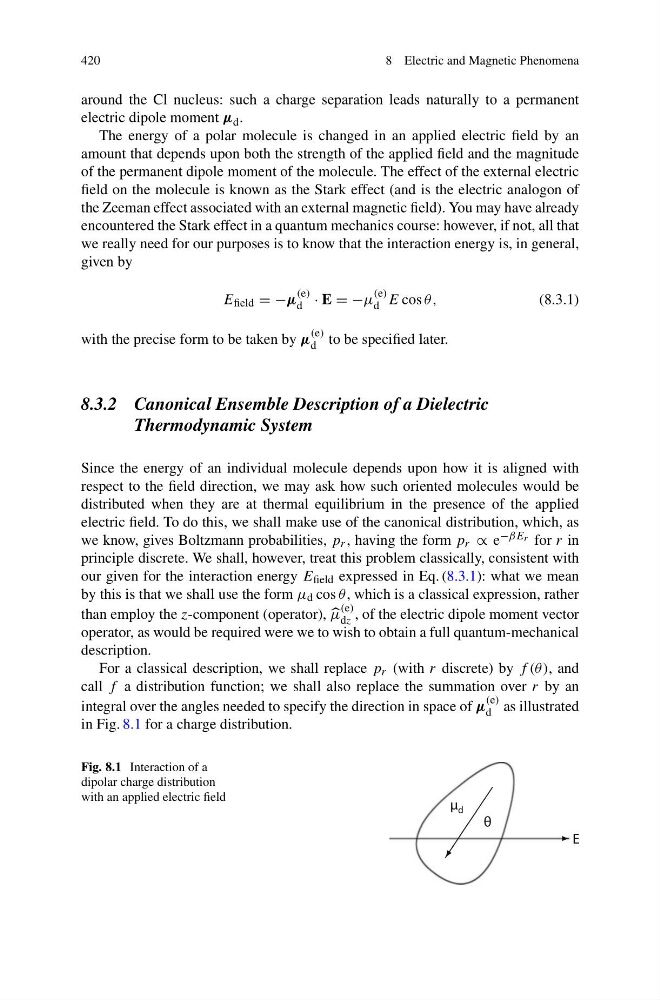
integral over the angles needed to specify the direction in space of μ
(e)
d as illustrated
in Fig. 8.1 for a charge distribution.
Fig. 8.1 Interaction of a
dipolar charge distribution
with an applied electric field
8 Electric and Magnetic Phenomena
around the Cl nucleus: such a charge separation leads naturally to a permanent
electric dipole moment μ d .
The energy of a polar molecule is changed in an applied electric field by an
amount that depends upon both the strength of the applied field and the magnitude
of the permanent dipole moment of the molecule. The effect of the external electric
field on the molecule is known as the Stark effect (and is the electric analogon of
the Zeeman effect associated with an external magnetic field). You may have already
encountered the Stark effect in a quantum mechanics course: however, if not, all that
we really need for our purposes is to know that the interaction energy is, in general,
given by
E field = −μ
(e)
d · E = −μ
(e)
d E cos θ,
(8.3.1)
with the precise form to be taken by μ
(e)
d to be specified later.
8.3.2 Canonical Ensemble Description of a Dielectric
Thermodynamic System
Since the energy of an individual molecule depends upon how it is aligned with
respect to the field direction, we may ask how such oriented molecules would be
distributed when they are at thermal equilibrium in the presence of the applied
electric field. To do this, we shall make use of the canonical distribution, which, as
we know, gives Boltzmann probabilities, p r , having the form p r ∝ e −βE r for r in
principle discrete. We shall, however, treat this problem classically, consistent with
our given for the interaction energy E field expressed in Eq. (8.3.1): what we mean
by this is that we shall use the form μ d cos θ , which is a classical expression, rather
than employ the z-component (operator), μ
(e)
dz , of the electric dipole moment vector
operator, as would be required were we to wish to obtain a full quantum-mechanical
description.
For a classical description, we shall replace p r (with r discrete) by f (θ), and
call f a distribution function; we shall also replace the summation over r by an
integral over the angles needed to specify the direction in space of μ
(e)
d as illustrated
in Fig. 8.1 for a charge distribution.
Fig. 8.1 Interaction of a
dipolar charge distribution
with an applied electric field