

408
7 Classical Statistical Mechanics
T =
1
2 M ˙
R
2
+
N
i=1
m i (˙ r
i )
2 .
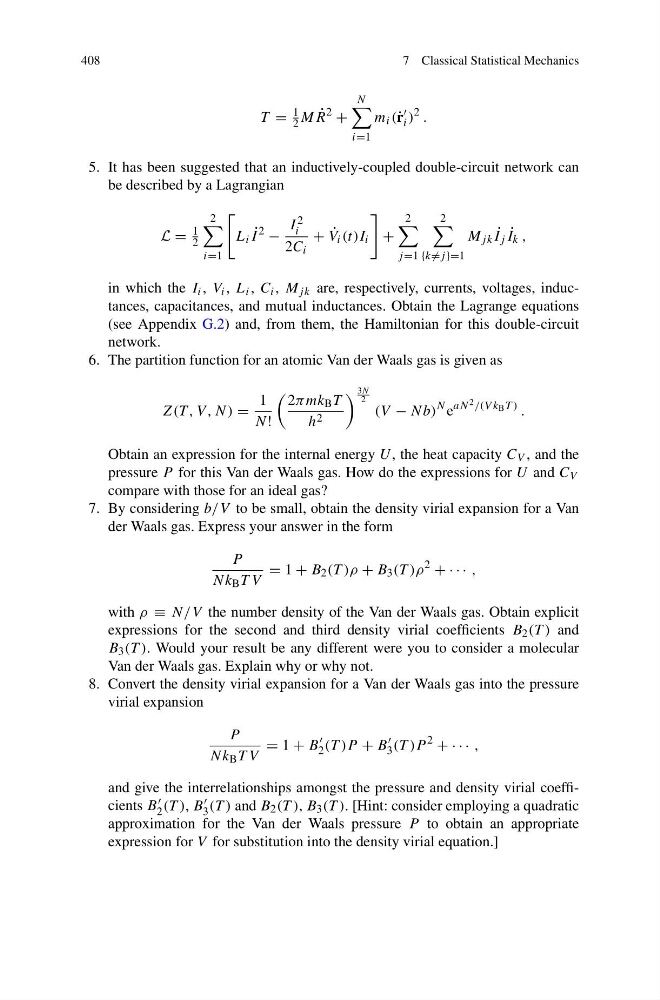
5. It has been suggested that an inductively-coupled double-circuit network can
be described by a Lagrangian
L =
1
2
2
i=1
L i ˙
I
2
−
I 2
i
2C i
+ ˙
V i (t)I i
+
2
j =1
2
{k =j }=1
M jk ˙
I j ˙
I k ,
in which the I i , V i , L i , C i , M jk are, respectively, currents, voltages, inductances, capacitances, and mutual inductances. Obtain the Lagrange equations
(see Appendix G.2) and, from them, the Hamiltonian for this double-circuit
network.
6. The partition function for an atomic Van der Waals gas is given as
Z(T , V , N) =
1
N!
2πmk B T
h 2
3N
2
(V − Nb)
N e
aN 2 /(V k B T ) .
Obtain an expression for the internal energy U , the heat capacity C V , and the
pressure P for this Van der Waals gas. How do the expressions for U and C V
compare with those for an ideal gas?
7. By considering b/V to be small, obtain the density virial expansion for a Van
der Waals gas. Express your answer in the form
P
Nk B T V
= 1 + B 2 (T )ρ + B 3 (T )ρ
2
+ · · · ,
with ρ ≡ N/V the number density of the Van der Waals gas. Obtain explicit
expressions for the second and third density virial coefficients B 2 (T ) and
B 3 (T ). Would your result be any different were you to consider a molecular
Van der Waals gas. Explain why or why not.
8. Convert the density virial expansion for a Van der Waals gas into the pressure
virial expansion
P
Nk B T V
= 1 + B
2 (T )P + B
3 (T )P
2
+ · · · ,
and give the interrelationships amongst the pressure and density virial coefficients B
2 (T ), B
3 (T ) and B 2 (T ), B 3 (T ). [Hint: consider employing a quadratic
approximation for the Van der Waals pressure P to obtain an appropriate
expression for V for substitution into the density virial equation.]
7 Classical Statistical Mechanics
T =
1
2 M ˙
R
2
+
N
i=1
m i (˙ r
i )
2 .
5. It has been suggested that an inductively-coupled double-circuit network can
be described by a Lagrangian
L =
1
2
2
i=1
L i ˙
I
2
−
I 2
i
2C i
+ ˙
V i (t)I i
+
2
j =1
2
{k =j }=1
M jk ˙
I j ˙
I k ,
in which the I i , V i , L i , C i , M jk are, respectively, currents, voltages, inductances, capacitances, and mutual inductances. Obtain the Lagrange equations
(see Appendix G.2) and, from them, the Hamiltonian for this double-circuit
network.
6. The partition function for an atomic Van der Waals gas is given as
Z(T , V , N) =
1
N!
2πmk B T
h 2
3N
2
(V − Nb)
N e
aN 2 /(V k B T ) .
Obtain an expression for the internal energy U , the heat capacity C V , and the
pressure P for this Van der Waals gas. How do the expressions for U and C V
compare with those for an ideal gas?
7. By considering b/V to be small, obtain the density virial expansion for a Van
der Waals gas. Express your answer in the form
P
Nk B T V
= 1 + B 2 (T )ρ + B 3 (T )ρ
2
+ · · · ,
with ρ ≡ N/V the number density of the Van der Waals gas. Obtain explicit
expressions for the second and third density virial coefficients B 2 (T ) and
B 3 (T ). Would your result be any different were you to consider a molecular
Van der Waals gas. Explain why or why not.
8. Convert the density virial expansion for a Van der Waals gas into the pressure
virial expansion
P
Nk B T V
= 1 + B
2 (T )P + B
3 (T )P
2
+ · · · ,
and give the interrelationships amongst the pressure and density virial coefficients B
2 (T ), B
3 (T ) and B 2 (T ), B 3 (T ). [Hint: consider employing a quadratic
approximation for the Van der Waals pressure P to obtain an appropriate
expression for V for substitution into the density virial equation.]