

References
409
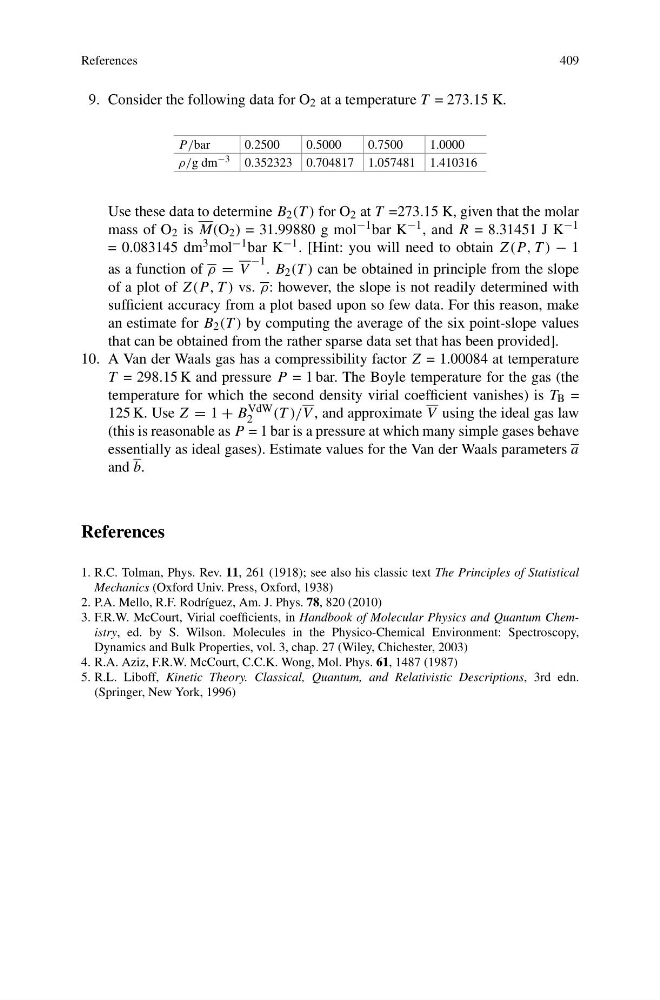
9. Consider the following data for O 2 at a temperature T = 273.15 K.
P /bar
0.2500
0.5000
0.7500
1.0000
ρ/g dm −3 0.352323 0.704817 1.057481 1.410316
Use these data to determine B 2 (T ) for O 2 at T =273.15 K, given that the molar
mass of O 2 is M(O 2 ) = 31.99880 g mol −1 bar K −1 , and R = 8.31451 J K −1
= 0.083145 dm 3 mol −1 bar K −1 . [Hint: you will need to obtain Z(P , T ) − 1
as a function of ρ = V
−1 . B 2 (T ) can be obtained in principle from the slope
of a plot of Z(P , T ) vs. ρ: however, the slope is not readily determined with
sufficient accuracy from a plot based upon so few data. For this reason, make
an estimate for B 2 (T ) by computing the average of the six point-slope values
that can be obtained from the rather sparse data set that has been provided].
10. A Van der Waals gas has a compressibility factor Z = 1.00084 at temperature
T = 298.15 K and pressure P = 1 bar. The Boyle temperature for the gas (the
temperature for which the second density virial coefficient vanishes) is T B =
125 K. Use Z = 1 + B VdW
2
(T )/V , and approximate V using the ideal gas law
(this is reasonable as P = 1 bar is a pressure at which many simple gases behave
essentially as ideal gases). Estimate values for the Van der Waals parameters a
and b.
References
1. R.C. Tolman, Phys. Rev. 11, 261 (1918); see also his classic text The Principles of Statistical
Mechanics (Oxford Univ. Press, Oxford, 1938)
2. P.A. Mello, R.F. Rodríguez, Am. J. Phys. 78, 820 (2010)
3. F.R.W. McCourt, Virial coefficients, in Handbook of Molecular Physics and Quantum Chemistry, ed. by S. Wilson. Molecules in the Physico-Chemical Environment: Spectroscopy,
Dynamics and Bulk Properties, vol. 3, chap. 27 (Wiley, Chichester, 2003)
4. R.A. Aziz, F.R.W. McCourt, C.C.K. Wong, Mol. Phys. 61, 1487 (1987)
5. R.L. Liboff, Kinetic Theory. Classical, Quantum, and Relativistic Descriptions, 3rd edn.
(Springer, New York, 1996)
409
9. Consider the following data for O 2 at a temperature T = 273.15 K.
P /bar
0.2500
0.5000
0.7500
1.0000
ρ/g dm −3 0.352323 0.704817 1.057481 1.410316
Use these data to determine B 2 (T ) for O 2 at T =273.15 K, given that the molar
mass of O 2 is M(O 2 ) = 31.99880 g mol −1 bar K −1 , and R = 8.31451 J K −1
= 0.083145 dm 3 mol −1 bar K −1 . [Hint: you will need to obtain Z(P , T ) − 1
as a function of ρ = V
−1 . B 2 (T ) can be obtained in principle from the slope
of a plot of Z(P , T ) vs. ρ: however, the slope is not readily determined with
sufficient accuracy from a plot based upon so few data. For this reason, make
an estimate for B 2 (T ) by computing the average of the six point-slope values
that can be obtained from the rather sparse data set that has been provided].
10. A Van der Waals gas has a compressibility factor Z = 1.00084 at temperature
T = 298.15 K and pressure P = 1 bar. The Boyle temperature for the gas (the
temperature for which the second density virial coefficient vanishes) is T B =
125 K. Use Z = 1 + B VdW
2
(T )/V , and approximate V using the ideal gas law
(this is reasonable as P = 1 bar is a pressure at which many simple gases behave
essentially as ideal gases). Estimate values for the Van der Waals parameters a
and b.
References
1. R.C. Tolman, Phys. Rev. 11, 261 (1918); see also his classic text The Principles of Statistical
Mechanics (Oxford Univ. Press, Oxford, 1938)
2. P.A. Mello, R.F. Rodríguez, Am. J. Phys. 78, 820 (2010)
3. F.R.W. McCourt, Virial coefficients, in Handbook of Molecular Physics and Quantum Chemistry, ed. by S. Wilson. Molecules in the Physico-Chemical Environment: Spectroscopy,
Dynamics and Bulk Properties, vol. 3, chap. 27 (Wiley, Chichester, 2003)
4. R.A. Aziz, F.R.W. McCourt, C.C.K. Wong, Mol. Phys. 61, 1487 (1987)
5. R.L. Liboff, Kinetic Theory. Classical, Quantum, and Relativistic Descriptions, 3rd edn.
(Springer, New York, 1996)