

7.6 Problems for this Chapter
407
7.6 Problems for this Chapter
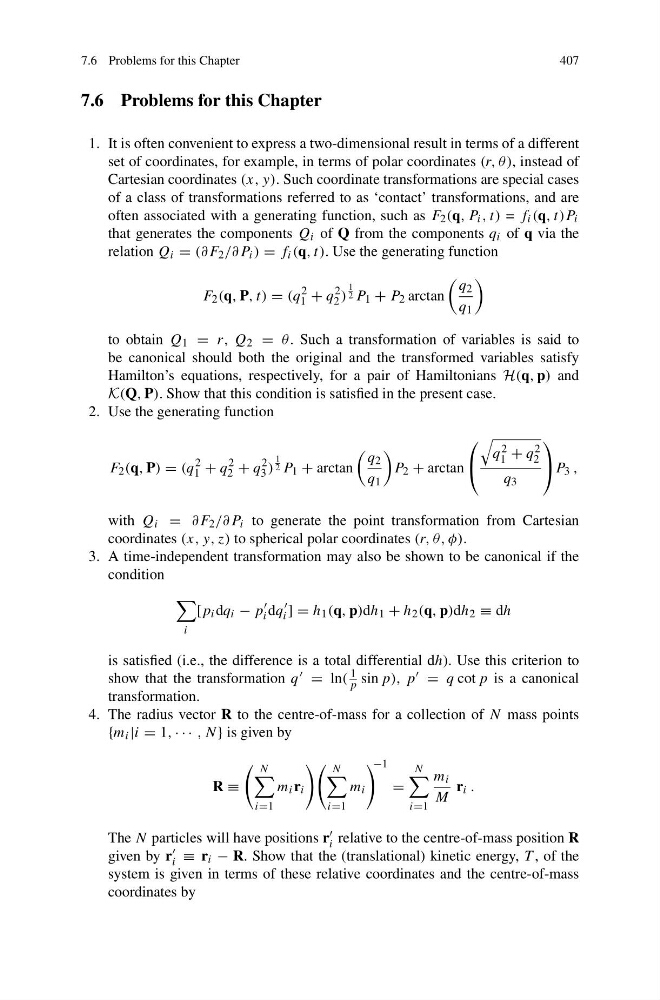
1. It is often convenient to express a two-dimensional result in terms of a different
set of coordinates, for example, in terms of polar coordinates (r, θ ), instead of
Cartesian coordinates (x, y). Such coordinate transformations are special cases
of a class of transformations referred to as ‘contact’ transformations, and are
often associated with a generating function, such as F 2 (q, P i , t) = f i (q, t)P i
that generates the components Q i of Q from the components q i of q via the
relation Q i = (∂F 2 /∂P i ) = f i (q, t). Use the generating function
F 2 (q, P, t) = (q
2
1 + q
2
2 )
1
2 P 1 + P 2 arctan
q 2
q 1
to obtain Q 1 = r, Q 2 = θ . Such a transformation of variables is said to
be canonical should both the original and the transformed variables satisfy
Hamilton’s equations, respectively, for a pair of Hamiltonians H(q, p) and
K(Q, P). Show that this condition is satisfied in the present case.
2. Use the generating function
F 2 (q, P) = (q
2
1 + q
2
2 + q
2
3 )
1
2 P 1 + arctan
q 2
q 1
P 2 + arctan
⎛
⎝
q 2
1 + q 2
2
q 3
⎞
⎠ P 3 ,
with Q i = ∂F 2 /∂P i to generate the point transformation from Cartesian
coordinates (x, y, z) to spherical polar coordinates (r, θ, φ).
3. A time-independent transformation may also be shown to be canonical if the
condition
i
[p i dq i − p
i dq
i ] = h 1 (q, p)dh 1 + h 2 (q, p)dh 2 ≡ dh
is satisfied (i.e., the difference is a total differential dh). Use this criterion to
show that the transformation q = ln(
1
p sin p), p = q cot p is a canonical
transformation.
4. The radius vector R to the centre-of-mass for a collection of N mass points
{m i |i = 1, · · · , N} is given by
R ≡
N
i=1
m i r i
N
i=1
m i
−1
=
N
i=1
m i
M
r i .
The N particles will have positions r
i relative to the centre-of-mass position R
given by r
i ≡ r i − R. Show that the (translational) kinetic energy, T , of the
system is given in terms of these relative coordinates and the centre-of-mass
coordinates by
407
7.6 Problems for this Chapter
1. It is often convenient to express a two-dimensional result in terms of a different
set of coordinates, for example, in terms of polar coordinates (r, θ ), instead of
Cartesian coordinates (x, y). Such coordinate transformations are special cases
of a class of transformations referred to as ‘contact’ transformations, and are
often associated with a generating function, such as F 2 (q, P i , t) = f i (q, t)P i
that generates the components Q i of Q from the components q i of q via the
relation Q i = (∂F 2 /∂P i ) = f i (q, t). Use the generating function
F 2 (q, P, t) = (q
2
1 + q
2
2 )
1
2 P 1 + P 2 arctan
q 2
q 1
to obtain Q 1 = r, Q 2 = θ . Such a transformation of variables is said to
be canonical should both the original and the transformed variables satisfy
Hamilton’s equations, respectively, for a pair of Hamiltonians H(q, p) and
K(Q, P). Show that this condition is satisfied in the present case.
2. Use the generating function
F 2 (q, P) = (q
2
1 + q
2
2 + q
2
3 )
1
2 P 1 + arctan
q 2
q 1
P 2 + arctan
⎛
⎝
q 2
1 + q 2
2
q 3
⎞
⎠ P 3 ,
with Q i = ∂F 2 /∂P i to generate the point transformation from Cartesian
coordinates (x, y, z) to spherical polar coordinates (r, θ, φ).
3. A time-independent transformation may also be shown to be canonical if the
condition
i
[p i dq i − p
i dq
i ] = h 1 (q, p)dh 1 + h 2 (q, p)dh 2 ≡ dh
is satisfied (i.e., the difference is a total differential dh). Use this criterion to
show that the transformation q = ln(
1
p sin p), p = q cot p is a canonical
transformation.
4. The radius vector R to the centre-of-mass for a collection of N mass points
{m i |i = 1, · · · , N} is given by
R ≡
N
i=1
m i r i
N
i=1
m i
−1
=
N
i=1
m i
M
r i .
The N particles will have positions r
i relative to the centre-of-mass position R
given by r
i ≡ r i − R. Show that the (translational) kinetic energy, T , of the
system is given in terms of these relative coordinates and the centre-of-mass
coordinates by