

406
7 Classical Statistical Mechanics
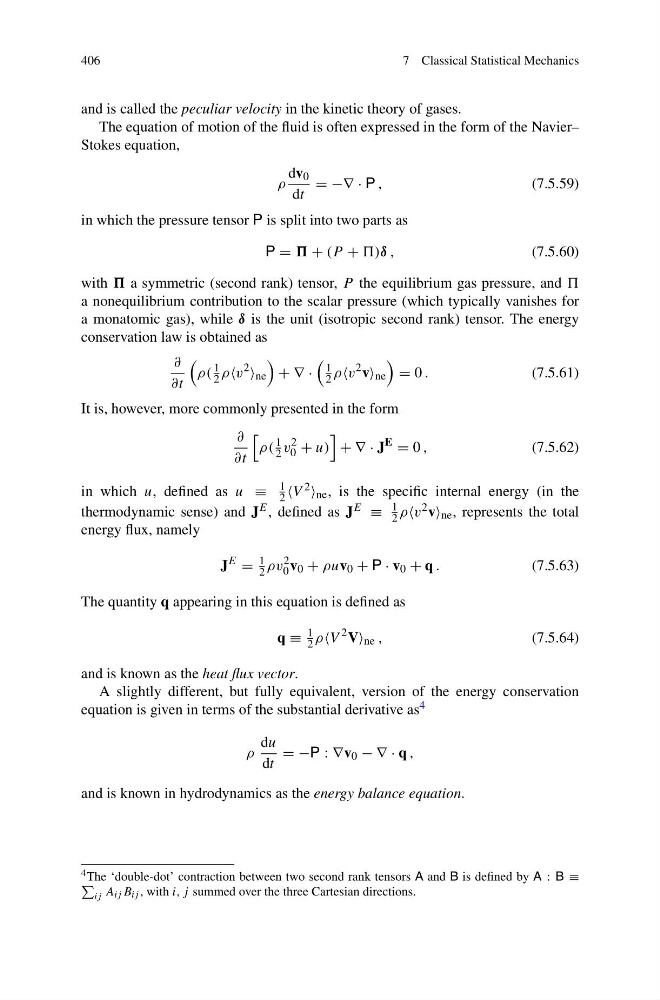
and is called the peculiar velocity in the kinetic theory of gases.
The equation of motion of the fluid is often expressed in the form of the Navier–
Stokes equation,
ρ
dv 0
dt
= −∇ · P ,
(7.5.59)
in which the pressure tensor P is split into two parts as
P = + (P + )δ ,
(7.5.60)
with a symmetric (second rank) tensor, P the equilibrium gas pressure, and
a nonequilibrium contribution to the scalar pressure (which typically vanishes for
a monatomic gas), while δ is the unit (isotropic second rank) tensor. The energy
conservation law is obtained as
∂
∂t
ρ(
1
2 ρv
2
ne
+ ∇ ·
1
2 ρv
2 v ne
= 0 .
(7.5.61)
It is, however, more commonly presented in the form
∂
∂t
ρ(
1
2 v
2
0 + u)
+ ∇ · J
E
= 0 ,
(7.5.62)
in which u, defined as u ≡
1
2 V 2 ne , is the specific internal energy (in the
thermodynamic sense) and J E , defined as J E ≡
1
2 ρv 2 v ne , represents the total
energy flux, namely
J
E
=
1
2 ρv
2
0 v 0 + ρuv 0 + P · v 0 + q .
(7.5.63)
The quantity q appearing in this equation is defined as
q ≡
1
2 ρV
2 V ne ,
(7.5.64)
and is known as the heat flux vector.
A slightly different, but fully equivalent, version of the energy conservation
equation is given in terms of the substantial derivative as 4
ρ
du
dt
= −P : ∇v 0 − ∇ · q ,
and is known in hydrodynamics as the energy balance equation.
4 The ‘double-dot’ contraction between two second rank tensors A and B is defined by A : B ≡
ij A ij B ij , with i, j summed over the three Cartesian directions.
7 Classical Statistical Mechanics
and is called the peculiar velocity in the kinetic theory of gases.
The equation of motion of the fluid is often expressed in the form of the Navier–
Stokes equation,
ρ
dv 0
dt
= −∇ · P ,
(7.5.59)
in which the pressure tensor P is split into two parts as
P = + (P + )δ ,
(7.5.60)
with a symmetric (second rank) tensor, P the equilibrium gas pressure, and
a nonequilibrium contribution to the scalar pressure (which typically vanishes for
a monatomic gas), while δ is the unit (isotropic second rank) tensor. The energy
conservation law is obtained as
∂
∂t
ρ(
1
2 ρv
2
ne
+ ∇ ·
1
2 ρv
2 v ne
= 0 .
(7.5.61)
It is, however, more commonly presented in the form
∂
∂t
ρ(
1
2 v
2
0 + u)
+ ∇ · J
E
= 0 ,
(7.5.62)
in which u, defined as u ≡
1
2 V 2 ne , is the specific internal energy (in the
thermodynamic sense) and J E , defined as J E ≡
1
2 ρv 2 v ne , represents the total
energy flux, namely
J
E
=
1
2 ρv
2
0 v 0 + ρuv 0 + P · v 0 + q .
(7.5.63)
The quantity q appearing in this equation is defined as
q ≡
1
2 ρV
2 V ne ,
(7.5.64)
and is known as the heat flux vector.
A slightly different, but fully equivalent, version of the energy conservation
equation is given in terms of the substantial derivative as 4
ρ
du
dt
= −P : ∇v 0 − ∇ · q ,
and is known in hydrodynamics as the energy balance equation.
4 The ‘double-dot’ contraction between two second rank tensors A and B is defined by A : B ≡
ij A ij B ij , with i, j summed over the three Cartesian directions.