

7.5 The Liouville and Boltzmann Equations
399
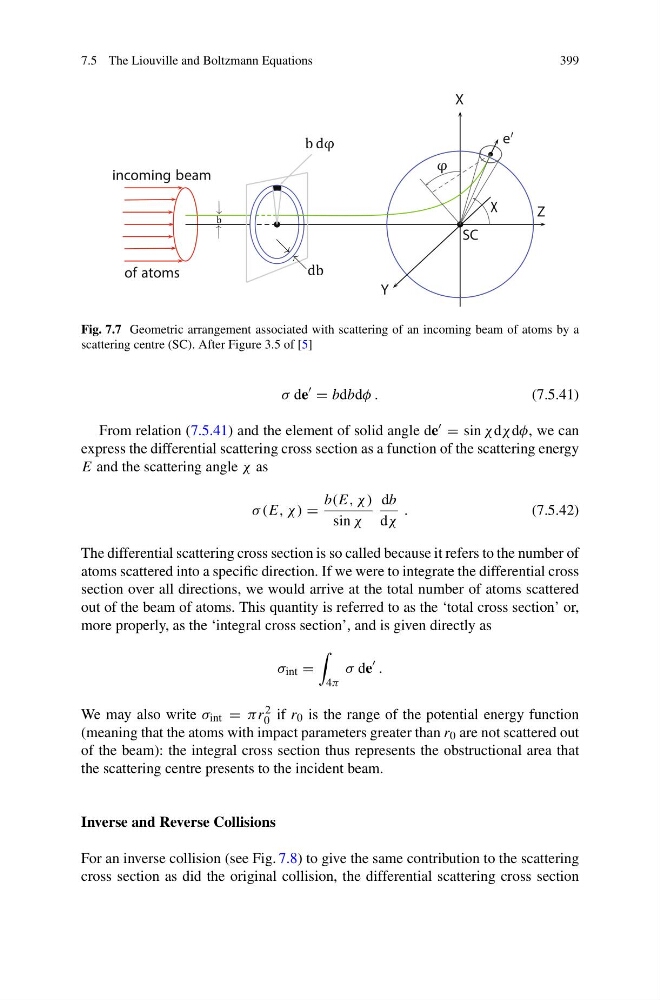
Fig. 7.7 Geometric arrangement associated with scattering of an incoming beam of atoms by a
scattering centre (SC). After Figure 3.5 of [5]
σ de
= bdbdφ .
(7.5.41)
From relation (7.5.41) and the element of solid angle de = sin χ dχ dφ, we can
express the differential scattering cross section as a function of the scattering energy
E and the scattering angle χ as
σ (E, χ) =
b(E, χ)
sin χ
db
dχ
.
(7.5.42)
The differential scattering cross section is so called because it refers to the number of
atoms scattered into a specific direction. If we were to integrate the differential cross
section over all directions, we would arrive at the total number of atoms scattered
out of the beam of atoms. This quantity is referred to as the ‘total cross section’ or,
more properly, as the ‘integral cross section’, and is given directly as
σ int =
4π
σ de
.
We may also write σ int = πr 2
0 if r 0 is the range of the potential energy function
(meaning that the atoms with impact parameters greater than r 0 are not scattered out
of the beam): the integral cross section thus represents the obstructional area that
the scattering centre presents to the incident beam.
Inverse and Reverse Collisions
For an inverse collision (see Fig. 7.8) to give the same contribution to the scattering
cross section as did the original collision, the differential scattering cross section
399
Fig. 7.7 Geometric arrangement associated with scattering of an incoming beam of atoms by a
scattering centre (SC). After Figure 3.5 of [5]
σ de
= bdbdφ .
(7.5.41)
From relation (7.5.41) and the element of solid angle de = sin χ dχ dφ, we can
express the differential scattering cross section as a function of the scattering energy
E and the scattering angle χ as
σ (E, χ) =
b(E, χ)
sin χ
db
dχ
.
(7.5.42)
The differential scattering cross section is so called because it refers to the number of
atoms scattered into a specific direction. If we were to integrate the differential cross
section over all directions, we would arrive at the total number of atoms scattered
out of the beam of atoms. This quantity is referred to as the ‘total cross section’ or,
more properly, as the ‘integral cross section’, and is given directly as
σ int =
4π
σ de
.
We may also write σ int = πr 2
0 if r 0 is the range of the potential energy function
(meaning that the atoms with impact parameters greater than r 0 are not scattered out
of the beam): the integral cross section thus represents the obstructional area that
the scattering centre presents to the incident beam.
Inverse and Reverse Collisions
For an inverse collision (see Fig. 7.8) to give the same contribution to the scattering
cross section as did the original collision, the differential scattering cross section