

400
7 Classical Statistical Mechanics
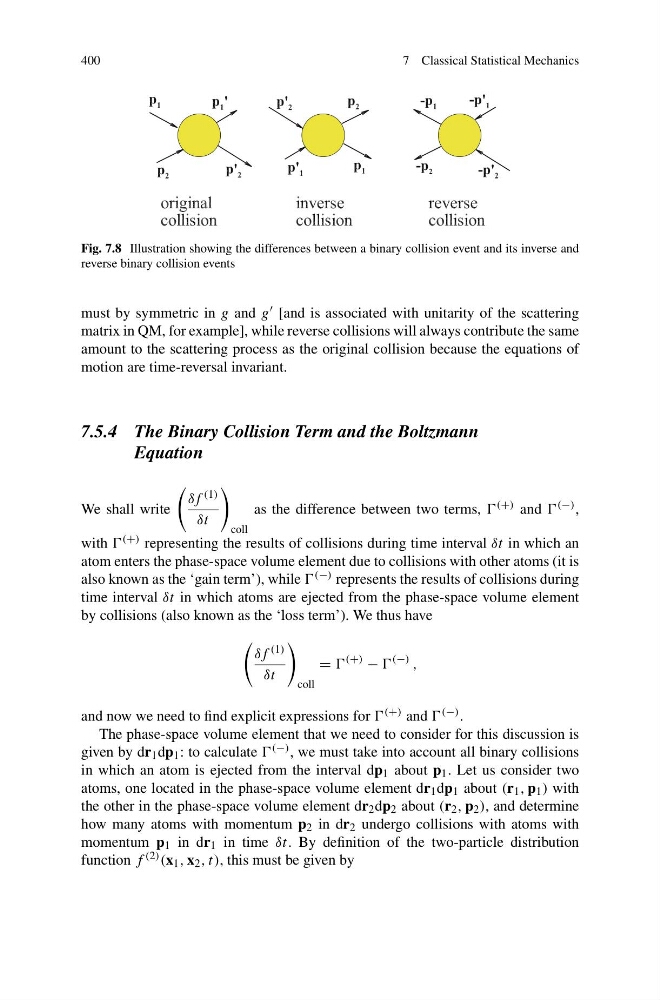
Fig. 7.8 Illustration showing the differences between a binary collision event and its inverse and
reverse binary collision events
must by symmetric in g and g [and is associated with unitarity of the scattering
matrix in QM, for example], while reverse collisions will always contribute the same
amount to the scattering process as the original collision because the equations of
motion are time-reversal invariant.
7.5.4 The Binary Collision Term and the Boltzmann
Equation
We shall write
δf (1)
δt
coll
as the difference between two terms, (+) and (−) ,
with (+) representing the results of collisions during time interval δt in which an
atom enters the phase-space volume element due to collisions with other atoms (it is
also known as the ‘gain term’), while (−) represents the results of collisions during
time interval δt in which atoms are ejected from the phase-space volume element
by collisions (also known as the ‘loss term’). We thus have
δf (1)
δt
coll
=
(+)
−
(−) ,
and now we need to find explicit expressions for (+) and (−) .
The phase-space volume element that we need to consider for this discussion is
given by dr 1 dp 1 : to calculate (−) , we must take into account all binary collisions
in which an atom is ejected from the interval dp 1 about p 1 . Let us consider two
atoms, one located in the phase-space volume element dr 1 dp 1 about (r 1 , p 1 ) with
the other in the phase-space volume element dr 2 dp 2 about (r 2 , p 2 ), and determine
how many atoms with momentum p 2 in dr 2 undergo collisions with atoms with
momentum p 1 in dr 1 in time δt. By definition of the two-particle distribution
function f (2) (x 1 , x 2 , t), this must be given by
7 Classical Statistical Mechanics
Fig. 7.8 Illustration showing the differences between a binary collision event and its inverse and
reverse binary collision events
must by symmetric in g and g [and is associated with unitarity of the scattering
matrix in QM, for example], while reverse collisions will always contribute the same
amount to the scattering process as the original collision because the equations of
motion are time-reversal invariant.
7.5.4 The Binary Collision Term and the Boltzmann
Equation
We shall write
δf (1)
δt
coll
as the difference between two terms, (+) and (−) ,
with (+) representing the results of collisions during time interval δt in which an
atom enters the phase-space volume element due to collisions with other atoms (it is
also known as the ‘gain term’), while (−) represents the results of collisions during
time interval δt in which atoms are ejected from the phase-space volume element
by collisions (also known as the ‘loss term’). We thus have
δf (1)
δt
coll
=
(+)
−
(−) ,
and now we need to find explicit expressions for (+) and (−) .
The phase-space volume element that we need to consider for this discussion is
given by dr 1 dp 1 : to calculate (−) , we must take into account all binary collisions
in which an atom is ejected from the interval dp 1 about p 1 . Let us consider two
atoms, one located in the phase-space volume element dr 1 dp 1 about (r 1 , p 1 ) with
the other in the phase-space volume element dr 2 dp 2 about (r 2 , p 2 ), and determine
how many atoms with momentum p 2 in dr 2 undergo collisions with atoms with
momentum p 1 in dr 1 in time δt. By definition of the two-particle distribution
function f (2) (x 1 , x 2 , t), this must be given by