

398
7 Classical Statistical Mechanics
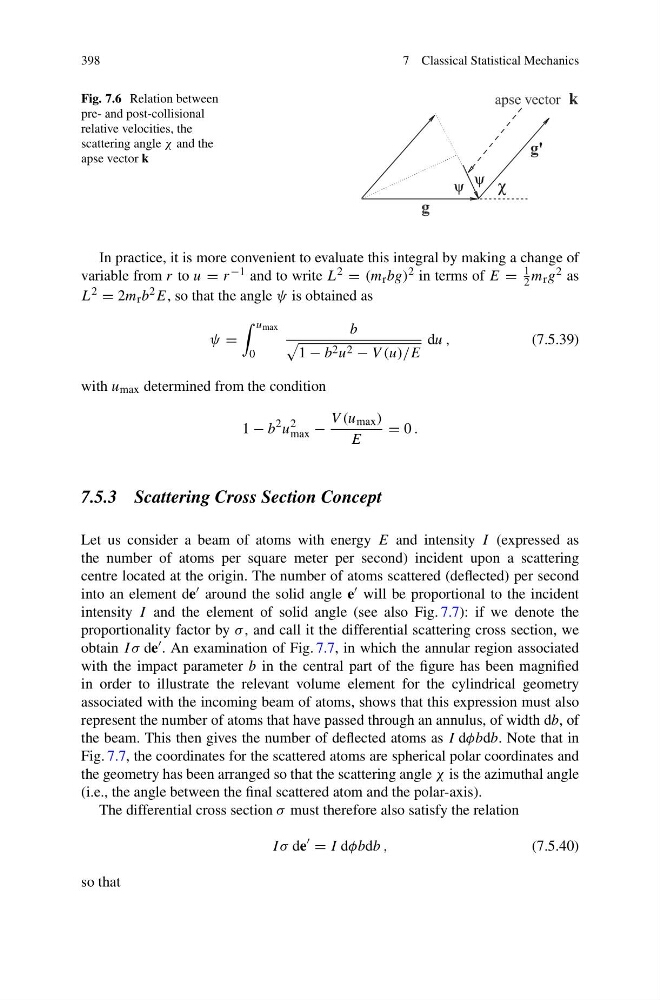
Fig. 7.6 Relation between
pre- and post-collisional
relative velocities, the
scattering angle χ and the
apse vector k
ψ ψ
χ
In practice, it is more convenient to evaluate this integral by making a change of
variable from r to u = r −1 and to write L 2 = (m r bg) 2 in terms of E =
1
2 m r g 2 as
L 2 = 2m r b 2 E, so that the angle ψ is obtained as
ψ =
u max
0
b
1 − b 2 u 2 − V (u)/E
du ,
(7.5.39)
with u max determined from the condition
1 − b
2 u
2
max −
V (u max )
E
= 0 .
7.5.3 Scattering Cross Section Concept
Let us consider a beam of atoms with energy E and intensity I (expressed as
the number of atoms per square meter per second) incident upon a scattering
centre located at the origin. The number of atoms scattered (deflected) per second
into an element de around the solid angle e will be proportional to the incident
intensity I and the element of solid angle (see also Fig. 7.7): if we denote the
proportionality factor by σ , and call it the differential scattering cross section, we
obtain I σ de . An examination of Fig. 7.7, in which the annular region associated
with the impact parameter b in the central part of the figure has been magnified
in order to illustrate the relevant volume element for the cylindrical geometry
associated with the incoming beam of atoms, shows that this expression must also
represent the number of atoms that have passed through an annulus, of width db, of
the beam. This then gives the number of deflected atoms as I dφbdb. Note that in
Fig. 7.7, the coordinates for the scattered atoms are spherical polar coordinates and
the geometry has been arranged so that the scattering angle χ is the azimuthal angle
(i.e., the angle between the final scattered atom and the polar-axis).
The differential cross section σ must therefore also satisfy the relation
I σ de
= I dφbdb ,
(7.5.40)
so that
7 Classical Statistical Mechanics
Fig. 7.6 Relation between
pre- and post-collisional
relative velocities, the
scattering angle χ and the
apse vector k
ψ ψ
χ
In practice, it is more convenient to evaluate this integral by making a change of
variable from r to u = r −1 and to write L 2 = (m r bg) 2 in terms of E =
1
2 m r g 2 as
L 2 = 2m r b 2 E, so that the angle ψ is obtained as
ψ =
u max
0
b
1 − b 2 u 2 − V (u)/E
du ,
(7.5.39)
with u max determined from the condition
1 − b
2 u
2
max −
V (u max )
E
= 0 .
7.5.3 Scattering Cross Section Concept
Let us consider a beam of atoms with energy E and intensity I (expressed as
the number of atoms per square meter per second) incident upon a scattering
centre located at the origin. The number of atoms scattered (deflected) per second
into an element de around the solid angle e will be proportional to the incident
intensity I and the element of solid angle (see also Fig. 7.7): if we denote the
proportionality factor by σ , and call it the differential scattering cross section, we
obtain I σ de . An examination of Fig. 7.7, in which the annular region associated
with the impact parameter b in the central part of the figure has been magnified
in order to illustrate the relevant volume element for the cylindrical geometry
associated with the incoming beam of atoms, shows that this expression must also
represent the number of atoms that have passed through an annulus, of width db, of
the beam. This then gives the number of deflected atoms as I dφbdb. Note that in
Fig. 7.7, the coordinates for the scattered atoms are spherical polar coordinates and
the geometry has been arranged so that the scattering angle χ is the azimuthal angle
(i.e., the angle between the final scattered atom and the polar-axis).
The differential cross section σ must therefore also satisfy the relation
I σ de
= I dφbdb ,
(7.5.40)
so that