

7.5 The Liouville and Boltzmann Equations
397
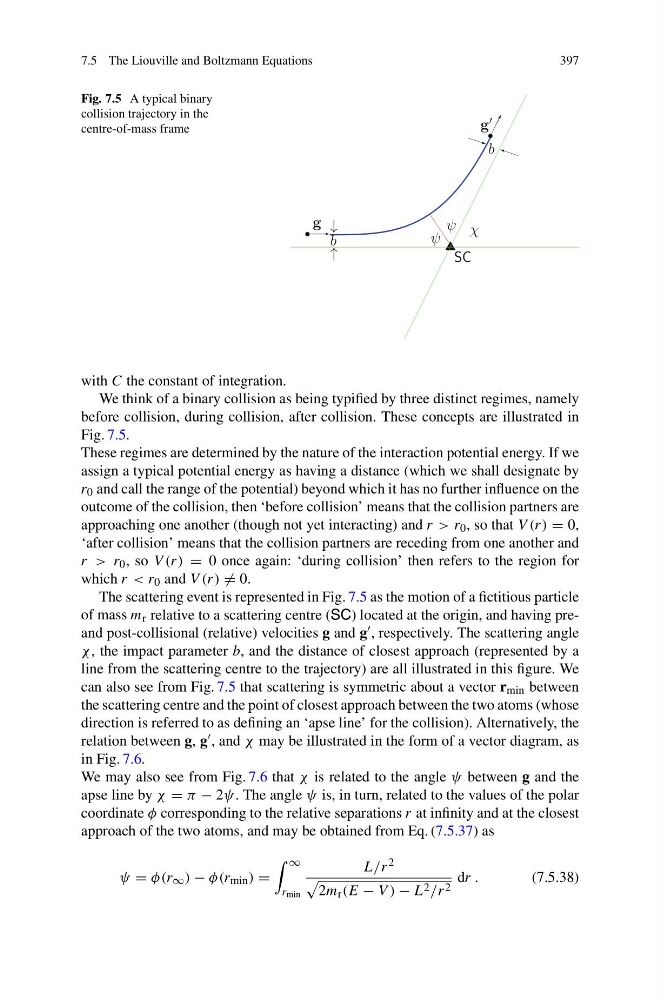
Fig. 7.5 A typical binary
collision trajectory in the
centre-of-mass frame
with C the constant of integration.
We think of a binary collision as being typified by three distinct regimes, namely
before collision, during collision, after collision. These concepts are illustrated in
Fig. 7.5.
These regimes are determined by the nature of the interaction potential energy. If we
assign a typical potential energy as having a distance (which we shall designate by
r 0 and call the range of the potential) beyond which it has no further influence on the
outcome of the collision, then ‘before collision’ means that the collision partners are
approaching one another (though not yet interacting) and r > r 0 , so that V (r) = 0,
‘after collision’ means that the collision partners are receding from one another and
r > r 0 , so V (r) = 0 once again: ‘during collision’ then refers to the region for
which r < r 0 and V (r) = 0.
The scattering event is represented in Fig. 7.5 as the motion of a fictitious particle
of mass m r relative to a scattering centre (SC) located at the origin, and having preand post-collisional (relative) velocities g and g , respectively. The scattering angle
χ , the impact parameter b, and the distance of closest approach (represented by a
line from the scattering centre to the trajectory) are all illustrated in this figure. We
can also see from Fig. 7.5 that scattering is symmetric about a vector r min between
the scattering centre and the point of closest approach between the two atoms (whose
direction is referred to as defining an ‘apse line’ for the collision). Alternatively, the
relation between g, g , and χ may be illustrated in the form of a vector diagram, as
in Fig. 7.6.
We may also see from Fig. 7.6 that χ is related to the angle ψ between g and the
apse line by χ = π − 2ψ. The angle ψ is, in turn, related to the values of the polar
coordinate φ corresponding to the relative separations r at infinity and at the closest
approach of the two atoms, and may be obtained from Eq. (7.5.37) as
ψ = φ(r ∞ ) − φ(r min ) =
∞
r min
L/r 2
2m r (E − V ) − L 2 /r 2
dr .
(7.5.38)
397
Fig. 7.5 A typical binary
collision trajectory in the
centre-of-mass frame
with C the constant of integration.
We think of a binary collision as being typified by three distinct regimes, namely
before collision, during collision, after collision. These concepts are illustrated in
Fig. 7.5.
These regimes are determined by the nature of the interaction potential energy. If we
assign a typical potential energy as having a distance (which we shall designate by
r 0 and call the range of the potential) beyond which it has no further influence on the
outcome of the collision, then ‘before collision’ means that the collision partners are
approaching one another (though not yet interacting) and r > r 0 , so that V (r) = 0,
‘after collision’ means that the collision partners are receding from one another and
r > r 0 , so V (r) = 0 once again: ‘during collision’ then refers to the region for
which r < r 0 and V (r) = 0.
The scattering event is represented in Fig. 7.5 as the motion of a fictitious particle
of mass m r relative to a scattering centre (SC) located at the origin, and having preand post-collisional (relative) velocities g and g , respectively. The scattering angle
χ , the impact parameter b, and the distance of closest approach (represented by a
line from the scattering centre to the trajectory) are all illustrated in this figure. We
can also see from Fig. 7.5 that scattering is symmetric about a vector r min between
the scattering centre and the point of closest approach between the two atoms (whose
direction is referred to as defining an ‘apse line’ for the collision). Alternatively, the
relation between g, g , and χ may be illustrated in the form of a vector diagram, as
in Fig. 7.6.
We may also see from Fig. 7.6 that χ is related to the angle ψ between g and the
apse line by χ = π − 2ψ. The angle ψ is, in turn, related to the values of the polar
coordinate φ corresponding to the relative separations r at infinity and at the closest
approach of the two atoms, and may be obtained from Eq. (7.5.37) as
ψ = φ(r ∞ ) − φ(r min ) =
∞
r min
L/r 2
2m r (E − V ) − L 2 /r 2
dr .
(7.5.38)