

396
7 Classical Statistical Mechanics
H rel =
p 2
r
2m r
+
p 2
φ
2m r r 2 + V (r) .
(7.5.33)
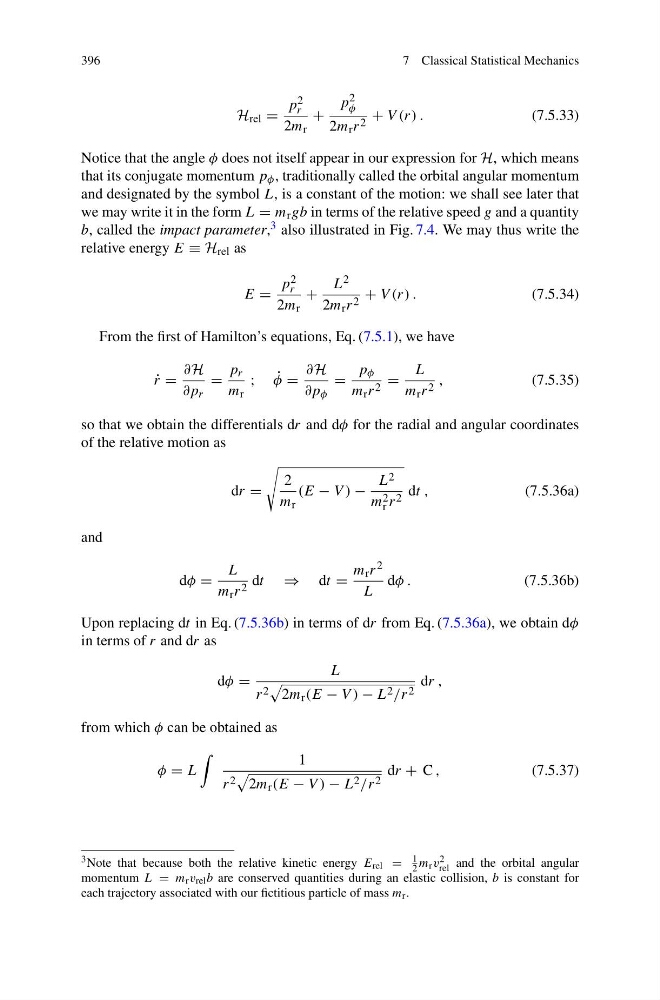
Notice that the angle φ does not itself appear in our expression for H, which means
that its conjugate momentum p φ , traditionally called the orbital angular momentum
and designated by the symbol L, is a constant of the motion: we shall see later that
we may write it in the form L = m r gb in terms of the relative speed g and a quantity
b, called the impact parameter, 3 also illustrated in Fig. 7.4. We may thus write the
relative energy E ≡ H rel as
E =
p 2
r
2m r
+
L 2
2m r r 2 + V (r) .
(7.5.34)
From the first of Hamilton’s equations, Eq. (7.5.1), we have
˙
r =
∂H
∂p r
=
p r
m r
; ˙
φ =
∂H
∂p φ
=
p φ
m r r 2 =
L
m r r 2 ,
(7.5.35)
so that we obtain the differentials dr and dφ for the radial and angular coordinates
of the relative motion as
dr =
2
m r
(E − V ) −
L 2
m 2
r r 2 dt ,
(7.5.36a)
and
dφ =
L
m r r 2 dt ⇒ dt =
m r r 2
L
dφ .
(7.5.36b)
Upon replacing dt in Eq. (7.5.36b) in terms of dr from Eq. (7.5.36a), we obtain dφ
in terms of r and dr as
dφ =
L
r 2
2m r (E − V ) − L 2 /r 2
dr ,
from which φ can be obtained as
φ = L
1
r 2
2m r (E − V ) − L 2 /r 2
dr + C ,
(7.5.37)
3 Note that because both the relative kinetic energy E rel =
1
2 m r v 2
rel and the orbital angular
momentum L = m r v rel b are conserved quantities during an elastic collision, b is constant for
each trajectory associated with our fictitious particle of mass m r .
7 Classical Statistical Mechanics
H rel =
p 2
r
2m r
+
p 2
φ
2m r r 2 + V (r) .
(7.5.33)
Notice that the angle φ does not itself appear in our expression for H, which means
that its conjugate momentum p φ , traditionally called the orbital angular momentum
and designated by the symbol L, is a constant of the motion: we shall see later that
we may write it in the form L = m r gb in terms of the relative speed g and a quantity
b, called the impact parameter, 3 also illustrated in Fig. 7.4. We may thus write the
relative energy E ≡ H rel as
E =
p 2
r
2m r
+
L 2
2m r r 2 + V (r) .
(7.5.34)
From the first of Hamilton’s equations, Eq. (7.5.1), we have
˙
r =
∂H
∂p r
=
p r
m r
; ˙
φ =
∂H
∂p φ
=
p φ
m r r 2 =
L
m r r 2 ,
(7.5.35)
so that we obtain the differentials dr and dφ for the radial and angular coordinates
of the relative motion as
dr =
2
m r
(E − V ) −
L 2
m 2
r r 2 dt ,
(7.5.36a)
and
dφ =
L
m r r 2 dt ⇒ dt =
m r r 2
L
dφ .
(7.5.36b)
Upon replacing dt in Eq. (7.5.36b) in terms of dr from Eq. (7.5.36a), we obtain dφ
in terms of r and dr as
dφ =
L
r 2
2m r (E − V ) − L 2 /r 2
dr ,
from which φ can be obtained as
φ = L
1
r 2
2m r (E − V ) − L 2 /r 2
dr + C ,
(7.5.37)
3 Note that because both the relative kinetic energy E rel =
1
2 m r v 2
rel and the orbital angular
momentum L = m r v rel b are conserved quantities during an elastic collision, b is constant for
each trajectory associated with our fictitious particle of mass m r .