

7.5 The Liouville and Boltzmann Equations
395
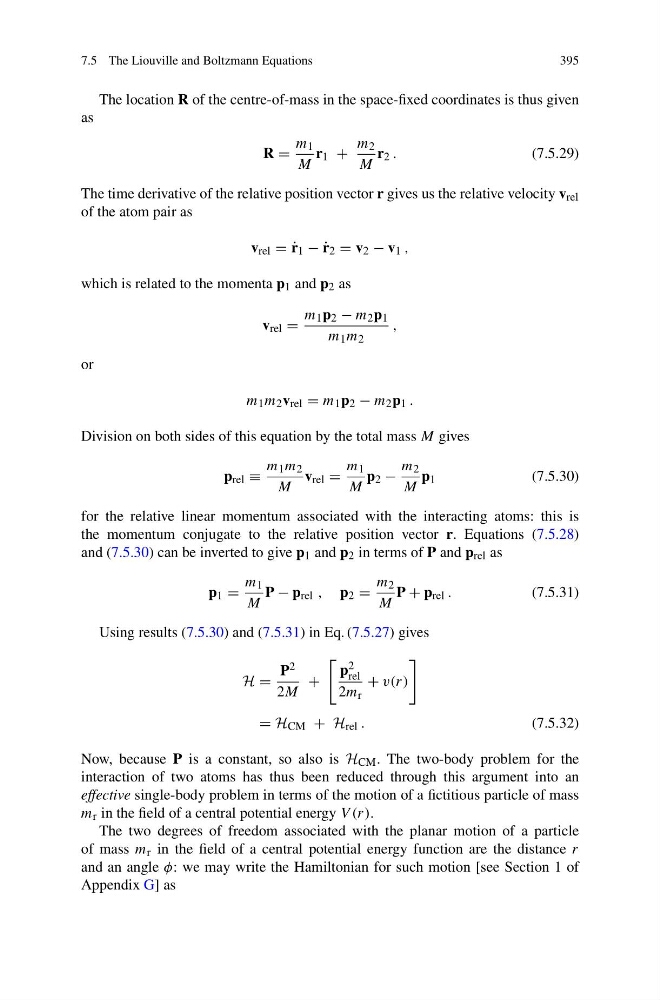
The location R of the centre-of-mass in the space-fixed coordinates is thus given
as
R =
m 1
M
r 1 +
m 2
M
r 2 .
(7.5.29)
The time derivative of the relative position vector r gives us the relative velocity v rel
of the atom pair as
v rel = ˙
r 1 − ˙
r 2 = v 2 − v 1 ,
which is related to the momenta p 1 and p 2 as
v rel =
m 1 p 2 − m 2 p 1
m 1 m 2
,
or
m 1 m 2 v rel = m 1 p 2 − m 2 p 1 .
Division on both sides of this equation by the total mass M gives
p rel ≡
m 1 m 2
M
v rel =
m 1
M
p 2 −
m 2
M
p 1
(7.5.30)
for the relative linear momentum associated with the interacting atoms: this is
the momentum conjugate to the relative position vector r. Equations (7.5.28)
and (7.5.30) can be inverted to give p 1 and p 2 in terms of P and p rel as
p 1 =
m 1
M
P − p rel , p 2 =
m 2
M
P + p rel .
(7.5.31)
Using results (7.5.30) and (7.5.31) in Eq. (7.5.27) gives
H =
P 2
2M
+
p 2
rel
2m r
+ v(r)
= H CM + H rel .
(7.5.32)
Now, because P is a constant, so also is H CM . The two-body problem for the
interaction of two atoms has thus been reduced through this argument into an
effective single-body problem in terms of the motion of a fictitious particle of mass
m r in the field of a central potential energy V (r).
The two degrees of freedom associated with the planar motion of a particle
of mass m r in the field of a central potential energy function are the distance r
and an angle φ: we may write the Hamiltonian for such motion [see Section 1 of
Appendix G] as
395
The location R of the centre-of-mass in the space-fixed coordinates is thus given
as
R =
m 1
M
r 1 +
m 2
M
r 2 .
(7.5.29)
The time derivative of the relative position vector r gives us the relative velocity v rel
of the atom pair as
v rel = ˙
r 1 − ˙
r 2 = v 2 − v 1 ,
which is related to the momenta p 1 and p 2 as
v rel =
m 1 p 2 − m 2 p 1
m 1 m 2
,
or
m 1 m 2 v rel = m 1 p 2 − m 2 p 1 .
Division on both sides of this equation by the total mass M gives
p rel ≡
m 1 m 2
M
v rel =
m 1
M
p 2 −
m 2
M
p 1
(7.5.30)
for the relative linear momentum associated with the interacting atoms: this is
the momentum conjugate to the relative position vector r. Equations (7.5.28)
and (7.5.30) can be inverted to give p 1 and p 2 in terms of P and p rel as
p 1 =
m 1
M
P − p rel , p 2 =
m 2
M
P + p rel .
(7.5.31)
Using results (7.5.30) and (7.5.31) in Eq. (7.5.27) gives
H =
P 2
2M
+
p 2
rel
2m r
+ v(r)
= H CM + H rel .
(7.5.32)
Now, because P is a constant, so also is H CM . The two-body problem for the
interaction of two atoms has thus been reduced through this argument into an
effective single-body problem in terms of the motion of a fictitious particle of mass
m r in the field of a central potential energy V (r).
The two degrees of freedom associated with the planar motion of a particle
of mass m r in the field of a central potential energy function are the distance r
and an angle φ: we may write the Hamiltonian for such motion [see Section 1 of
Appendix G] as