

394
7 Classical Statistical Mechanics
particles in interaction is illustrated in Panel (b), with R the position of the centreof-mass, r 1 and r 2 the positions of the colliding atoms, all relative to a space-fixed
origin O. Panel (c) shows the pre- and post-collisional relative position vectors and
the scattering angle χ in the centre-of-mass frame. Because the interaction energy
depends only upon the relative distance r between the two atoms, we may anticipate
that H can be simplified if we also express the kinetic energy in terms of the
relative and centre-of-mass momenta, by which we understand the linear momenta
conjugate to position coordinates R and r. Because V does not depend upon R and
the kinetic energy terms in H cannot introduce R into the Hamiltonian obtained
upon transformation into CM and relative coordinates, H will be cyclic in R, with
the consequence that its conjugate momentum P will be a conserved quantity, i.e.,
the centre-of-mass momentum P = p 1 + p 2 is conserved.
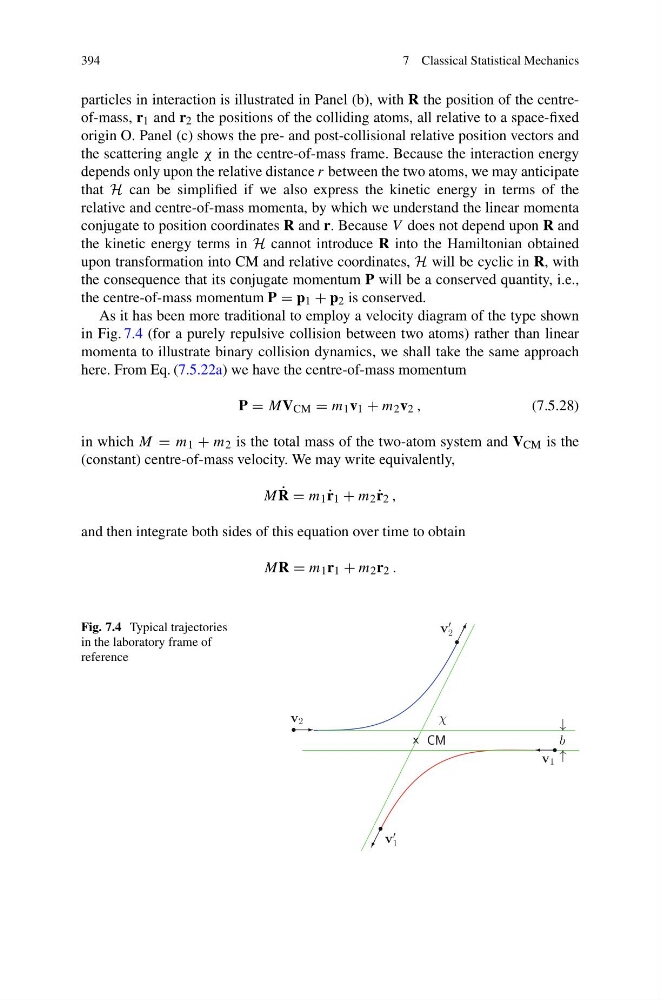
As it has been more traditional to employ a velocity diagram of the type shown
in Fig. 7.4 (for a purely repulsive collision between two atoms) rather than linear
momenta to illustrate binary collision dynamics, we shall take the same approach
here. From Eq. (7.5.22a) we have the centre-of-mass momentum
P = MV CM = m 1 v 1 + m 2 v 2 ,
(7.5.28)
in which M = m 1 + m 2 is the total mass of the two-atom system and V CM is the
(constant) centre-of-mass velocity. We may write equivalently,
M ˙
R = m 1 ˙
r 1 + m 2 ˙
r 2 ,
and then integrate both sides of this equation over time to obtain
MR = m 1 r 1 + m 2 r 2 .
Fig. 7.4 Typical trajectories
in the laboratory frame of
reference
7 Classical Statistical Mechanics
particles in interaction is illustrated in Panel (b), with R the position of the centreof-mass, r 1 and r 2 the positions of the colliding atoms, all relative to a space-fixed
origin O. Panel (c) shows the pre- and post-collisional relative position vectors and
the scattering angle χ in the centre-of-mass frame. Because the interaction energy
depends only upon the relative distance r between the two atoms, we may anticipate
that H can be simplified if we also express the kinetic energy in terms of the
relative and centre-of-mass momenta, by which we understand the linear momenta
conjugate to position coordinates R and r. Because V does not depend upon R and
the kinetic energy terms in H cannot introduce R into the Hamiltonian obtained
upon transformation into CM and relative coordinates, H will be cyclic in R, with
the consequence that its conjugate momentum P will be a conserved quantity, i.e.,
the centre-of-mass momentum P = p 1 + p 2 is conserved.
As it has been more traditional to employ a velocity diagram of the type shown
in Fig. 7.4 (for a purely repulsive collision between two atoms) rather than linear
momenta to illustrate binary collision dynamics, we shall take the same approach
here. From Eq. (7.5.22a) we have the centre-of-mass momentum
P = MV CM = m 1 v 1 + m 2 v 2 ,
(7.5.28)
in which M = m 1 + m 2 is the total mass of the two-atom system and V CM is the
(constant) centre-of-mass velocity. We may write equivalently,
M ˙
R = m 1 ˙
r 1 + m 2 ˙
r 2 ,
and then integrate both sides of this equation over time to obtain
MR = m 1 r 1 + m 2 r 2 .
Fig. 7.4 Typical trajectories
in the laboratory frame of
reference