

7.5 The Liouville and Boltzmann Equations
391
course, the laws of conservation of mass, linear momentum, angular momentum,
and energy all apply to binary collision dynamics. For a (chemically) nonreactive
collision, the conservation of mass has the consequence that both m 1 and m 2 are
unchanged after the collision, while for a reactive collision, it means that the total
mass, M = m 1 + m 2 of the pair of colliding molecules remains unchanged, even
though m
1 and m
2 need not equal m 1 and m 2 , respectively.
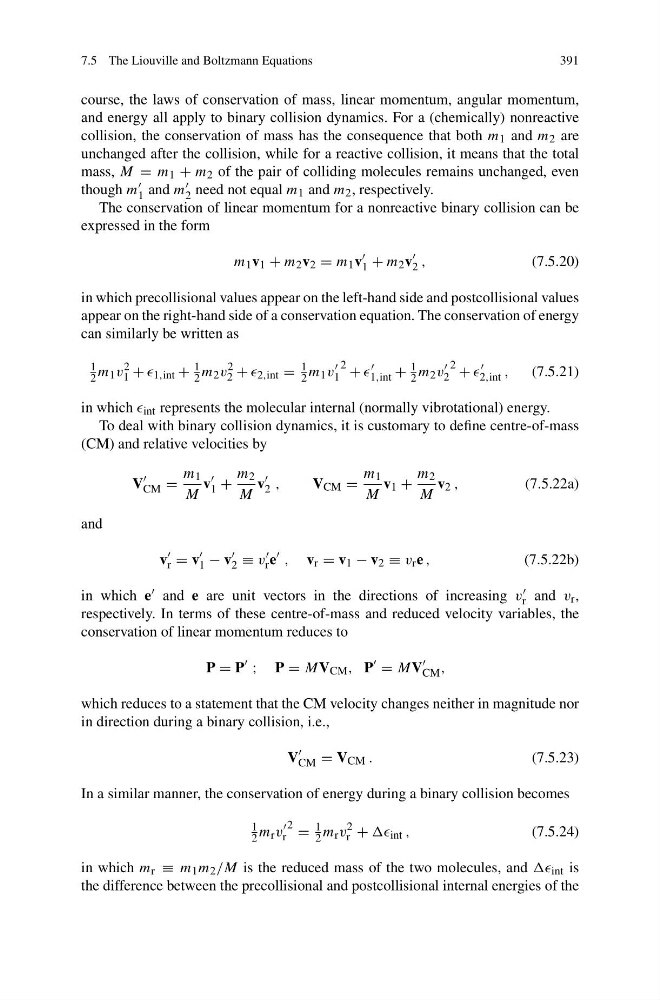
The conservation of linear momentum for a nonreactive binary collision can be
expressed in the form
m 1 v 1 + m 2 v 2 = m 1 v
1 + m 2 v
2 ,
(7.5.20)
in which precollisional values appear on the left-hand side and postcollisional values
appear on the right-hand side of a conservation equation. The conservation of energy
can similarly be written as
1
2 m 1 v
2
1 + 1,int +
1
2 m 2 v
2
2 + 2,int =
1
2 m 1 v
1
2 +
1,int +
1
2 m 2 v
2
2 +
2,int ,
(7.5.21)
in which int represents the molecular internal (normally vibrotational) energy.
To deal with binary collision dynamics, it is customary to define centre-of-mass
(CM) and relative velocities by
V
CM =
m 1
M
v
1 +
m 2
M
v
2 ,
V CM =
m 1
M
v 1 +
m 2
M
v 2 ,
(7.5.22a)
and
v
r = v
1 − v
2 ≡ v
r e
, v r = v 1 − v 2 ≡ v r e ,
(7.5.22b)
in which e and e are unit vectors in the directions of increasing v
r and v r ,
respectively. In terms of these centre-of-mass and reduced velocity variables, the
conservation of linear momentum reduces to
P = P
; P = MV CM , P
= MV
CM ,
which reduces to a statement that the CM velocity changes neither in magnitude nor
in direction during a binary collision, i.e.,
V
CM = V CM .
(7.5.23)
In a similar manner, the conservation of energy during a binary collision becomes
1
2 m r v
r
2 =
1
2 m r v
2
r + int ,
(7.5.24)
in which m r ≡ m 1 m 2 /M is the reduced mass of the two molecules, and int is
the difference between the precollisional and postcollisional internal energies of the
391
course, the laws of conservation of mass, linear momentum, angular momentum,
and energy all apply to binary collision dynamics. For a (chemically) nonreactive
collision, the conservation of mass has the consequence that both m 1 and m 2 are
unchanged after the collision, while for a reactive collision, it means that the total
mass, M = m 1 + m 2 of the pair of colliding molecules remains unchanged, even
though m
1 and m
2 need not equal m 1 and m 2 , respectively.
The conservation of linear momentum for a nonreactive binary collision can be
expressed in the form
m 1 v 1 + m 2 v 2 = m 1 v
1 + m 2 v
2 ,
(7.5.20)
in which precollisional values appear on the left-hand side and postcollisional values
appear on the right-hand side of a conservation equation. The conservation of energy
can similarly be written as
1
2 m 1 v
2
1 + 1,int +
1
2 m 2 v
2
2 + 2,int =
1
2 m 1 v
1
2 +
1,int +
1
2 m 2 v
2
2 +
2,int ,
(7.5.21)
in which int represents the molecular internal (normally vibrotational) energy.
To deal with binary collision dynamics, it is customary to define centre-of-mass
(CM) and relative velocities by
V
CM =
m 1
M
v
1 +
m 2
M
v
2 ,
V CM =
m 1
M
v 1 +
m 2
M
v 2 ,
(7.5.22a)
and
v
r = v
1 − v
2 ≡ v
r e
, v r = v 1 − v 2 ≡ v r e ,
(7.5.22b)
in which e and e are unit vectors in the directions of increasing v
r and v r ,
respectively. In terms of these centre-of-mass and reduced velocity variables, the
conservation of linear momentum reduces to
P = P
; P = MV CM , P
= MV
CM ,
which reduces to a statement that the CM velocity changes neither in magnitude nor
in direction during a binary collision, i.e.,
V
CM = V CM .
(7.5.23)
In a similar manner, the conservation of energy during a binary collision becomes
1
2 m r v
r
2 =
1
2 m r v
2
r + int ,
(7.5.24)
in which m r ≡ m 1 m 2 /M is the reduced mass of the two molecules, and int is
the difference between the precollisional and postcollisional internal energies of the